• Fri frakt över 249 kr
  • •
  • Snabba leveranser
  • •
  • Billiga böcker
Kundservice

Du är på sajten för privatpersoner.

Företag, bibliotek eller offentlig verksamhet?

Du handlar på classic.bokus.com, där alla dina funktioner finns intakta.
Till classic.bokus.com
Bokus logotyp. Gå till startsidan.
  • Erbjudanden
  • Nyheter
  • Student
  • Topplistor
  • Barn & ungdom
  • Bokus Play
  • E-böcker
  • Pocketböcker
  • Spel & pussel

10% rabatt på allt med kod NYSTART10 →

Sidfot

Mina sidor

    Hjälp

    • Kundservice
    • Vanliga frågor och svar
    • Frakt och leverans
    • Retur vid ångerrätt
    • Reklamera vara
    • Betalning
    • Köpvillkor
    • Allmänna villkor
    • Information om webbplatsens tillgänglighet

    Om Bokus

    • Om oss
    • Pressrum
    • För studenter
    • För företag
    • För bibliotek och offentlig verksamhet
    • För leverantörer
    • Hållbarhet

    Populärt

    • Aktuella erbjudanden
    • Presentkort
    • Studentlitteratur
    • Nya böcker
    • Topplistor
    • Signerade böcker
    • Engelska böcker

    Inspiration

    • Boktips
    • BookTok
    • Populära bokserier
    • Barnbokskaraktärer
    • Populära författare
    Logotyp för Bokus
    Följ oss på Facebook (extern länk)Följ oss på Instagram (extern länk)Följ oss på YouTube (extern länk)Följ oss på TikTok (extern länk)
    bokus @ CookiesAnpassa cookiesIntegritetspolicyKöpvillkor
    Till Citymail hemsida (extern länk)Till Budbee hemsida (extern länk)Till Postnord hemsida (extern länk)Till Schenker hemsida (extern länk)Till Early Bird hemsida (extern länk)Till Walleys hemsida (extern länk)
    1. Språk och ordböcker
    2. Språkundervisning och språkinlärning

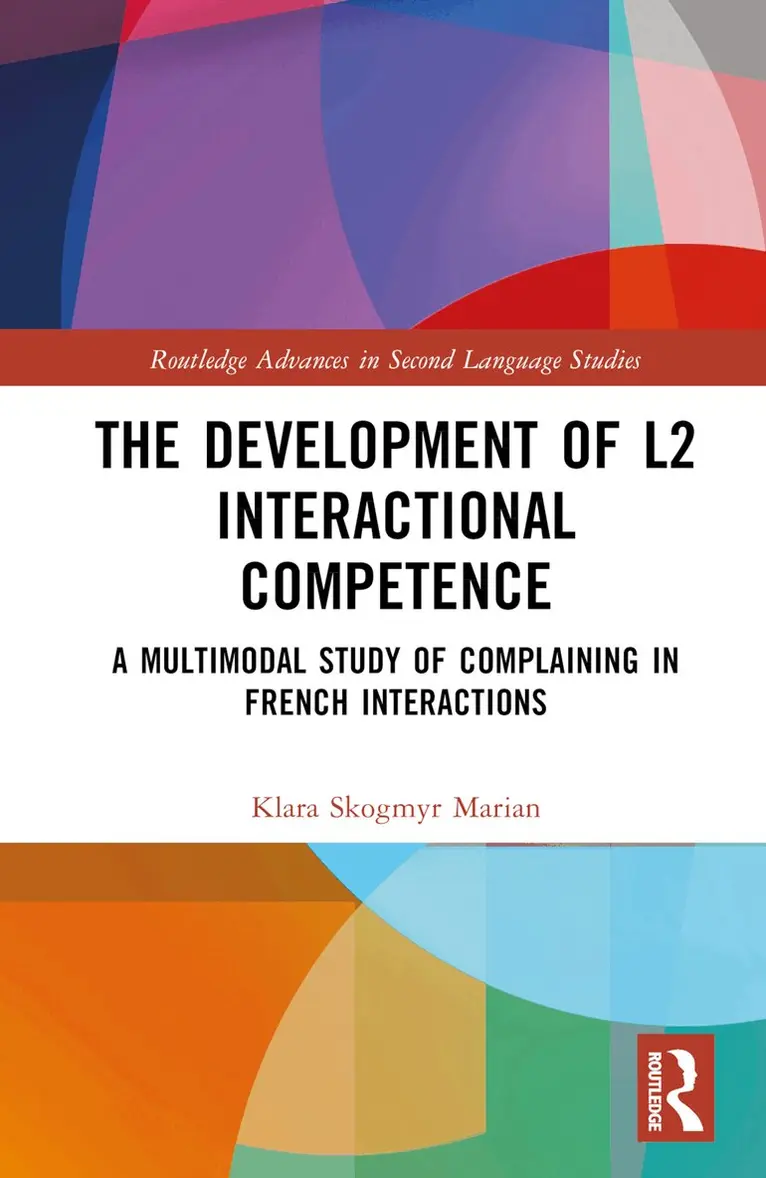
    Development of L2 Interactional Competence

    A Multimodal Study of Complaining in French Interactions

    AvKlara Skogmyr Marian

    Inbunden, Engelska, 2022

    Del i serien Routledge Advances in Second Language Studies

    2 119 kr

    Beställningsvara. Skickas inom 10-15 vardagar. Fri frakt över 249 kr.

    Fler format och utgåvor

    Häftad

    629 kr

    Beskrivning

    This book presents unique insights into the development of L2 interactional competence through the lens of complaining, demonstrating how a closer study of complaining as a social activity can enhance our understanding of certain aspects of language learning with implications for future L2 research.The volume employs a multimodal, longitudinal conversation analytic (CA) approach in its analysis of data from video-recorded interactions of several elementary and advanced L2 speakers of French as they build their interactional competence, understood as the ability to accomplish social actions and activities in the L2 in context-dependent and recipient-designed ways. Skogmyr Marian calls attention to three key dimensions of complaining in these conversations – its structural organization, the interactional resources people use when they complain, and how speakers’ shared interactional histories and changing social relationships affect complaint practices. The volume underscores the fundamentally multimodal, socially situated, and co-constructed nature of L2 interactional competence and the socialization processes involved in its development, indicating paths for new work on interactional competence and L2 research more broadly.This book will be of appeal to students and scholars interested in second language acquisition, social interaction, and applied linguistics.The Open Access version of this book, available at www.taylorfrancis.com, has been made available under a Creative Commons Attribution 4.0 license.

    Produktinformation

    • Utgivningsdatum:2022-11-01
    • Mått:152 x 229 x 19 mm
    • Vikt:453 g
    • Format:Inbunden
    • Språk:Engelska
    • Serie:Routledge Advances in Second Language Studies
    • Antal sidor:254
    • Förlag:Taylor & Francis Ltd
    • ISBN:9781032221168

    Utforska kategorier

    • Språkundervisning och språkinlärning inom Språk och ordböcker
    • Språkvetenskap och lingvistik inom Språk och ordböcker

    Mer om författaren

    Klara Skogmyr Marian completed her PhD and postdoc at the University of Neuchâtel, Switzerland, and is now assistant professor at Stockholm University, Sweden. Her research focuses primarily on L2 learning and social interaction from a conversation analytic and multimodal perspective. Her works have been published in Research on Language and Social Interaction, Frontiers in Psychology and The Modern Language Journal.

    Recensioner i media

    "Skogmyr Marian’s research offers us a master class in social observation. Through careful sequential analysis, she demonstrates how L2 learners’ interactional repertoires are developed and diversified, both in the moment and over time." Tim Greer, Kobe University, Japan"Framed within the construct of interactional competence, this book elegantly demonstrates how to do longitudinal, second language learning-related research from the perspective of multimodal, ethnomethodological conversation analysis. Specifically, it is particularly notable for its brilliant use of emic learning behavior tracking techniques. A must-read contribution to the literature."Numa Markee, University of Illinois at Urbana-Champaign, USA"This book is a double intellectual treat: a well-executed longitudinal study with enlightening findings and a thoughtful discussion of theoretical and methodological issues with far-reaching implications for future research. An in-depth exploration into the development of interactional competence in a second language, it is a stellar addition to the field."Hanh thi Nguyen, Hawaii Pacific University, USA

    Innehållsförteckning

    • ContentsForewordAcknowledgments1. Introduction1.1 A praxeological research perspective1.2 Aim and research questions1.3 Outline of the bookReferences2. L2 interactional competence and its development2.1 Epistemological roots and current understanding of L2 IC2.2 Empirical findings about the development of L2 IC2.2.1 Developing practices for action2.2.2 Developing linguistic resources for interaction2.2.3 Developing interactional routines and shared interactional histories2.3 Cumulative evidence about the development of L2 IC and research gapsReferences3. Complaining in (L1) interaction3.1 Core features of complaints3.2 Structural organization of complaints3.2.1 Complaint initiations3.2.2 Complaint development3.2.3 Recipient responses to complaints3.2.4 Complaint closings3.3 Interactional resources for complaining3.3.1 Verbal and linguistic resources3.3.2 Prosodic and other non-linguistic resources3.4 Complaining in L2 interaction3.5 Cumulative evidence about complaining and research gapsReferences4. Investigating change longitudinally: Methodological concerns and data4.1 EMCA and CA-SLA4.2 Longitudinal CA: Research design and challenges4.3 This study: Empirical material4.3.1. Setting and participants4.3.2 Recordings, supplementary material4.3.3 Transcription and anonymization4.3.4 Determining the analytical focus and establishing collections4.3.5 Focal participants4.3.6 Overview of collections4.3.7 ComparabilityReferences5. The structural organization of L2 complaints5.1 Interactional building blocks of indirect complaints5.2 Moving into complaints5.2.1 Elementary level5.2.2 Upper-intermediate/advanced level5.3 Co-constructing complaints5.3.1 Elementary level5.3.2 Upper-intermediate/advanced level5.4 DiscussionReferences6. Interactional resources for complaining in the L26.1 Negative assessments6.1.1 Elementary level6.1.2 Upper-intermediate/advanced level6.1.3 Negative assessments: Quantitative comparison6.2 Direct-reported speech and reenactments6.2.1 Elementary level6.2.2 Upper-intermediate/advanced level6.2.3 Direct-reported speech and reenactments: Quantitative comparison6.3 DiscussionReferences7. The interactional history of a complainable7.1 Case study 1: Suresh7.1.1 Proffering a complaint about the heat7.1.2 Proffering a complaint about the cold7.1.3 Suresh: Summary and intermediate discussion7.2 Case study 2: Malia7.2.1 Fall semester of 2016 (months 1-3)7.2.2 Spring semester of 2017 (months 4-9) – same coparticipants7.2.3 Fall semester of 2017 (months 11-15) – new coparticipants7.2.4 Malia: Summary and intermediate discussion7.3 DiscussionReferences8. Discussion of results and perspectives8.1 Understanding L2 interactional competence and its development8.1.1 Stability in the basic composition of conversational activities8.1.2. Turn-taking management: Increased synchronization and co-construction8.1.3 Sequence and preference organization: Diversification of methods8.1.4 Linguistic resources for action: Diversification and routinization8.1.5 Language and the body for action: Change in multimodal practices8.1.6 Socialization processes in L2 learning: Shared experiences as interactional resource8.1.7 Increased ‘success’ in the accomplishment of social activities8.1.8 Summary of implications for understanding the development of L2 IC8.2 Understanding complaining in interaction8.3 PerspectivesReferencesAppendix: Transcription conventionsIndex