• Fri frakt över 249 kr
  • •
  • Snabba leveranser
  • •
  • Billiga böcker
Kundservice

Du är på sajten för privatpersoner.

Företag, bibliotek eller offentlig verksamhet?

Du handlar på classic.bokus.com, där alla dina funktioner finns intakta.
Till classic.bokus.com
Bokus logotyp. Gå till startsidan.
  • Erbjudanden
  • Nyheter
  • Student
  • Topplistor
  • Barn & ungdom
  • Bokus Play
  • E-böcker
  • Pocketböcker
  • Spel & pussel

Må bättre, för mindre! Upp till 50% rabatt på hälsoböcker

Sidfot

Mina sidor

    Hjälp

    • Kundservice
    • Vanliga frågor och svar
    • Frakt och leverans
    • Retur vid ångerrätt
    • Reklamera vara
    • Betalning
    • Köpvillkor
    • Allmänna villkor
    • Information om webbplatsens tillgänglighet

    Om Bokus

    • Om oss
    • Pressrum
    • För studenter
    • För företag
    • För bibliotek och offentlig verksamhet
    • För leverantörer
    • Hållbarhet

    Populärt

    • Aktuella erbjudanden
    • Presentkort
    • Studentlitteratur
    • Nya böcker
    • Topplistor
    • Signerade böcker
    • Engelska böcker

    Inspiration

    • Boktips
    • BookTok
    • Populära bokserier
    • Barnbokskaraktärer
    • Populära författare
    Logotyp för Bokus
    Följ oss på Facebook (extern länk)Följ oss på Instagram (extern länk)Följ oss på YouTube (extern länk)Följ oss på TikTok (extern länk)
    bokus @ CookiesAnpassa cookiesIntegritetspolicyKöpvillkor
    Till Citymail hemsida (extern länk)Till Budbee hemsida (extern länk)Till Postnord hemsida (extern länk)Till Schenker hemsida (extern länk)Till Early Bird hemsida (extern länk)Till Walleys hemsida (extern länk)
    1. Naturvetenskap och teknik
    2. Matematik och naturvetenskap
    3. Kemi
    4. Fysikalisk kemi

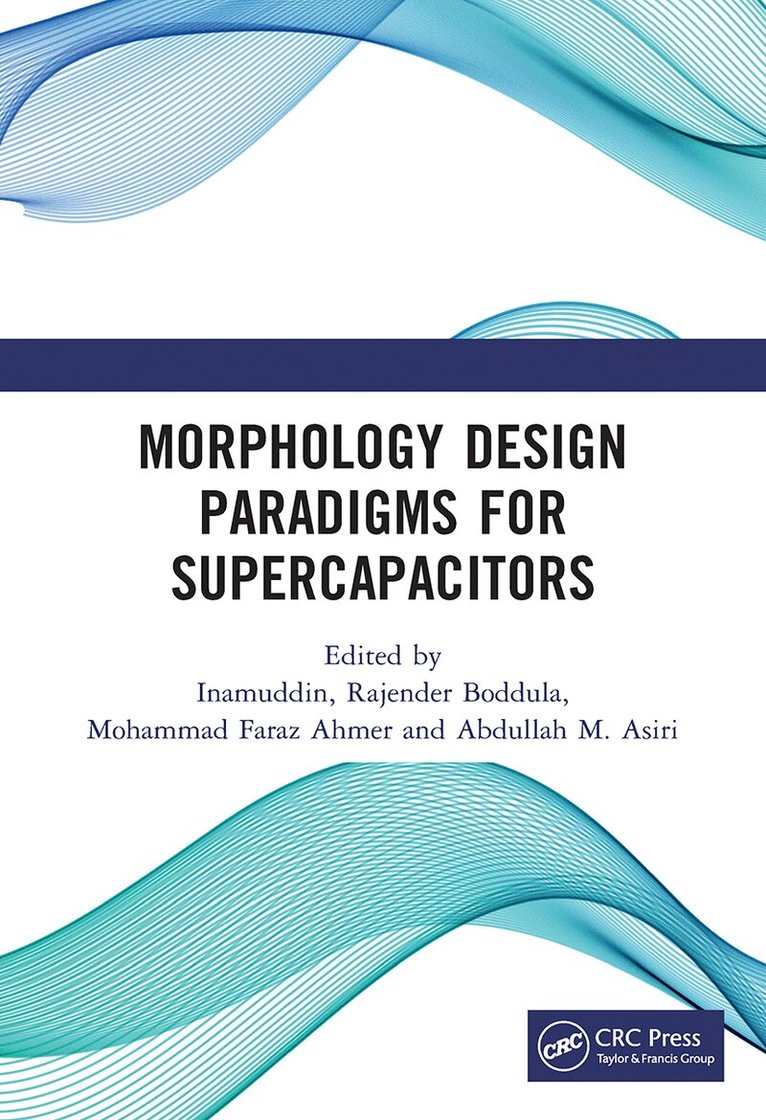
    Morphology Design Paradigms for Supercapacitors

    AvInamuddin,Rajender Boddula

    Häftad, Engelska, 2021

    723 kr

    Beställningsvara. Skickas inom 10-15 vardagar. Fri frakt över 249 kr.

    Beskrivning

    Nanostructured electrode materials have exhibited unrivaled electrochemical properties in creating elite supercapacitors. Morphology Design Paradigm for Supercapacitors presents the latest advances in the improvement of supercapacitors, a result of the incorporation of nanomaterials into the design – from zero-dimensional to three-dimensional, and microporous to mesoporous. The book includes a comprehensive description of capacitive practices at the levels of sub-atomic and nanoscales. These have the ability to enhance device performance for an extensive assortment of potential applications, including consumer electronics, wearable gadgets, hybrid electric vehicles, stationary and industrial frameworks. Key Features:Provides readers with a clear understanding of the implementation of these materials as electrodes in electrochemical supercapacitors. Covers recent material designs and an extensive scope of electrode materials such as 0D to 3D. Explores recent nanostructured-system material designs that have been created and tested in supercapacitor configurations. Considers microporous to mesoporous supercapacitor electrode materials. Features the impact of nanostructures on the properties of supercapacitors, including specific capacitance, cycle stability, and rate capability.

    Produktinformation

    • Utgivningsdatum:2021-12-13
    • Mått:156 x 234 x 14 mm
    • Vikt:453 g
    • Format:Häftad
    • Språk:Engelska
    • Antal sidor:258
    • Förlag:Taylor & Francis Ltd
    • ISBN:9781032238142

    Utforska kategorier

    • Fysikalisk kemi inom Naturvetenskap och teknik

    Mer om författaren

    Dr. Inamuddin is currently working as an Assistant Professor in the Chemistry Department, Faculty of Science, King Abdulaziz University, Jeddah, Saudi Arabia. He is a permanent faculty member (Assistant Professor) at the Department of Applied Chemistry, Aligarh Muslim University, Aligarh, India. He obtained Master of Science degree in Organic Chemistry from Chaudhary Charan Singh (CCS) University, Meerut, India, in 2002. He received his Master of Philosophy and Doctor of Philosophy degrees in Applied Chemistry from Aligarh Muslim University (AMU), India, in 2004 and 2007, respectively. He has extensive research experience in multidisciplinary fields of Analytical Chemistry, Materials Chemistry, and Electrochemistry and, more specifically, Renewable Energy and Environment. His research interests include ion exchange materials, a sensor for heavy metal ions, biofuel cells, supercapacitors, and bending actuators.Dr. Rajender Boddula is currently working for the Chinese Academy of Sciences-President's International Fellowship Initiative (CAS-PIFI) atthe National Center for Nanoscience and Technology (NCNST, Beijing). His specialized research areas focus on energy conversion and storage, including nanomaterials, graphene, polymer composites, heterogeneous catalysis, photoelectrocatalytic water splitting, biofuel cell, and supercapacitors.Dr. Mohammad Faraz Ahmer is presently working as an Assistant Professor in the Department of Electrical Engineering, Mewat Engineering College, Nuh Haryana, India. He completed M.Tech. (2009) and Bachelor of Engineering (2007) degrees in Electrical Engineering in Aligarh Muslim University, Aligarh, in the first division. He obtained a Ph.D. degree in 2016 on his thesis entitled “Studies on Electrochemical Capacitor Electrodes.” His scientific interests include electrospun nanocomposites and supercapacitors. He is actively engaged in searching of new methodologies involving the development of organic composite materials for energy storage systems.Prof. Abdullah M. Asiri has been the Head of the Chemistry Department at King Abdulaziz University in Jeddah, Saudi Arabia, since October 2009, and he is the founder and the Director of the Center of Excellence for Advanced Materials Research (CEAMR). He is the Professor of Organic Photochemistry. He graduated from King Abdulaziz University (KAU) with B.Sc. in Chemistry in 1990 and gained a Ph.D. from University of Wales, College of Cardiff, U.K. in 1995. His research interest covers color chemistry, synthesis of novel photochromic and thermochromic systems, synthesis of novel coloring matters and dyeing of textiles, materials chemistry, nanochemistry and nanotechnology, and polymers and plastics. A major achievement of Prof. Asiri is the discovery of tribochromic compounds, a new class of compounds which change from slightly or colorless to deep colored when subjected to small pressure or grinding.

    Innehållsförteckning

    • 1. Zero-Dimensional Carbon Nanostructures for Supercapacitors2. One-Dimensional Nanomaterials for Supercapacitors3. Core-Shell Nanomaterials for Supercapacitors4. Hierarchical Nanostructures for Supercapacitors5. Vertically Aligned 1D and 2D Nanomaterials for High-Frequency Supercapacitors6. Mesoporous Electrodes for Supercapacitors7. Honeycomb Nanostructures for Supercapacitors8. Chemical Synthesis of Hybrid Nanoparticles Based on Metal–Metal Oxide Systems9. Inorganic One-Dimensional Nanomaterials for Supercapacitor Electrode Applications10. One-Dimensional Carbon Nanostructures for Supercapacitors