• Fri frakt över 249 kr
  • •
  • Snabba leveranser
  • •
  • Billiga böcker
Kundservice

Du är på sajten för privatpersoner.

Företag, bibliotek eller offentlig verksamhet?

Du handlar på classic.bokus.com, där alla dina funktioner finns intakta.
Till classic.bokus.com
Bokus logotyp. Gå till startsidan.
  • Erbjudanden
  • Nyheter
  • Student
  • Topplistor
  • Barn & ungdom
  • Bokus Play
  • E-böcker
  • Pocketböcker
  • Spel & pussel

10% studentrabatt med kod TERM26

Sidfot

Mina sidor

    Hjälp

    • Kundservice
    • Vanliga frågor och svar
    • Frakt och leverans
    • Retur vid ångerrätt
    • Reklamera vara
    • Betalning
    • Köpvillkor
    • Allmänna villkor
    • Information om webbplatsens tillgänglighet

    Om Bokus

    • Om oss
    • Pressrum
    • För studenter
    • För företag
    • För bibliotek och offentlig verksamhet
    • För leverantörer
    • Hållbarhet

    Populärt

    • Aktuella erbjudanden
    • Presentkort
    • Studentlitteratur
    • Nya böcker
    • Topplistor
    • Signerade böcker
    • Engelska böcker

    Inspiration

    • Boktips
    • BookTok
    • Populära bokserier
    • Barnbokskaraktärer
    • Populära författare
    Logotyp för Bokus
    Följ oss på Facebook (extern länk)Följ oss på Instagram (extern länk)Följ oss på YouTube (extern länk)Följ oss på TikTok (extern länk)
    bokus @ CookiesAnpassa cookiesIntegritetspolicyKöpvillkor
    Till Citymail hemsida (extern länk)Till Budbee hemsida (extern länk)Till Postnord hemsida (extern länk)Till Schenker hemsida (extern länk)Till Early Bird hemsida (extern länk)Till Walleys hemsida (extern länk)
    1. Medicin
    2. Andra medicinska specialiteter
    3. Farmakologi

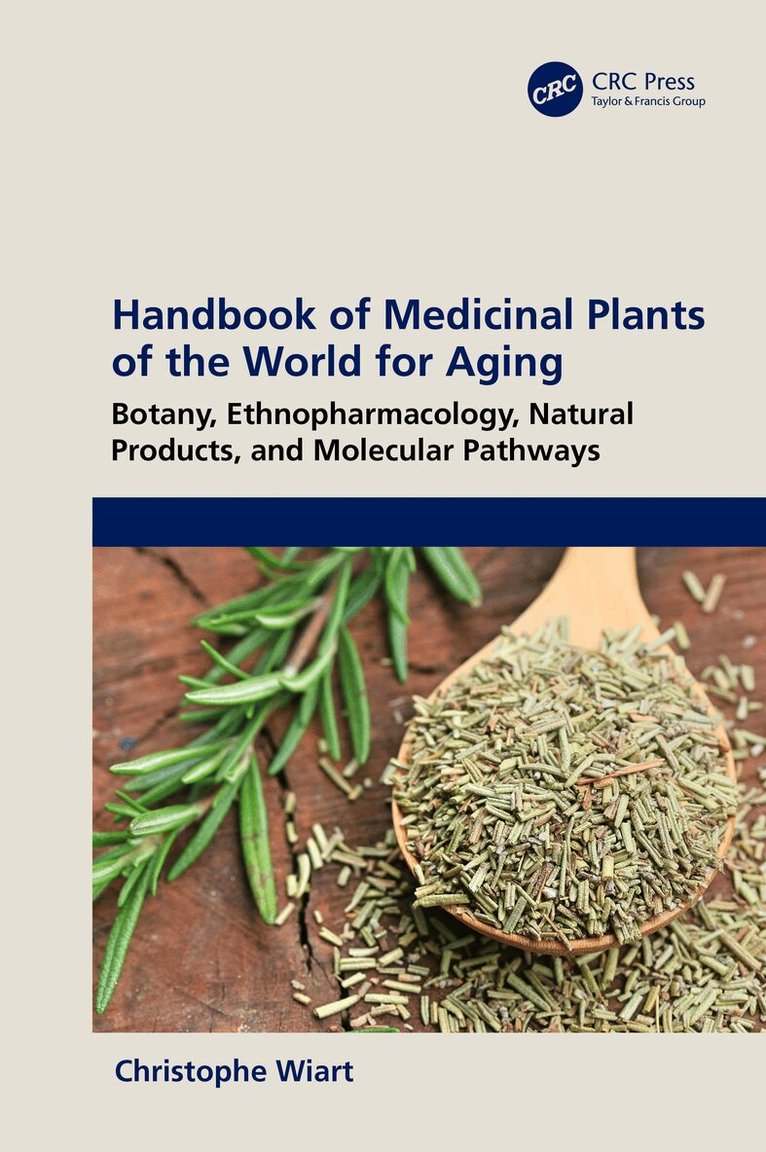
    Handbook of Medicinal Plants of the World for Aging

    Botany, Ethnopharmacology, Natural Products, and Molecular Pathways

    AvChristophe Wiart

    Häftad, Engelska, 2025

    806 kr

    Beställningsvara. Skickas inom 10-15 vardagar. Fri frakt över 249 kr.

    Fler format och utgåvor

    E-bok

    950 kr

    E-bok

    950 kr

    Inbunden

    2 506 kr

    Beskrivning

    Handbook of Medicinal Plants of the World for Aging: Botany, Ethnopharmacology, Natural Products, and Molecular Pathways provides an unprecedented comprehensive overview of more than 100 plants used globally as medicine with the potential to prevent premature aging. This handbook covers the pathophysiology of aging from the molecular and cellular to the organ levels, as well as the current state of knowledge about the modes of action of natural products from plants on the pathophysiological pathways related to the (i) cardiovascular system and metabolism, (ii) central nervous system, (iii) kidneys, (iv) bones, (v) skin and hair, and (vi) immune system.Medicinal plants are presented alphabetically. For each plant is indicated the botanical family, synonyms, and common names in English, French, German, Portuguese, Russian, and Spanish. For each plant, the reader will also □find the part used, active principles, medical history, contemporary medicinal uses, as well as pharmacological, clinical, and toxicological studies. The bibliographical references have been carefully selected for their relevance. This handbook is intended for medical doctors, nurses, pharmacists, dieticians, and nutritionists, as well as readers with interest in health food and herbs.FEATURESAlphabetical presentation of over 100 medicinal plants and the pharmacological rationales for their uses for agingDiscusses the medical history, current medicinal uses, and potential candidates for the prevention of premature agingIntroduces the molecular mechanism of natural products on the pathophysiology of agingContains a selection of bibliographic referencesA useful research tool for postgraduates, academics, and the pharmaceutical, herbal, or nutrition industriesHandbook of Medicinal Plants of the World for Aging: Botany, Ethnopharmacology, Natural Products, and Molecular Pathways presents comment sections that invite further research and reflection on the fascinating and timely subject of herbals for healthy aging. This is an ideal reference text for medicinal plant enthusiasts.

    Produktinformation

    • Utgivningsdatum:2025-05-05
    • Mått:156 x 234 x 20 mm
    • Vikt:580 g
    • Format:Häftad
    • Språk:Engelska
    • Antal sidor:294
    • Förlag:Taylor & Francis Ltd
    • ISBN:9781032293981

    Utforska kategorier

    • Farmakologi inom Medicin
    • Alternativ medicin och terapier inom Medicin
    • Växtböcker inom Djur och Natur

    Mer om författaren

    Christophe Wiart was born on 12th of August□ 1967 in Saint Malo, France. After his A-levels, he completed his Pharm.D. at the Facultée des Sciences Pharmaceutiques et Biologiques, Université Rennes 2 (France) and earned his Ph.D. in Natural Products Chemistry at the Universiti Pertanian Malaysia. He has taught pharmacognosy at the University of Malaya, and elsewhere. Dr. Wiart is the author of Medicinal Plants of the Asia-Pacific: Drugs from the Future? (2006), Medicinal Plants of Asia and the Pacific (2006), Ethnopharmacology of Medicinal Plants: Asia and the Pacific (2006), Medicinal Plants from the East (2010), Medicinal Plants from China, Korea and Japan: Bioresource for Tomorrow’s Drug and Cosmetic Discovery (2012), Lead Compounds from Medicinal Plants for the Treatment of Cancer (2012), Lead Compounds from Medicinal Plants for the Treatment of Neurodegenerative Diseases (2013), Medicinal Plants in Asia for Metabolic Syndrome (2018), Medicinal Plants from West Bengal and Bangladesh (2019), Medicinal Plants in Asia and Pacific for Parasitic Infections: Botany, Ethnopharmacology, Molecular Basis, and Future Prospect (2020), Medicinal Plants in Asia and the Pacific for Zoonotic Pandemics (2021). He has published numerous articles. Dr. Wiart is presently completing a book on the medicinal plants of North Borneo. Other current research interest include the ethnopharmacological study of the medicinal plants of Southeast Asia for the development of herbals and lead therapeutic compounds.

    Recensioner i media

    It gives me significant pleasure to write a foreword to Christophe Wiart’s latest compendium covering plant-related treatments for “premature ageing’. This is an area that has not been covered to any significant extent in translated treatises based on TCM (Traditional Chinese Medicine) or Ayurvedic-derived treatments (Indian subcontinent and contiguous areas). Ageing includes loss of cognition and includes dementia, which are frequently obvious to relatives of the “patient” and have been treated for centuries in many parts of the world.This treatise covers the areas that “modern-day” natural product chemists and pharmacognosists would search in order to identify the active principles involved in the “treatment modalities” covered in the text. He has used indigenous lore to identify the plant(s) and/or their components and subsequent treatment, covering over 100 medicinal plants. What is of definite utility is the listing of the different names ascribed to a plant depending upon the sources of the information. This is a point that is frequently overlooked when describing a medicinal plant, since cross-referencing the name(s) used in different languages permits one to search current databases for information.Another “plus” is his linkage of identified plant entities to information as to their “formal toxicities” which in some cases link-back to identified chemical entities. This part of the overall dataset should not stop any scientific work on the components that are described, since today, methods of delivery of toxic agents are well defined and used.Therefore, I definitely recommend this handbook to anyone who is interested in potential treatments for premature ageing, be they scientific or medical professionals or people who are interested in the topic for general interest.David J. Newman, DPhil (Retired Chief, Natural Products Branch, National Cancer Institute, NIH, USA)

    Innehållsförteckning

    • Foreword - David J. Newman1 Yarrow (Achillea millefolium L.)2 Venus’s Hair Fern (Adiantum capillus-veneris L.)3 Bael (Aegle marmelos (L.) Corrêa)4 Grains of Paradise (Aframomum melegueta (Roscoe) K. Schum.)5 Common Agrimony (Agrimonia eupatoria L.)6 Shallot (Allium ascalonicum L.)7 Leek (Allium porrum L.)8 Garlic (Allium sativum L.)9 Onions (Allium cepa L.)10 Indian Aloe (Aloe vera L.)11 Citron Verbena (Aloysia citrodora Paláu)12 Greater Galangal (Alpinia galanga (L.) Willd.)13 Lesser Galangal (Alpinia of- cinarum Hance)14 Marshmallow (Althaea of- cinalis L.)15 Khella (Ammi visnaga (L.) Lam.)16 Sweet Almonds (Amygdalus communis L.)17 Italian Alkanet (Anchusa italica Retz.)18 Dill (Anethum graveolens L.)19 Garden Angelica (Angelica archangelica L.)20 Chervil (Anthriscus cerefolium (L.) Hoffm.)21 Celery (Apium graveolens L.)22 Bearberry (Arctostaphylos uva-ursi (L.) Spreng.)23 Burdock (Arctium lappa L.)24 Horseradish (Armoracia rusticana G. Gaertn., B. Mey. & Scherb.)25 Southernwood (Artemisia abrotanum L.)26 Wormwood (Artemisia absinthium L.)27 Tarragon (Artemisia dracunculus L.)28 Mugwort (Artemisia vulgaris L.)29 Asparagus (Asparagus of- cinalis L.)30 Beetroot (Beta vulgaris L.)31 Borage (Borago of- cinalis L.)32 White Mustard (Brassica alba L.)33 Indian Mustard (Brassica juncea (L.) Czern)34 Rapeseed (Brassica napus L.)35 Black Mustard (Brassica nigra (L.) W.D.J. Koch)36 Cabbage (Brassica oleracea L.)37 Turnip (Brassica rapa L.)38 Tea (Camellia sinensis (L.) Kuntze)39 Shepherd’s Purse (Capsella bursa-pastoris (L.) Medik)40 Chili Pepper (Capsicum annuum L.)41 Papaya (Carica papaya L.)42 Caraway (Carum carvi L.)43 Indian Pennywort (Centella asiatica (L.) Urb.)44 Chicory (Cichorium intybus L.)45 True Cinnamon (Cinnamomum zeylanicum Bl.)46 Watermelon (Citrullus lanatus (Thunb.) Matsum. & Nakai)47 Lemon (Citrus limon (L.) Osbeck)48 Hawthorn (Crataegus oxyacantha L.)49 Coriander (Coriandrum sativum L.)50 Saffron (Crocus sativus L.)51 Melon (Cucumis melo L.)52 Cucumber (Cucumis sativus L.)53 Pumpkin (Cucurbita pepo L.)54 Cumin (Cuminum cyminum L.)55 Turmeric (Curcuma longa L.)56 Quince (Cydonia oblonga Mill.)57 Artichoke (Cynara scolymus L.)58 Lesser Cardamom (Elettaria cardamomum (L.) Maton)59 Horsetail (Equisetum arvense L.)60 Philippines Wax Flower (Etlingera elatior (Jack) R.M. Sm.)61 Japanese Horseradish (Eutrema japonicum (Miq.) Koidz.)62 Asafetida (Ferula assa-foetida L.)63 Figs (Ficus carica L.)64 Fennel (Foeniculum vulgare Mill.)65 Asam Gelugur (Garcinia atroviridis Griff. ex T. Anderson)66 Tournefort’s Gundelia (Gundelia tournefortii L.)67 Okra (Hibiscus esculentus L.)68 Kangkong (Ipomoea aquatica Forssk.)69 Sweet Potato (Ipomoea batatas (L.) Lam)70 Walnut (Juglans regia L.)71 Lettuce (Lactuca sativa L.)72 Bottle Gourd (Lagenaria siceraria (Molina) Standl.)73 Banaba (Lagerstroemia speciosa (L.) Pers.)74 Garden Cress (Lepidium sativum L.)75 Sponge Gourd (Luffa aegyptiaca Mill.)76 Common White Horehound (Marrubium vulgare L.)77 Lemon Balm (Melissa of- cinalis L.)78 Bitter Gourd (Momordica charantia L.)79 Moringa (Moringa oleifera Lam.)80 Common Watercress (Nasturtium of- cinale W.T. Aiton)81 Nigella (Nigella sativa L.)82 Sweet Basil (Ocimum basilicum L.)83 Olive (Olea europaea L.)84 Wild Marjoram (Origanum vulgare L.)85 Java Tea (Orthosiphon aristatus (Blume) Miq.)86 Parsley (Petroselinum crispum (Mill.) Fuss.)87 Avocado (Persea americana Mill.)88 Vietnamese Coriander (Polygonum odoratum Lour.)89 Sour Cherry (Prunus cerasus L.)90 Pomegranate (Punica granatum L.)91 Pear (Pyrus communis L.)92 Radish (Raphanus sativus L.)93 Blackcurrant (Ribes nigrum L.)94 Rosemary (Rosmarinus of- cinalis L.)95 Sage (Salvia of- cinalis L.)96 Common Elder (Sambucus nigra L.)97 Summer Savory (Satureja hortensis L.)98 Chayote (Sechium edule (Jacq.) Sw.)99 Sesame (Sesamum indicum L.)100 Milk Thistle (Silybum marianum (L.) Gaetn.)101 Spinach (Spinacia oleracea L.)102 Dandelion (Taraxacum of- cinale F.H. Wigg.)103 Thyme (Thymus vulgaris L.)104 Ajowan (Trachyspermum ammi (L.) Sprague)105 Stinging Needle (Urtica dioica L.)106 Bilberry (Vaccinium myrtillus L.)107 Cassumunar Ginger (Zingiber cassumunar Roxb.)