• Fri frakt över 249 kr
  • •
  • Snabba leveranser
  • •
  • Billiga böcker
Kundservice

Du är på sajten för privatpersoner.

Företag, bibliotek eller offentlig verksamhet?

Du handlar på classic.bokus.com, där alla dina funktioner finns intakta.
Till classic.bokus.com
Bokus logotyp. Gå till startsidan.
  • Erbjudanden
  • Nyheter
  • Student
  • Topplistor
  • Barn & ungdom
  • Bokus Play
  • E-böcker
  • Pocketböcker
  • Spel & pussel

10% rabatt på allt med kod: NYSTART10 →

Sidfot

Mina sidor

    Hjälp

    • Kundservice
    • Vanliga frågor och svar
    • Frakt och leverans
    • Retur vid ångerrätt
    • Reklamera vara
    • Betalning
    • Köpvillkor
    • Allmänna villkor
    • Information om webbplatsens tillgänglighet

    Om Bokus

    • Om oss
    • Pressrum
    • För studenter
    • För företag
    • För bibliotek och offentlig verksamhet
    • För leverantörer
    • Hållbarhet

    Populärt

    • Aktuella erbjudanden
    • Presentkort
    • Studentlitteratur
    • Nya böcker
    • Topplistor
    • Signerade böcker
    • Engelska böcker

    Inspiration

    • Boktips
    • BookTok
    • Populära bokserier
    • Barnbokskaraktärer
    • Populära författare
    Logotyp för Bokus
    Följ oss på Facebook (extern länk)Följ oss på Instagram (extern länk)Följ oss på YouTube (extern länk)Följ oss på TikTok (extern länk)
    bokus @ CookiesAnpassa cookiesIntegritetspolicyKöpvillkor
    Till Citymail hemsida (extern länk)Till Budbee hemsida (extern länk)Till Postnord hemsida (extern länk)Till Schenker hemsida (extern länk)Till Early Bird hemsida (extern länk)Till Walleys hemsida (extern länk)
    1. Naturvetenskap och teknik
    2. Matematik och naturvetenskap
    3. Fysik

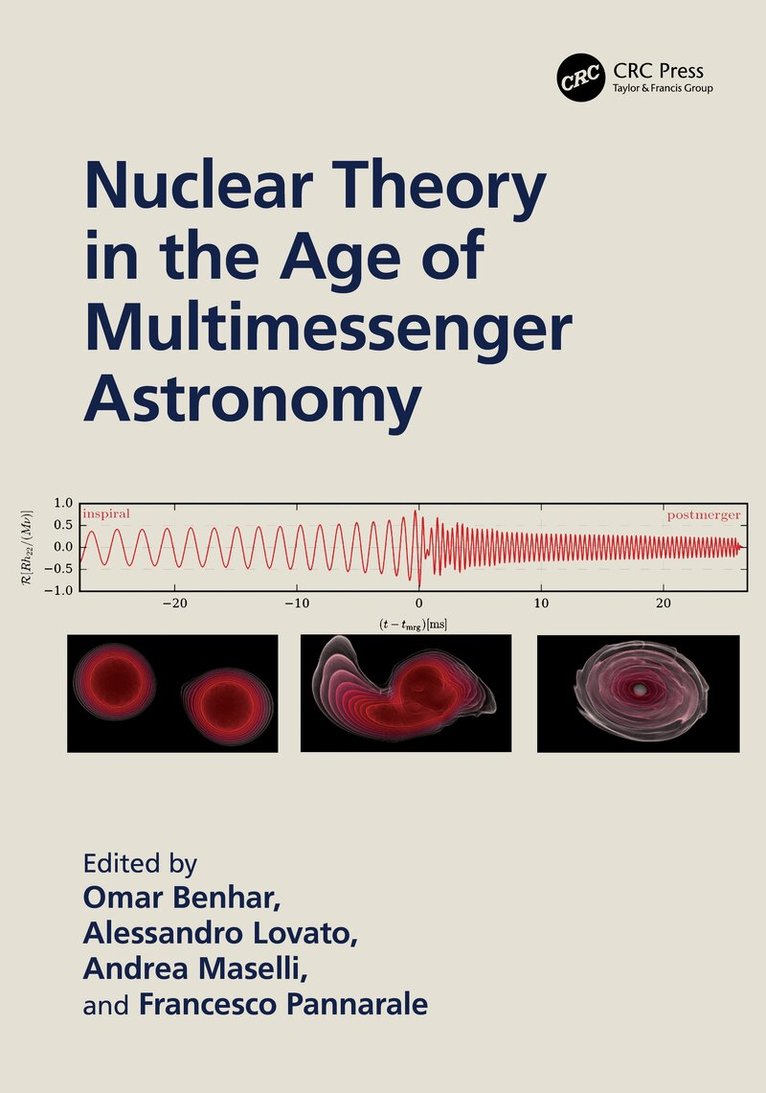
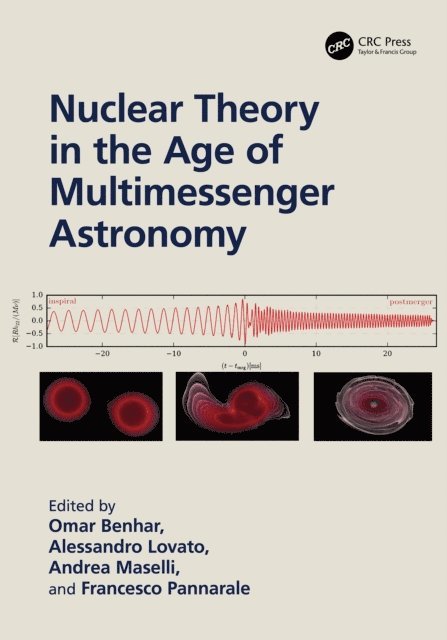
    Nuclear Theory in the Age of Multimessenger Astronomy

    AvOmar Benhar,Alessandro Lovato

    Häftad, Engelska, 2026

    793 kr

    Beställningsvara. Skickas inom 10-15 vardagar. Fri frakt över 249 kr.

    Beskrivning

    Over the last decade, astrophysical observations of neutron stars — both as isolated and binary sources — have paved the way for a deeper understanding of the structure and dynamics of matter beyond nuclear saturation density. The mapping between astrophysical observations and models of dense matter based on microscopic dynamics has been poorly investigated so far. However, the increased accuracy of present and forthcoming observations may be instrumental in resolving the degeneracy between the predictions of different equations of state. Astrophysical and laboratory probes have the potential to paint to a new coherent picture of nuclear matter — and, more generally, strong interactions — over the widest range of densities occurring in the Universe. This book provides a self-contained account of neutron star properties, microscopic nuclear dynamics and the recent observational developments in multimessenger astronomy. It also discusses the unprecedented possibilities to shed light on long standing and fundamental issues, such as the validity of the description of matter in terms of pointlike baryons and leptons and the appearance of deconfined quarks in the high density regime.It will be of interest to researchers and advanced PhD students working in the fields of Astrophysics, Gravitational Physics, Nuclear Physics and Particle Physics.Key Features:Reviews state-of-the-art theoretical and experimental developmentsSelf-contained and cross-disciplinaryWhile being devoted to a very lively and fast developing field, the book fundamentally addresses methodological issues. Therefore, it will not be subject to fast obsolescence.

    Produktinformation

    • Utgivningsdatum:2026-05-21
    • Mått:178 x 254 x 19 mm
    • Vikt:710 g
    • Format:Häftad
    • Språk:Engelska
    • Antal sidor:364
    • Förlag:Taylor & Francis Ltd
    • ISBN:9781032307763

    Utforska kategorier

    • Fysik inom Naturvetenskap och teknik
    • Astronomi inom Naturvetenskap och teknik

    Mer om författaren

    Omar Benhar is an INFN Emeritus Research Director, and has been teaching Relativistic Quantum Mechanics, Quantum Electrodynamics and Structure of Compact Stars at “Sapienza” University of Rome for over twenty years. He has worked extensively in the United States, and since 2013 has served as an adjunct professor at the Center for Neutrino Physics of Virginia Polytechnic Institute and State University. Prof. Benhar has authored or co-authored three textbooks on Relativistic Quantum Mechanics, Gauge Theories, and Structure and Dynamics of Compact Stars, and published more than one hundred scientific papers on the theory of many-particle systems, the structure of compact stars and the electroweak interactions of nuclei.Alessandro Lovato is a physicist at Argonne National Laboratory and an INFN researcher in Trento. His research in theoretical nuclear physics focuses on consistently modeling the self-emerging properties of atomic nuclei and neutron-star matter in terms of the microscopic interactions among the constituent protons and neutrons. He has co-authored more than eighty scientific publications on the theory of many-particle systems, the structure of compact stars, and the electroweak interactions of nuclei. He is at the forefront of high-performance computing applied to solving the quantum many-body problem.Andrea Maselli is an Associate Professor at the Gran Sasso Science Institute, in L’Aquila, where he teaches Gravitation and Cosmology and Physics of Black Hole. His research focuses on strong gravity, which plays a crucial role in many astrophysical phenomena involving black hole and neutron stars, representing natural laboratories to test fundamental physics. Prof. Maselli has co-authored more than eighty scientific papers on the modelling of black holes and neutron stars in General Relativity and extension thereof, their gravitational wave emission, and on tests of gravity in the strong filed regime. He is active in various collaborations aimed at developing next generation of gravitational wave detectors, such as the LISA satellite, the Einstein Telescope, and the Lunar Gravitational Wave Antenna.Francesco Pannarale is an Associate Professor at “Sapienza” Univeristy of Rome, where he teaches Gravitational Waves, Compact Objects and Black Holes, Computing Methods for Physics, and Electromagnetism. His research interests are in gravitational-wave physics and multimessenger astronomy, and they range from modelling compact binary sources to data analysis. He has co-authored over one hundred and eighty scientific publications and was at the forefront of the joint observation of GW170817 and GRB 170817A. He is currently serving as co-chair of the LIGO-Virgo-KAGRA Data Analysis Council.

    Innehållsförteckning

    • Chapter 1: Astronomical Constraints on Composition and Dynamics of Neutron-Star Matter. Chapter 2: Measuring Neutron Star Mass and Radius Using Pulse Profile Modelling - NICER and Beyond. Chapter 3: Multimessenger Constraints on the Neutron Star Equation of State Microphysics. Chapter 4: Neutron Stars and Multi-Messenger Observations: a Challenge for Nuclear Physics Theory. Chapter 5: Relativistic Description of the Neutron Star Equation of State. Chapter 6: Inference of Microscopic Nuclear Interactions and the EOS. Chapter 7: Quark-Hadron Crossover in Neutron Stars. Chapter 8: Bulk Viscosity in Dense Nuclear Matter. Chapter 9: Neutron Star Asteroseismology: Beyond the Mass-Radius Curve. Chapter 10: Probing the Equation of State Through Binary Neutron Star Mergers.