• Fri frakt över 249 kr
  • •
  • Snabba leveranser
  • •
  • Billiga böcker
Kundservice

Du är på sajten för privatpersoner.

Företag, bibliotek eller offentlig verksamhet?

Du handlar på classic.bokus.com, där alla dina funktioner finns intakta.
Till classic.bokus.com
Bokus logotyp. Gå till startsidan.
  • Erbjudanden
  • Nyheter
  • Student
  • Topplistor
  • Barn & ungdom
  • Bokus Play
  • E-böcker
  • Pocketböcker
  • Spel & pussel

10% rabatt på allt med kod NYSTART10 →

Sidfot

Mina sidor

    Hjälp

    • Kundservice
    • Vanliga frågor och svar
    • Frakt och leverans
    • Retur vid ångerrätt
    • Reklamera vara
    • Betalning
    • Köpvillkor
    • Allmänna villkor
    • Information om webbplatsens tillgänglighet

    Om Bokus

    • Om oss
    • Pressrum
    • För studenter
    • För företag
    • För bibliotek och offentlig verksamhet
    • För leverantörer
    • Hållbarhet

    Populärt

    • Aktuella erbjudanden
    • Presentkort
    • Studentlitteratur
    • Nya böcker
    • Topplistor
    • Signerade böcker
    • Engelska böcker

    Inspiration

    • Boktips
    • BookTok
    • Populära bokserier
    • Barnbokskaraktärer
    • Populära författare
    Logotyp för Bokus
    Följ oss på Facebook (extern länk)Följ oss på Instagram (extern länk)Följ oss på YouTube (extern länk)Följ oss på TikTok (extern länk)
    bokus @ CookiesAnpassa cookiesIntegritetspolicyKöpvillkor
    Till Citymail hemsida (extern länk)Till Budbee hemsida (extern länk)Till Postnord hemsida (extern länk)Till Schenker hemsida (extern länk)Till Early Bird hemsida (extern länk)Till Walleys hemsida (extern länk)
    1. Ekonomi och Ledarskap
    2. Företagsekonomi
    3. Affärsförhandlingar

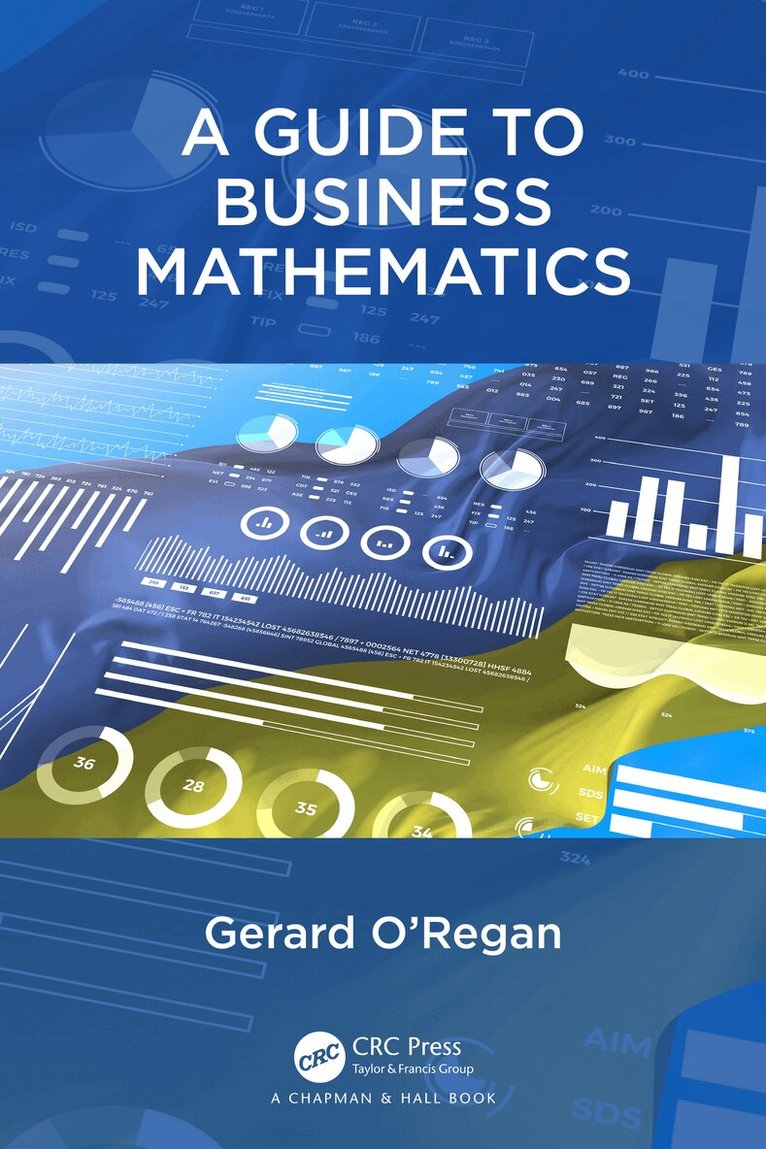
    Guide to Business Mathematics

    AvGerard O'Regan

    Häftad, Engelska, 2022

    1 280 kr

    Beställningsvara. Skickas inom 10-15 vardagar. Fri frakt över 249 kr.

    Fler format och utgåvor

    E-bok

    1 475 kr

    E-bok

    1 475 kr

    Inbunden

    3 407 kr

    Beskrivning

    The success of business today is dependent on the knowledge and expertise of its employees. The need for mathematics arises naturally in business such as in the work of the actuary in an insurance company, the financial mathematics required in the day-to-day work of the banker and the need to analyse data to extract useful information to enable the business to make the right decisions to be successful.A Guide to Business Mathematics provides a valuable self-study guide to business practitioners, business students and the general reader to enable them to gain an appropriate insight into the mathematics used in business. This book offers an accessible introduction to essential mathematics for the business field.A wide selection of topics is discussed with the mathematical material presented in a reader-friendly way. The business context motivates the presentation. The author uses modelling and applications to motivate the material, demonstrating how mathematics is used in the financial sector. In addition to the role of the actuary and the banker, the book covers operations research including game theory, trade discounts and the fundamentals of statistics and probability.The book is also a guide to using metrics to manage and measure performance, and business economics. Foundations on algebra, number theory, sequences and series, matrix theory and calculus are included as is a complete chapter on using software.Features• Discusses simple interest and its application to promissory notes/treasury bills.• Discusses compound interest with applications to present and future values.• Introduces the banking field including loans, annuities and the spot/forward FX market.• Discusses trade discounts and markups/markdowns.• Introduces the insurance field and the role of the actuary.• Introduces the fields of data analytics and operations research.• Discusses business metrics and problem solving.• Introduces matrices and their applications.• Discusses calculus and its applications.• Discusses basic financial statements such as balance sheet, profit and loss and cash account.• Reviews a selection of software to support business mathematics.This broad-ranging text gives the reader a flavour of the applications of mathematics to the business field and stimulates further study in the subject. As such, it will be of great benefit to business students, while also capturing the interest of the more casual reader.About the AuthorDr. Gerard O'Regan is an Assistant Professor in Mathematics at the University of Central Asia in Kyrgyzstan. His research interests include software quality and software process improvement, mathematical approaches to software quality, and the history of computing. He is the author of several books in the Mathematics and Computing fields.

    Produktinformation

    • Utgivningsdatum:2022-08-25
    • Mått:156 x 234 x 27 mm
    • Vikt:500 g
    • Format:Häftad
    • Språk:Engelska
    • Antal sidor:390
    • Förlag:Taylor & Francis Ltd
    • ISBN:9781032311166

    Utforska kategorier

    • Affärsförhandlingar inom Ekonomi och Ledarskap

    Mer om författaren

    Dr. Gerard O'Regan is an Assistant Professor in Mathematics at the University of Central Asia in Kyrgyzstan. His research interests include software quality and software process improvement, mathematical approaches to software quality, and the history of computing. He is the author of several books in the Mathematics and Computing fields.

    Innehållsförteckning

    • 1. Introduction to Number Theory. 1.1. Basic Number Theory. 1.2. Fractions and Decimals. 1.3. Prime Number Theory. 1.4. Ratios and Proportions. 1.5. Percentages. 1.6. Review Questions. 1.7. Summary. 2. Algebra. 2.1. Simplification of Algebraic Expressions. 2.2. Simple and Simultaneous Equations. 2.3. Quadratic Equations. 2.4. Indices and Logarithms. 2.5. Exponentials and Natural Logarithms. 2.6. Review Questions. 2.7. Summary. 3. Sets, Relations and Functions. 3.1. Set Theory. 3.2. Relations. 3.3. Functions. 3.4. Review Questions. 3.5. Summary. 4. Sequences, Series and Permutations and Combinations. 4.1 Sequences and Series. 4.2. Arithmetic and Geometric Sequences. 4.3. Arithmetic and Geometric Series. 4.4. Permutations and Combinations. 4.5. Review Questions. 4.6. Summary. 5. Simple Interest and Applications. 5.1. Simple Interest. 5.2. Computing Future and Present Values. 5.3. Promissory Notes. 5.4. Treasury Bills. 5.5. Review Questions. 5.6. Summary. 6. Compound Interest and Applications. 6.1. Compound Interest. 6.2. Present Value. 6.3. Long Term Promissory Notes. 6.4. Equivalent Values. 6.5. Analysing the Business Case for a project. 6.6. Review Questions. 6.7. Summary. 7. Banking and Financial Services. 7.1. Central Bank. 7.2. Retail Banks. 7.3. Financial Instruments. 7.4. Basic Mathematics of Annuities. 7.5. Loans and Mortgages. 7.6. Foreign Exchange. 7.7. Corporate Bonds. 7.8. Review Questions. 7.9. Summary. 8. Trade Discounts and Pricing. 8.1. Calculating Discounts. 8.2. Markups and Markdowns. 8.3. Payment Terms and Cash Discounts. 8.4. Pricing and Pricing Policy. 8.5. Review Questions. 8.6. Summary. 9. Statistics. 9.1. Basic Statistics. 9.2. Frequency Distribution and Charts. 9.3. Statistical Measures. 9.4. Variance and Standard Deviation. 9.5. Correlation and Regression. 9.6. Statistical Inference and Hypothesis Testing. 9.7. Review Questions. 9.8. Summary. 10. Probability Theory. 10.1. Basic Probability Theory. 10.2. Random Variables. 10.3. Binomial and Poisson Distributions. 10.4. The Normal Distribution. 10.5. Bayesianism. 10.6. Review Questions. 10.7. Summary. 11. The Insurance Industry. 11.1. Basic Mathematics of Motor Insurance. 11.2. Basic Mathematics of Health Insurance. 11.3. Basic Mathematics of Pensions. 11.4. The Actuary. 11.5. Review Questions. 11.6. Summary. 12. Data Science and Data Analytics. 12.1. What is Data Science? 12.2. What is Data Analytics? 12.3. Mathematics in Data Science and Analytics. 12.4. Privacy. 12.5. Security. 12.6. Review Questions. 12.7. Summary. 13. Business Metrics and Problem Solving. 13.1. The Goal Question Metric Paradigm. 13.2. The Balanced Scorecard. 13.3. Metrics for an Organization. 13.4. Implementing a Metrics Program. 13.5. Problem-Solving Techniques. 13.6. Review Questions. 13.7. Summary. 14. Matrix Theory. 14.1. Two x Two Matrices. 14.2. Matrix Operations. 14.3. Determinants. 14.4. Eigen Vectors and Values. 14.5. Gaussian Elimination. 14.6. Applications of Matrices. 14.7. Review Questions. 14.8. Summary. 15. Operations Research. 15.1. Linear Programming. 15.2. Cost Volume Profit Analysis. 15.3. Game Theory. 15.4. Queueing Theory. 15.5. Review Questions. 15.6. Summary. 16. Basic Financial Statements. 16.1. Balance Sheet. 16.2. Profit and Loss Account. 16.3. Managing Cash. 16.4. Review Questions. 16.5. Summary. 17. Calculus I. 17.1. Differentiation. 17.2. Integration. 17.3. Review Questions. 17.4. Summary. 18. Calculus II. 18.1. Applications of Calculus. 18.2. Fourier Series. 18.3. The Laplace Transform. 18.4. Differential Equations. 18.5. Review Questions. 18.6. Summary. 19. A Brief Introduction to Economics. 19.1. Macroeconomics. 19.2. Microeconomics. 19.3. Gross Domestic Product. 19.4. Utility. 19.5. Comparative and Absolute Advantage. 19.6. Elasticity of Demand. 19.7. Role of Money. 19.8. Role of Government in the Economy. 19.9. Economic Indicators. 19.10. Competition. 19.11. Globalisation and Terms of Trade. 19.12. Mathematics in Economics. 19.13. Review Questions. 19.14. Summary. 20. Software to support Business Mathematics. 20.1. Microsoft Excel. 20.2. Python. 20.3. Maple. 20.4. Minitab Statistical Software. 20.5. R Statistical Software Environment. 20.6. Mathematica. 20.7. MATLAB. 20.8. Sage Accounting Software. 20.9. SPSS Statistics. 20.10. SQL and Relational Databases. 20.11. SAS. 20.12. Review Questions. 20.13. Summary.