• Fri frakt över 249 kr
  • •
  • Snabba leveranser
  • •
  • Billiga böcker
Kundservice

Du är på sajten för privatpersoner.

Företag, bibliotek eller offentlig verksamhet?

Du handlar på classic.bokus.com, där alla dina funktioner finns intakta.
Till classic.bokus.com
Bokus logotyp. Gå till startsidan.
  • Erbjudanden
  • Nyheter
  • Student
  • Topplistor
  • Barn & ungdom
  • Bokus Play
  • E-böcker
  • Pocketböcker
  • Spel & pussel

10% rabatt på allt med kod: NYSTART10 →

Sidfot

Mina sidor

    Hjälp

    • Kundservice
    • Vanliga frågor och svar
    • Frakt och leverans
    • Retur vid ångerrätt
    • Reklamera vara
    • Betalning
    • Köpvillkor
    • Allmänna villkor
    • Information om webbplatsens tillgänglighet

    Om Bokus

    • Om oss
    • Pressrum
    • För studenter
    • För företag
    • För bibliotek och offentlig verksamhet
    • För leverantörer
    • Hållbarhet

    Populärt

    • Aktuella erbjudanden
    • Presentkort
    • Studentlitteratur
    • Nya böcker
    • Topplistor
    • Signerade böcker
    • Engelska böcker

    Inspiration

    • Boktips
    • BookTok
    • Populära bokserier
    • Barnbokskaraktärer
    • Populära författare
    Logotyp för Bokus
    Följ oss på Facebook (extern länk)Följ oss på Instagram (extern länk)Följ oss på YouTube (extern länk)Följ oss på TikTok (extern länk)
    bokus @ CookiesAnpassa cookiesIntegritetspolicyKöpvillkor
    Till Citymail hemsida (extern länk)Till Budbee hemsida (extern länk)Till Postnord hemsida (extern länk)Till Schenker hemsida (extern länk)Till Early Bird hemsida (extern länk)Till Walleys hemsida (extern länk)
    1. Språk och ordböcker
    2. Språkvetenskap och lingvistik

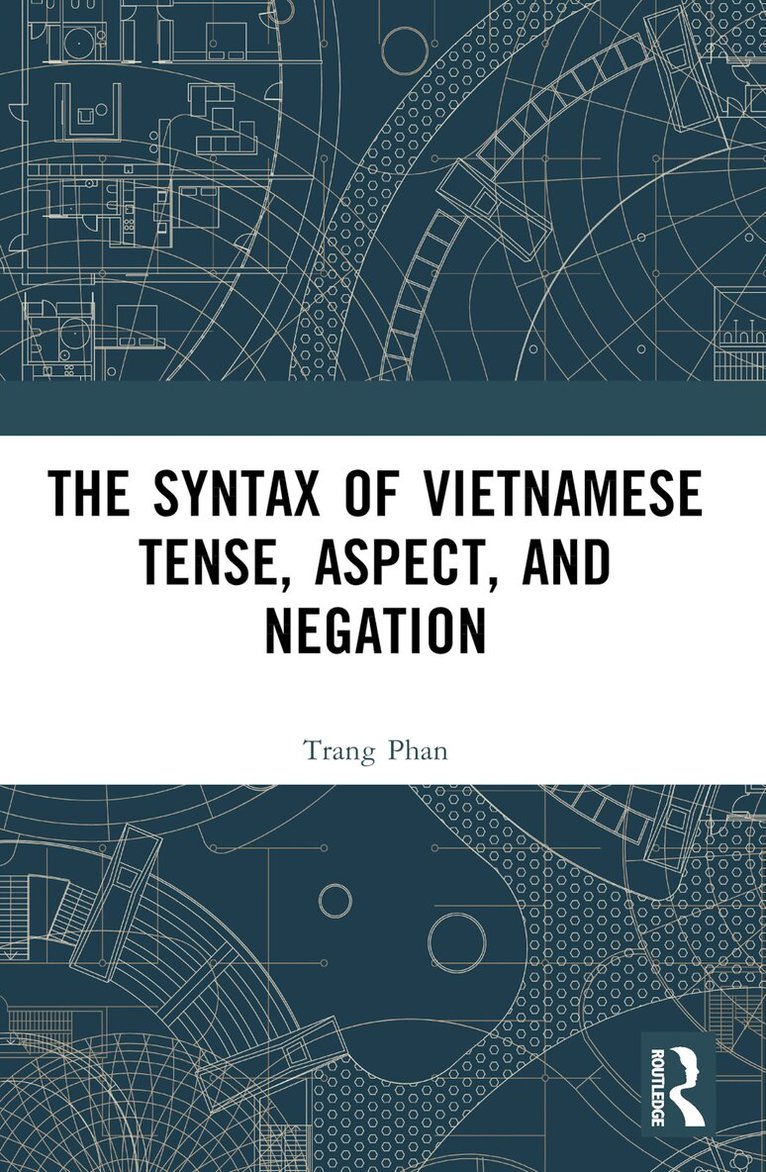
    Syntax of Vietnamese Tense, Aspect, and Negation

    AvTrang Phan

    Häftad, Engelska, 2024

    643 kr

    Beställningsvara. Skickas inom 10-15 vardagar. Fri frakt över 249 kr.

    Fler format och utgåvor

    E-bok

    760 kr

    E-bok

    760 kr

    Inbunden

    2 493 kr

    Beskrivning

    The Syntax of Vietnamese Tense, Aspect, and Negation investigates familiar grammatical phenomena including Tense, Aspect, and Negation in a theoretically understudied language, Vietnamese.The purpose of this book is to thoroughly examine how these categories are realised and how they interact with one another in Vietnamese in the spirit of Generative Grammar, in particular, the Cartographic approach to syntax and its most recently developed lexicalisation technique, Nanosyntax. It is concluded that despite lacking inflectional tense, Vietnamese does have syntactic tense, i.e., Vietnamese has those structural positions which are dedicated to Tense and Aspect. In fact, Tense and Aspect in Vietnamese are realised via a rigid fine-grained functional sequence which syntacticises subtle semantic distinctions both preverbally and post-verbally. There is a two-way complicated relationship between Negation and Aspect in Vietnamese, which can be explained in a principled way by taking into consideration how the internal syntax of the temporal, aspectual, and negative markers derives their clausal syntax. This book also discusses how Vietnamese Tense, Aspect, and Negation pattern with, and differ from, their counterparts in Western Indo-European languages, and how this study contributes to a better understanding of East and mainland Southeast Asian languages more generally, as well as of language universally.This book will be of interest to both undergraduate and postgraduate students of contemporary linguistics, and for scholars interested in contemporary approaches to Vietnamese linguistics, and Southeast Asian languages more generally.

    Produktinformation

    • Utgivningsdatum:2024-11-28
    • Mått:156 x 234 x 10 mm
    • Vikt:280 g
    • Format:Häftad
    • Språk:Engelska
    • Antal sidor:166
    • Förlag:Taylor & Francis Ltd
    • ISBN:9781032482682

    Utforska kategorier

    • Språkvetenskap och lingvistik inom Språk och ordböcker

    Mer om författaren

    Trang Phan is currently a lecturer of Vietnamese language and linguistics at VNU University of Languages & International Studies, Vietnamese National University Hanoi. Phan obtained her PhD from University of Sheffield (England) in 2013 on the structure and acquisition of Vietnamese verbal aspect. From 2014 to 2016, she was a postdoctoral researcher of the Cartographic Syntax project at Ghent University (Belgium), working on various aspects of Vietnamese clausal structure in a crosslinguistic perspective, including the position of Vietnamese with respect to the NP/DP parameter, the prodrop parameter, and the topic-prominent/subject-prominent parameter. From 2019 to 2021, Phan was the principal investigator of the project on the Nanosyntax of Vietnamese tense and aspect funded by Vietnam National Foundation for Science and Technology Development (NAFOSTED). From 2020 to 2021, Phan was a visiting scholar at Harvard Yenching Institute (Cambridge, USA), working on how Vietnamese classifiers, plurals, and articles update our current understanding of classifier languages. In addition to having papers published at well-established linguistic journals and publishers, Trang Phan is the co-editor of the volume Interdisciplinary Perspectives on Vietnamese Linguistics (2019) and the JSEALS special issue Vietnamese Linguistics: State of the Field (2022).

    Recensioner i media

    ‘There is tense in “tenseless” languages. This book investigates key aspects of the clause structure of an understudied language in a remarkably clear and insightful way. It’s a beautiful example of the richness of modern generative linguistics. Also Vietnamese now becomes a protagonist in the exciting debate on the nature of crosslinguistic variation.’- Professor Gennaro Chierchia, Harvard University.‘This book is of a very high value, not just for researchers specializing in Vietnamese linguistics, but clearly for all theoretical linguists. Vietnamese is a language of a very specific type; it is an analytic language with no inflection typically wearing its logical structure on its sleeves. As such, results arrived at for Vietnamese will very often have direct repercussions for the analysis of other languages as well.’- Prof. Dr. Daniel Hole, University of Stuttgart

    Innehållsförteckning

    • PREFACEABBREVIATIONSCHAPTER 1: INTRODUCTION1. Objectives2. Why Vietnamese Tense, Aspect, and Negation?3. Research questions4. Theoretical assumptions5. Outline of the bookCHAPTER 2: SYNTACTICISING TENSEDNESS1. Introduction2. Theoretical background3. Non-peripherality4. Non-optionality5. The hierarchy of tense and aspect6. Other properties associated with tensedness6.1. Bare predicates6.2. Finiteness6.3. Expletive subjects7. ConclusionCHAPTER 3: DECOMPOSING THE PERFECT1. Introduction2. Theoretical background3. The semantic compositionality of đã3.1. Achievements and đã3.2. States and đã3.3. Activities and đã3.4. Accomplishments and đã3.5. Discussion4. The interaction between đã and negative/interrogative markers không/chýa4.1. Đã in the absence of negative không/chưa4.2. Đã in the presence of negative không/chưa4.3. Đã in the presence of interrogative không/chưa4.4. Discussion5. The Interaction between đã and other preverbal elements6. ConclusionCHAPTER 4: CALCULATING TELICITY1. On the compositionality of telicity in Vietnamese1.1. Inherently telic verbs1.2. Telic particles1.3. Numeral direct object1.4. Other factors2. The syntactic projection of telicity in Vietnamese3. Immediate consequence: Thematic hierarchy in causatives4. Extension5. ConclusionCHAPTER 5: DECOMPOSING THE NEGATORS1. Introduction2. Negation and Lexical Aspect3. Negation and Grammatical Aspect: the differences between không and chưa4. Negation and Interrogativity4.1. A cross-linguistic perspective4.2. The similarities between negative không/chưa and interrogative không/chưa4.3. Differences between negative không/chưa and interrogative không/chưa4.4. A proposal for the featural make-up of không and chưa5. ConclusionCHAPTER 6: EXPLAINING THE NEGATION CONSTRAINT ON ASPECT1. Introduction2. Previous accounts3. Explaining the negation constraint: The Nanosyntactic approach4. ConclusionCHAPTER 7: FINAL REMARKS1. Does Vietnamese have Tense?2. What is the functional sequence of Aspect markers in Vietnamese?3. How does Negation interact with Tense Aspect in Vietnamese?4. What does this study of Vietnamese TAN contribute to a better understanding of East and mainland Southeast Asian languages as well as of language more universally?