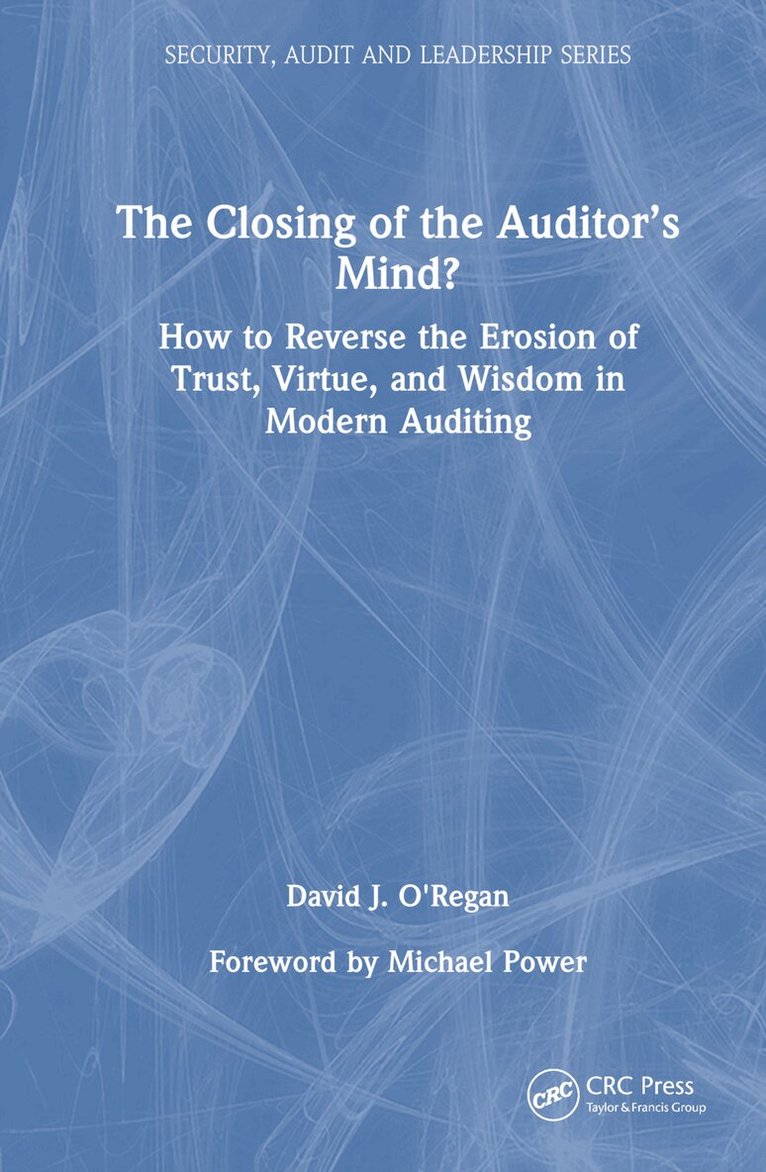
Inbunden, Engelska, 2024
The Closing of the Auditor’s Mind?
How to Reverse the Erosion of Trust, Virtue, and Wisdom in Modern Auditing
Del i serien Security, Audit and Leadership Series
1865 kr
Beställningsvara. Skickas inom 10-15 vardagar. Fri frakt över 249 kr.
Fler format och utgåvor
Beskrivning
Produktinformation
- Utgivningsdatum: 2024-12-10
- Mått: 156 x 234 x 15 mm
- Vikt: 453 g
- Format: Inbunden
- Språk: Engelska
- Serie: Security, Audit and Leadership Series
- Antal sidor: 174
- Förlag: Taylor & Francis Ltd
- ISBN: 9781032664866
Utforska kategorier
Recensioner i media
“The Closing of the Auditor’s Mind? How to Reverse the Erosion of Trust, Virtue, and Wisdom in Modern Auditing” (2024) by David J. O’Regan is a goldmine for all professional peers in the governance and audit arena caring about the betterment of internal auditing on a macro- and micro level, as a profession and as practitioners…It is a comprehensive read benefitting from the author’s rich intellectual capital…He does not only point to issues, but he also offers his perspective on how to bring the internal audit profession to a better place.In July 2024, the global standard setter, The Institute of Internal Auditors Inc. in the US, has officially confirmed: “We must transform now or risk becoming irrelevant by 2035” (Anthony Pugliese, President and Chief Executive Officer). David’s book comes timely. He challenges the present narrative of internal auditing. David views internal auditing as creative and humanistic art. David suggests freeing up that creativity, individual judgement, and critical thinking. His critique suggests putting less weight on algorithms and checklists. He sees value in the cultivation of virtues, such as wisdom, courage, moderation, and justice. I particularly enjoyed reading chapter 6: “Toward a Renaissance of Internal Auditing?”…David’s book is a fascinating read.The full version of the review can be found via the following social media post:https://www.linkedin.com/feed/update/urn:li:activity:7237159123992109056/– Dr. Rainer LenzInternal audit and internal control have become increasingly important due to the need to manage processes brought about by technological advancements and to identify and mitigate risks. However, their relevance has sometimes led to a lack of awareness regarding potential issues. Dr. David J. O’Regan’s book serves as an essential resource for navigating this complex situation that internal audits face. It raises thought-provoking questions that compel readers to reflect and reconsider their perspectives. Additionally, the book provides a historical overview and explores philosophical concepts, making it particularly valuable for those involved in auditing activities.The book is approached with a blend of practical experience and scientific knowledge, which opens up two important avenues for the future. First, it addresses the need to establish rules for auditing artificial intelligence that arise from technological advancements, alongside ensuring the effectiveness of internal audits. Second, it highlights the necessity of creating a foundational understanding of ethics and developing approaches to audit these ethical standards.Dr. David J. O’Regan highlights a critical challenge in internal auditing: the difficulty of complying with the evolving dynamics of social trust and capital. This shift has led to a loss of a vital position within the “seat at the table”. The new societal structure, characterized as a "risk universe," has emerged as a digital risk society that requires protection akin to handling crystal. In this context, internal audit becomes an essential control tool. The sections of the book aim to awaken the readers from a metaphorical deep sleep and address the implications of losing its significance and impact.We would like to extend our gratitude to Dr. David J. O’Regan for offering us a new perspective on the importance of analyzing the spreading effects of risks and their potential consequences. This book not only serves as a “wake-up call” for internal auditors but also acts as a valuable reference for professionals in cybersecurity, artificial intelligence, and the auditing of AI systems. Additionally, it is relevant for those involved in developing ethical guidelines in our increasingly risk-driven, digital society and for consultants who support these efforts.This work serves as a reference source that clarifies and guides the understanding of risk and control, i.e. “riskification” and “the dangers of a ritualization of practices” in a digitalizing world, focusing on sociology and behavioral sciences in relation to the historical and philosophical aspects of internal auditing.– Sezer Bozkus Kahyaoglu, PhDCIA, CFE, CFSA, CRMA, CPAAssociate Prof of FinanceDavid J. O'Regan’s The Closing of the Auditor’s Mind? is a thought-provoking and timely examination of the challenges facing modern internal auditing. With a sharp critique of the profession’s growing reliance on rigid, algorithmic approaches, O'Regan argues that internal auditing is at risk of losing its intellectual agility, creativity, and moral judgment. He highlights how the shift from hierarchical accountability to decentralized, networked trust structures has left auditors clinging to outdated methodologies, unable to meet the evolving demands of assurance in a rapidly changing world.What makes this book stand out is its philosophical depth. O'Regan draws from classical virtues, history, and even neuroscience to explore how auditing has become a mechanistic exercise, detached from the human judgment and wisdom it once embodied. He challenges auditors to reclaim their role as critical thinkers and ethical stewards, rather than mere box-checkers. Whether you are an auditor, a governance professional, or simply someone concerned with the broader implications of trust and accountability, this book is an essential read. It not only diagnoses the malaise within auditing but also offers compelling solutions to restore virtue and wisdom to the profession.– Gary Craven, P.Ag., FCMC, ITCPPartner, Paradigm Consulting Group
Betyg & recensioner
0 recensioner
Inga recensioner tillgängliga.