• Fri frakt över 249 kr
  • •
  • Snabba leveranser
  • •
  • Billiga böcker
Kundservice

Du är på sajten för privatpersoner.

Företag, bibliotek eller offentlig verksamhet?

Du handlar på classic.bokus.com, där alla dina funktioner finns intakta.
Till classic.bokus.com
Bokus logotyp. Gå till startsidan.
  • Erbjudanden
  • Student
  • Topplistor
  • Barn & ungdom
  • Bokus Play
  • E-böcker
  • Ljudböcker
  • Pocketböcker
  • Spel & pussel

10% rabatt på allt med kod NYSTART10 →

Sidfot

Mina sidor

    Hjälp

    • Kundservice
    • Vanliga frågor och svar
    • Frakt och leverans
    • Retur vid ångerrätt
    • Reklamera vara
    • Betalning
    • Köpvillkor
    • Allmänna villkor
    • Information om webbplatsens tillgänglighet

    Om Bokus

    • Om oss
    • Pressrum
    • För studenter
    • För företag
    • För bibliotek och offentlig verksamhet
    • För leverantörer
    • Hållbarhet

    Populärt

    • Aktuella erbjudanden
    • Presentkort
    • Studentlitteratur
    • Nya böcker
    • Topplistor
    • Signerade böcker
    • Engelska böcker

    Inspiration

    • Boktips
    • BookTok
    • Populära bokserier
    • Barnbokskaraktärer
    • Populära författare
    Logotyp för Bokus
    Följ oss på Facebook (extern länk)Följ oss på Instagram (extern länk)Följ oss på YouTube (extern länk)Följ oss på TikTok (extern länk)
    bokus @ CookiesAnpassa cookiesIntegritetspolicyKöpvillkor
    Till Citymail hemsida (extern länk)Till Budbee hemsida (extern länk)Till Postnord hemsida (extern länk)Till Schenker hemsida (extern länk)Till Early Bird hemsida (extern länk)Till Walleys hemsida (extern länk)
    1. Naturvetenskap och teknik
    2. Teknik och industri
    3. Elektronik och kommunikationer

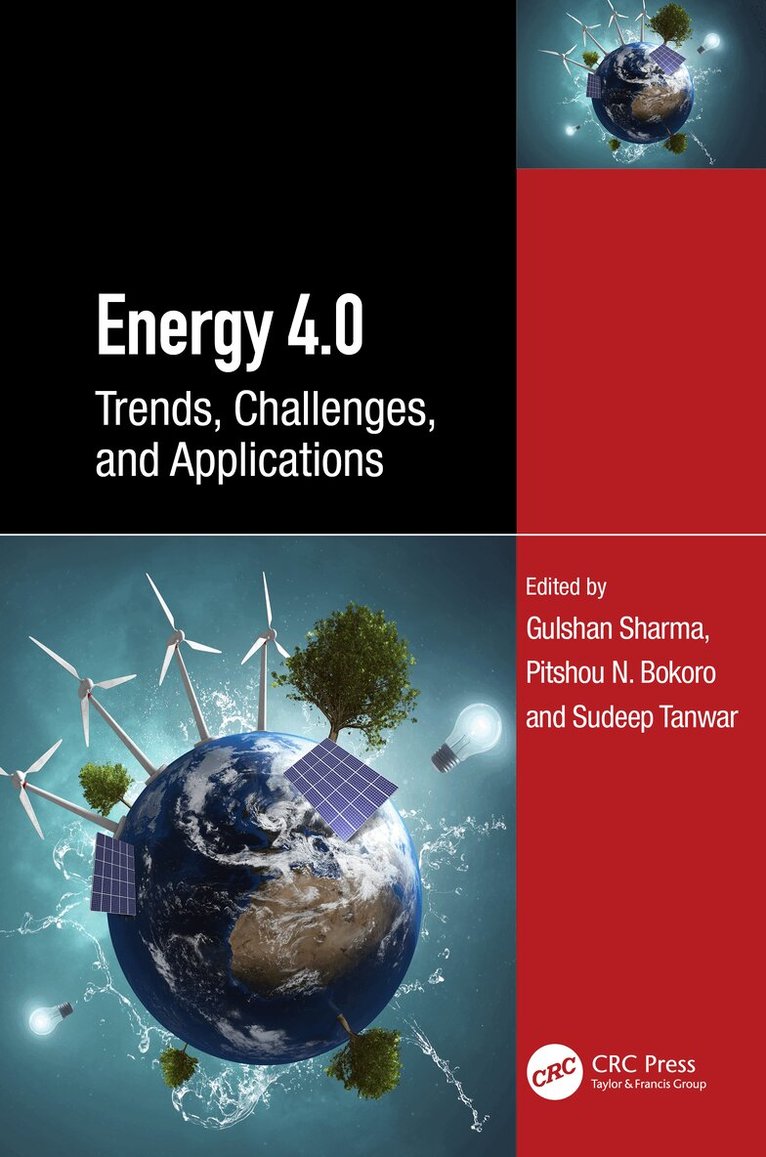
    Energy 4.0

    Trends, Challenges, and Applications

    AvGulshan Sharma,Pitshou N. Bokoro

    Inbunden, Engelska, 2025

    2 060 kr

    Beställningsvara. Skickas inom 10-15 vardagar. Fri frakt över 249 kr.

    Beskrivning

    The text provides insight into renewable technologies, and their challenges in terms of design, efficiency, implementation, and solutions to mitigate the problem of energy crisis. It will help the readers to understand the role of the fourth industrial revolution technologies in developing user-friendly, economic, and implementable solutions to mitigate the present and future energy crisis through cleaner and renewable technologies.Discusses electric energy transportation systems, electricity distribution systems, demand response, metering, smart grids, and cyber-security.Covers electric vehicles, vehicle-to-grid technologies, charging-while-driving technology for future roads and highways, and autonomous mobile robots.Presents data-driven modeling, forecasting, and optimization techniques of power and energy systems.Illustrates energy storage technologies, energy-efficient systems, power conversion topologies, and related control techniques.Explains the design of control algorithms for solar systems and the design of efficient energy management for solar power.The text is primarily written for senior undergraduates, graduate students, and academic researchers in the fields of electrical engineering, electronics and communications engineering, energy, environmental engineering, computer science, and engineering.

    Produktinformation

    • Utgivningsdatum:2025-06-01
    • Mått:156 x 234 x 21 mm
    • Vikt:700 g
    • Format:Inbunden
    • Språk:Engelska
    • Antal sidor:276
    • Förlag:Taylor & Francis Ltd
    • ISBN:9781032744513

    Utforska kategorier

    • Elektronik och kommunikationer inom Naturvetenskap och teknik
    • Energiteknik inom Naturvetenskap och teknik
    • Systemvetenskap och AI inom Data och IT

    Mer om författaren

    Gulshan Sharma, Ph.D., earned his Bachelor of Technology (B. Tech) degree in Electrical Engineering from Punjab Technical University in 2007, Master of Technology (M. Tech) in Electrical Power System Management from Jamia Millia Islamia University, New Delhi, in 2009, and Doctor of Philosophy (Ph.D.) in Electrical Engineering from Malaviya National Institute of Technology, Jaipur, India, in 2015. He was a post-doctoral research fellow at the University of Pretoria, South Africa from 2015 to 2016. He has more than 17 years of teaching and research experience at various institutes at the territory level. Presently, he is working as an Associate Professor in the Department of Electrical Engineering Technology, University of Johannesburg, South Africa. Earlier, he was with Durban University of Technology, South Africa, as a Senior Lecturer in the Department of Electrical Power Engineering and he acts as Departmental Research Committee Chair and Faculty Research Committee Representative in the Department of Electrical Power Engineering, Durban University of Technology. He is registered with the Engineering Council of South Africa. He received Y-rated research award from NRF South Africa in 2021 and the best researcher award from the Department of Electrical Power Engineering, Durban University of Technology in 2021. He is the Associate Editor of the International Journal of Modelling and Simulation (Taylor & Francis). Additionally, he serves as an Academic Editor for the International Transactionson Electrical Energy Systems (Wiley) and the Journal of Electrical and Computer Engineering (Wiley). He has received research funding from various research agencies and has published several book chapters & research papers in international journals and conferences and has been continuously engaged in guiding research activities at graduate/post-graduate and Ph.D. levels. His areas of interests include power system operation and control, renewable power generation, FACTS, and the application of AI techniques to power systems.Pitshou N. Bokoro, Ph.D., is an accomplished academic and researcher with a distinguished career in the field of Electrical Engineering. He completed his Bachelor’s degree in Electrical Engineering from the Durban University of Technology in 2006, followed by a Master’s degree in Electrical Engineering from the University of Johannesburg in 2011, and a Ph.D. from the University of the Witwatersrand, South Africa, in 2016. He joined the University of Johannesburg in 2007 as a Lecturer in the Department of Electrical Engineering Technology. He has since advanced to the position of Senior Lecturer, Head of Department, Associate Professor, and currently Head of School. He is professionally registered with the Engineering Council of South Africa and is a senior member of both the South African Institute of Electrical Engineers (SAIEE) and the Institute of Electrical and Electronics Engineers (IEEE). In addition, he serves as a specialist editor for the SAIEE Africa Research Journal. As a prolific researcher, he has authored and coauthored over 72 journal articles, including publications in high-impact, quartile-1 journals. He has presented 74 papers at both local and internationally recognized conferences in the field of engineering. His scholarly contributions also extend to authoring two books, and eight book chapters (with three currently in print) published by globally reputed publishers such as Springer Nature, IGI Global, and IET. He has successfully conducted numerous research projects, securing over US$42,611.72 in grants. Notably, he is a recipient of the prestigious Erasmus+ funding in collaboration with the University of Klagenfurt, Austria and the University of Perugia, Italy. He has mentored a significant number of postgraduate students, having supervised to completion of 20 master’s students (with 8 currently under supervision) and 6 Ph.D. candidates (with another 7 currently under his guidance). His research interests encompass a wide range of topics, including power quality, distributed generation, virtual sensors, condition monitoring of dielectrics and insulation materials, the reliability of surge protective devices, and the economics of energy.Sudeep Tanwar, Ph.D., is a full professor at the Nirma University, India. He is also, a Visiting Professor with WSG University, Bydgoszcz, Poland; Jan Wyzykowski University, Poland; and the University of Pitesti, Romania. He earned his B.Tech in 2002 from Kurukshetra University, India; M. Tech (Honors) in 2009 from Guru Gobind Singh Indraprastha University, Delhi, India; and Ph.D. in 2016 with a specialization in Wireless Sensor Network. He has authored 5 books, edited 25 books, and published more than 350 technical articles in top-cited journals and conferences, including IEEE TNSE, IEEE TVT, IEEE TII, IEEE TGCN, IEEE TCSC, IEEE IoTJ, IEEE NETWORKS, IEEE WCM, ICC, IWCMC, GLOBECOM, CITS, and INFOCOM. He initiated the research field of blockchain technology adoption in various verticals in the year 2017. His H-index as per Google Scholar and Scopus is 68 and 55, respectively. His research interests include blockchain technology, deep learning/machine learning, wireless sensor networks, fog computing, smart grid, and the IoT. He is a member of the Technical Committee on Tactile Internet of the IEEE Communication Society. Recently, he was awarded a cash prize of Rs. 50,000 for publishing papers with an impact factor of 5+ and publication of books with Springer, IET, and CRC under the scheme of "Faculty Awards and Incentives" of Nirma University for the year 2019–2020. He received Best Research Paper Awards from IEEE SCIoT 2022, IEEE IWCMC-2021, IEEE ICCCA-2021, IEEE GLOBECOM 2018, IEEE ICC 2019, and Springer ICRIC-2019. He also won Dr. KW Wong Annual Best Paper Prize (750 USD) in2021, sponsored by Elsevier (publishers of Journal of Information Security and Applications). He has served many international conferences as a member of the organizing committees, such as Publication Chair for FTNCT-2020, ICCIC 2020, and WiMob2019; and a General Chair for IC4S 2019, 2020, 2021, 2022; ICCSDF 2020; and FTNCT 2021. He is on the editorial boards of COMCOM-Elsevier, IJCS-Wiley, Cyber Security and Applications-Elsevier, Frontiers of Blockchain, SPY-Wiley, IJMIS-Inderscience, JCCE, and JSSS. He also leads the ST Research Laboratory, where group members work on the latest cutting-edge technologies.

    Innehållsförteckning

    • Section 1: Alternative Energy Sources and Grid IntegrationChapter 1: Power generation at highways using vertical windmill, efficient solar systems and internet of thingsAuthors: S. Ravikanti, P. Khanwalkar, A. Pune, K. Dasari and B. NeerajaChapter 2: Grid interconnection of high step-up DC to AC converter for renewable sourceAuthors: S. Shukla, D. Pandey and N. SinghChapter 3: Amplify and forward based cooperative communication of energy harvesting tagsAuthors: M. A. Mulatu, Y.S. Han and L. Chang Section 2: Converters and Electric Vehicle Charging SystemsChapter 4: Solar PV incorporated with boost converter using perturbation and observation method of maximum power point tracking technique for EV charging applicationsAuthors: S. Panchanathan, P. Vishnuram, M. Bajaj and A.R. SinghChapter 5: A comprehensive study on off-grid and hybrid charging system for electric vehiclesAuthors: S.K. Almas and N. SinghChapter 6: Mathematical modelling and analysis of DC-DC converters for voltage regulation in DC microgridsAuthors: Authors: S. Panchanathan, P. Vishnuram, M. Bajaj and A.R. SinghSection 3: Intelligent Technologies in Energy SystemsChapter 7: The impact of IoT on the performance of electric vehicle charging station networksAuthors: S. Nagar, A. Kashiv and N. Singh Chapter 8: Prediction forecasting and optimisation of energy consumption: An AI-ML based approachAuthors: P. Khanwalkar and S. RavikantiChapter 9: Cyber physical systems related issues and digital twins for power and energy systemsAuthors: P. Shekinah and S. R. Mani SekharChapter 10: Digitally enhanced adaptive security: A solution for power theft in smart citiesAuthor: P. Pandey and D. SharmaSection 4: Distribution Systems and Sustainable Energy InfrastructureChapter 11: An integrated approach to enhance distribution system reliability: Analysis of load growth dynamicsAuthors: G.S. Sivasankar and K. NarayananChapter 12: A review of power trading models between distribution systems: The South African contextAuthors: Z. Khumalo, P. N. Bokoro, and G. SharmaChapter 13: Modelling and Simulation of three-phase induction motor under faulty conditionsAuthors: P. Pohakar, R. Gandhi and B. ChampatiSection 5 ConclusionsChapter 14: Summary of the contributions