• Fri frakt över 249 kr
  • •
  • Snabba leveranser
  • •
  • Billiga böcker
Kundservice

Du är på sajten för privatpersoner.

Företag, bibliotek eller offentlig verksamhet?

Du handlar på classic.bokus.com, där alla dina funktioner finns intakta.
Till classic.bokus.com
Bokus logotyp. Gå till startsidan.
  • Erbjudanden
  • Nyheter
  • Student
  • Topplistor
  • Barn & ungdom
  • Bokus Play
  • E-böcker
  • Pocketböcker
  • Spel & pussel

10% rabatt på allt med kod NYSTART10 →

Sidfot

Mina sidor

    Hjälp

    • Kundservice
    • Vanliga frågor och svar
    • Frakt och leverans
    • Retur vid ångerrätt
    • Reklamera vara
    • Betalning
    • Köpvillkor
    • Allmänna villkor
    • Information om webbplatsens tillgänglighet

    Om Bokus

    • Om oss
    • Pressrum
    • För studenter
    • För företag
    • För bibliotek och offentlig verksamhet
    • För leverantörer
    • Hållbarhet

    Populärt

    • Aktuella erbjudanden
    • Presentkort
    • Studentlitteratur
    • Nya böcker
    • Topplistor
    • Signerade böcker
    • Engelska böcker

    Inspiration

    • Boktips
    • BookTok
    • Populära bokserier
    • Barnbokskaraktärer
    • Populära författare
    Logotyp för Bokus
    Följ oss på Facebook (extern länk)Följ oss på Instagram (extern länk)Följ oss på YouTube (extern länk)Följ oss på TikTok (extern länk)
    bokus @ CookiesAnpassa cookiesIntegritetspolicyKöpvillkor
    Till Citymail hemsida (extern länk)Till Budbee hemsida (extern länk)Till Postnord hemsida (extern länk)Till Schenker hemsida (extern länk)Till Early Bird hemsida (extern länk)Till Walleys hemsida (extern länk)
    1. Data och IT
    2. Hårdvara

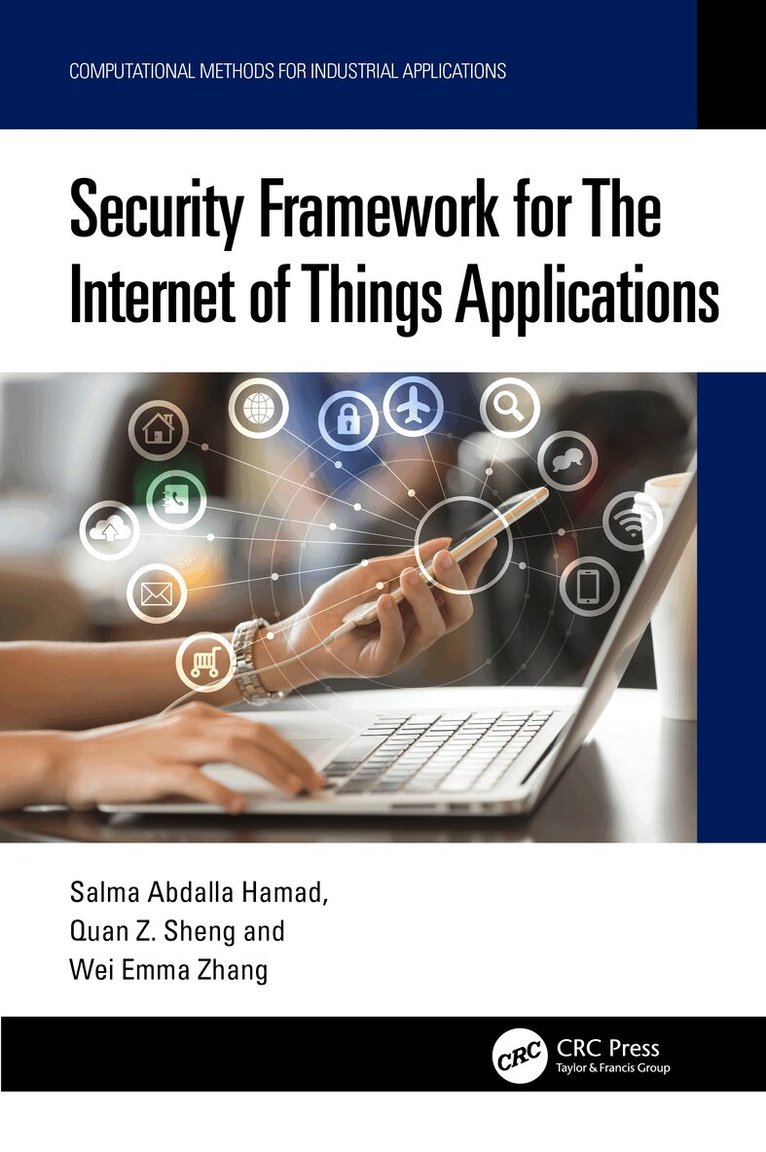
    Security Framework for The Internet of Things Applications

    AvSalma Abdalla Hamad,Quan Z. Sheng

    Häftad, Engelska, 2026

    Del i serien Computational Methods for Industrial Applications

    817 kr

    Beställningsvara. Skickas inom 10-15 vardagar. Fri frakt över 249 kr.

    Fler format och utgåvor

    Inbunden

    1 222 kr

    Beskrivning

    The text highlights a comprehensive survey that focuses on all security aspects and challenges facing the Internet of Things systems, including outsourcing techniques for partial computations on edge or cloud while presenting case studies to map security challenges. It further covers three security aspects including Internet of Things device identification and authentication, network traffic intrusion detection, and executable malware files detection.This book:Presents a security framework model design named Behavioral Network Traffic Identification and Novelty Anomaly Detection for the IoT InfrastructuresHighlights recent advancements in machine learning, deep learning, and networking standards to boost Internet of Things securityBuilds a near real-time solution for identifying Internet of Things devices connecting to a network using their network traffic traces and providing them with sufficient access privilegesDevelops a robust framework for detecting IoT anomalous network trafficCovers an anti-malware solution for detecting malware targeting embedded devicesIt will serve as an ideal text for senior undergraduate and graduate students, and professionals in the fields of electrical engineering, electronics and communication engineering, computer engineering, and information technology.

    Produktinformation

    • Utgivningsdatum:2026-06-21
    • Mått:156 x 234 x 8 mm
    • Vikt:280 g
    • Format:Häftad
    • Språk:Engelska
    • Serie:Computational Methods for Industrial Applications
    • Antal sidor:134
    • Förlag:Taylor & Francis Ltd
    • ISBN:9781032764894

    Utforska kategorier

    • Hårdvara inom Data och IT
    • IT-säkerhet inom Data och IT
    • Nätverk och kommunikation inom Data och IT

    Mer om författaren

    Salma Abdalla Hamad is currently a Senior Technology Security Compliance Manager at a telecommunication firm.. She received a Ph.D. degree in Computer Science from Macquarie University, Sydney, Australia in 2021. She worked under the supervision of Professor Michael Sheng and Dr. Wei Emma Zhang. Salma obtained her bachelor’s and master’s degrees in Electronics and Communication Engineering from the Arab Academy for Science, Technology, and Maritime Transport, Egypt with distinctions in 2005 and 2009, respectively. Salma also possesses more than 19 years of working experience in both the government sector and the financial sector, where she executed several projects pertinent to Information Security. Her research interests are concentrated in the domain of Information Security, more specifically, for the Internet of Things, Smart Cities, and Smart Homes.Quan Z. Sheng is a full Professor and Head of the Department of Computing at Macquarie University, Sydney, Australia. His research interests include the Internet of Things, service-oriented computing, distributed computing, Internet computing, and pervasive computing. Professor Sheng holds a Ph.D. degree in Computer Science from the University of New South Wales (UNSW) and did his post-doc as a research scientist at CSIRO ICT Centre. Professor Sheng is the recipient of the AMiner Most Influential Scholar in IoT Award in 2019, the ARC Future Fellowship in 2014, the Chris Wallace Award for Outstanding Research Contribution in 2012, and a Microsoft fellowship in 2003.Wei Emma Zhang is currently a Lecturer in the School of Computer Science, at the University of Adelaide. Her research interests include the Internet of Things, text mining, data mining, and knowledge base. She received a Ph.D. degree in Computer Science from the University of Adelaide in 2017. She has authored and co-authored more than 50 papers. She has also served on various conference committees and international journals in different roles such as track chair, proceeding chair, PC member, and reviewer. She is a member of the IEEE and ACM.

    Innehållsförteckning

    • 1. Introduction 2. Background and the State-Of-The-Art Security Solutions. 3. IoT Device Identification and Finger-printing. 4. Behavioural Novelty Detection for IoT Network Traffic. 5. Detection of Malware Targeting Embedded Devices. 6. Conclusion and Future Directions References