• Fri frakt över 249 kr
  • •
  • Snabba leveranser
  • •
  • Billiga böcker
Kundservice

Du är på sajten för privatpersoner.

Företag, bibliotek eller offentlig verksamhet?

Du handlar på classic.bokus.com, där alla dina funktioner finns intakta.
Till classic.bokus.com
Bokus logotyp. Gå till startsidan.
  • Erbjudanden
  • Student
  • Topplistor
  • Barn & ungdom
  • Bokus Play
  • E-böcker
  • Ljudböcker
  • Pocketböcker
  • Spel & pussel

10% rabatt på allt med kod NYSTART10 →

Sidfot

Mina sidor

    Hjälp

    • Kundservice
    • Vanliga frågor och svar
    • Frakt och leverans
    • Retur vid ångerrätt
    • Reklamera vara
    • Betalning
    • Köpvillkor
    • Allmänna villkor
    • Information om webbplatsens tillgänglighet

    Om Bokus

    • Om oss
    • Pressrum
    • För studenter
    • För företag
    • För bibliotek och offentlig verksamhet
    • För leverantörer
    • Hållbarhet

    Populärt

    • Aktuella erbjudanden
    • Presentkort
    • Studentlitteratur
    • Nya böcker
    • Topplistor
    • Signerade böcker
    • Engelska böcker

    Inspiration

    • Boktips
    • BookTok
    • Populära bokserier
    • Barnbokskaraktärer
    • Populära författare
    Logotyp för Bokus
    Följ oss på Facebook (extern länk)Följ oss på Instagram (extern länk)Följ oss på YouTube (extern länk)Följ oss på TikTok (extern länk)
    bokus @ CookiesAnpassa cookiesIntegritetspolicyKöpvillkor
    Till Citymail hemsida (extern länk)Till Budbee hemsida (extern länk)Till Postnord hemsida (extern länk)Till Schenker hemsida (extern länk)Till Early Bird hemsida (extern länk)Till Walleys hemsida (extern länk)
    1. Språk och ordböcker
    2. Språkvetenskap och lingvistik
    • Nyhet

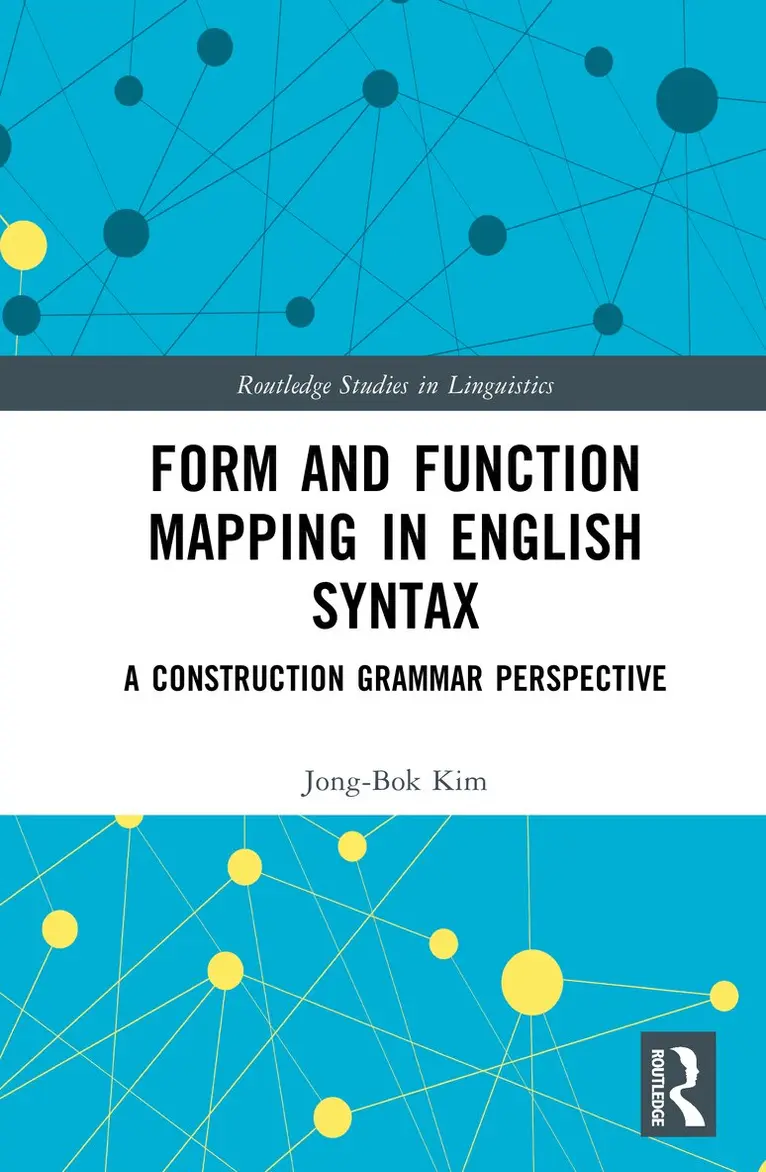
    Form and Function Mapping in English Syntax

    A Construction Grammar Perspective

    AvJong-Bok Kim

    Inbunden, Engelska, 2026

    Del i serien Routledge Studies in Linguistics

    2 490 kr

    Beställningsvara. Skickas inom 10-15 vardagar. Fri frakt över 249 kr.

    Fler format och utgåvor

    E-bok

    777 kr

    E-bok

    777 kr

    Beskrivning

    This book presents a construction-based approach to understanding English syntactic constructions that challenge traditional form-function relationships, exploring complex linguistic phenomena that have posed empirical and analytical puzzles in grammatical research.The volume establishes theoretical foundations before examining how unusual mapping relations between form and function manifest in complex English constructions. Drawing exclusively on attested data, the book investigates constructions with unpredictable form-meaning relationships, developing an innovative framework that enables broader predictions about specific phenomena and related grammatical structures. The approach advances understanding of English grammar while maintaining methodological rigor through emphasis on empirical evidence. The book offers a mathematically robust grammar from a construction-based perspective while minimizing formal representations to ensure accessibility across theoretical frameworks. It provides fresh insights into form-meaning mismatches across diverse complex grammatical phenomena. The author strikes an optimal balance between data and theory, grounding analyses in authentic language use to ensure theoretical contributions are empirically sound and practically applicable. Examples illuminate broader insights into complex form-function mappings in English, paving the way for future research in construction grammar and syntactic theory.This book will interest students and scholars in linguistics, syntax, construction grammar, and theoretical linguistics.

    Produktinformation

    • Utgivningsdatum:2026-07-28
    • Mått:156 x 234 x 24 mm
    • Vikt:940 g
    • Format:Inbunden
    • Språk:Engelska
    • Serie:Routledge Studies in Linguistics
    • Antal sidor:404
    • Förlag:Taylor & Francis Ltd
    • ISBN:9781041194613

    Utforska kategorier

    • Språkvetenskap och lingvistik inom Språk och ordböcker

    Mer om författaren

    Jong-Bok Kim is Professor at the Department of English Linguistics and Literature at Kyung Hee University, Seoul. He was Distinguished Research Fellow of the National Research Foundation of Korea and also a winner of the Alexander von Humboldt Research Award in 2019.

    Recensioner i media

    "This is an outstanding book on English syntax, remarkable not only for its empirical breadth but also for its analytical depth. It demonstrates how a constructional account of English can be rendered formally precise while encompassing a wide range of phenomena, from well-known puzzles to smaller, idiosyncratic cases that nonetheless deserve just as much attention. With its wealth of attested data, cogent analyses, and extensive references, it should be an invaluable resource for both students and researchers. This advanced textbook sets a high bar for non-constructivist approaches, and I, for one, do not expect to see its equal surface anytime soon."-Rui P. Chaves, Chair and Professor of Linguistics, University at Buffalo, SUNY"Why do English sentences so often mean more—or something other—than what their words alone predict? Form and Function Mapping in English Syntax reveals how such mismatches arise and why they matter, presenting a clear and compelling argument that English grammar is best understood as a network of constructions. Drawing on authentic corpus data, Jong-Bok Kim uses Sign-Based Construction Grammar to illuminate both the familiar architecture of English syntax and its most surprising patterns—from verb-particle sequences and VP ellipsis to free relatives, clefts, inversion, and comparative correlatives. The result is a concise, rigorous, and empirically rich account of how form and function interact to produce the expressive range of English."-Laura A. Michaelis, Professor of Linguistics , University of Colorado Boulder“This book offers an insightful exploration of both, let’s say, canonical and more intricate English constructions from a constructional standpoint, drawing on the framework of Sign-Based Construction Grammar (SBCG). Two aspects of the book stand out as exceptionally valuable. First, Kim guides the reader – someone likely comfortable with syntactic analysis but not necessarily versed in SBCG – step-by-step through the complexities of a broad set of English constructions, ranging from agreement and ellipsis to verb-particle structures and clefts. Second, the treatment of each construction raises questions that will interest not only those already working within SBCG but also linguists willing to revisit assumptions widely accepted in other theoretical frameworks, making the book a motivator for theoretical reflection. This monograph will be a seminal resource and essential reading for anyone wishing to explore in greater depth the syntax of English from a usage-based perspective, and will provide the perfect incentive to revisit its complex syntax with a critical spirit, grounded in authentic linguistic evidence.”-Javier Pérez-Guerra (he/him)Professor of English linguistics, Universidade de Vigo

    Innehållsförteckning

    • PrefaceList of abbreviations1 Theoretical Foundations 1.1 Linguistic signs and constructions 1.2 Inheritance network of constructions1.3 Why constructions? 1.3.1 Constructional meaning 1.3.2 No core and peripheral distinction 1.3.3 Extraordinary creativity and productivity 1.4 Sign-Based Construction Grammar 1.4.1 Basic architecture: Linguistic objects, modelling, and descriptions 1.4.2 Lexical signs 1.4.3 Phrasal constructions and combinatorial rules 1.4.4 Compositional semantics 1.4.5 Semantic composition and constructional meaning 1.5 Conclusion2 Mapping between Form and Function 2.1 Mismatches among grammatical components 2.1.1 Extended notion of sign and isomorphic relations 2.1.2 Non-isomorphic mappings: complexity and content mismatch 2.2 Grammatical categories and functions 2.3 Grammatical categories and meaning2.4 Form and meaning in raising 2.5 Form and meaning in binominal NPs2.6 More on mismatch phenomena in grammar 2.7 Conclusion 3 Simple and Complex NP Constructions 3.1 NP structures 3.1.1 NP vs. DP hypothesis3.1.2 Clausal properties of nominals 3.2 Agreement phenomena 3.2.1 Agreement features 3.2.2 Configurational and constraint-based views 3.2.3 Against purely syntactic or semantic agreement 3.3 A construction-based approach 3.3.1 Hybrid agreement 3.3.2 Determiner-head agreement 3.3.3 Subject-verb agreement 3.3.4 Agreement in coordination 3.4 Partitive constructions3.4.1 Partitive vs. pseudo-partitive 3.4.2 Two subtypes 3.4.3 Welcome consequences 3.5 Pseudo-partitive constructions 3.5.1 Issues in simple syntactic structures 3.5.2 Pseudo-partitives with a measure noun 3.5.3 Pseudo-partitives with a quantity noun 3.5.4 Pseudo-partitives with a collective noun 3.6 Conclusion 4 Verb-Particle Constructions 4.1 Introduction 4.2 Basic grammatical properties4.2.1 Syntactic patterns 4.2.2 Semantic patterns: compositional vs. idiomatic 4.3 Previous analyses 4.3.1 Transformational analyses 4.3.2 Ternary structure analyses 4.3.3 Small clause analyses4.3.4 Compound analyses 4.4 A construction-based analysis 4.4.1 Verb-particle sequence as a verb-complex construction 4.4.2 Predicative vs. non-predicative constructions 4.4.3 Extensions of the argument structure constructions 4.4.4 Interacting with information structure 4.5 Conclusion 5 VP Ellipsis and Fronting 5.1 Introduction 5.2 General properties 5.3 Invisible syntactic structures?5.4 A construction-based analysis 5.5 Antecedent identification and mismatches 5.6 VPE in other environments 5.6.1 VPE with negation 5.6.2 VPE in infinitival clauses 5.7 VP fronting 5.8 Conclusion 6 Free Relative Clause Constructions 6.1 Introduction 6.2 Free relatives and interrogatives 6.3 Externally nominal and internally clausal properties6.4 Matching effects 6.5 Mismatching effects 6.6 Previous analyses 6.7 A construction-based analysis 6.7.1 Key points of the analysis 6.7.2 Capturing mismatching effects 6.8 Transparent free relative clause 6.8.1 Some key properties 6.8.2 Previous analyses 6.8.3 A construction-based analysis 6.8.4 Welcome consequences 6.9 Conclusion 7 Extraposition Constructions 7.1 Introduction 7.2 Basic properties 7.2.1 Subject extraposition 7.2.2 Object extraposition 7.3 Movement analyses 7.3.1 For subject extraposition 7.3.2 For object extraposition 7.4 A construction-based analysis 7.4.1 Generalizations over lexical classes 7.4.2 Constructional regularities and subject extraposition7.4.3 Variations in object extraposition 7.4.4 Some further consequences and predictions 7.5 Adjunct extraposition7.6 Conclusion 8 Cleft Constructions 8.1 Prototypical and non-prototypical clefts 8.2 Key syntactic properties 8.2.1 It-clefts 8.2.2 Pseudo-clefts 8.2.3 Inverted pseudo-clefts8.3 Semantics/pragmatics and information structure 8.4 Movement-based perspective8.4.1 Extraposition analysis8.4.2 Expletive analyses 8.5 Non-derivational perspective8.5.1 Expletive analysis 8.5.2 Extraposition analysis 8.6 A construction-based analysis 8.6.1 Clefts as a family of copular constructions 8.6.2 It-clefts 8.6.3 Pseudo-clefts 8.6.4 Inverted pseudo-clefts8.7 Non-prototypical clefts 8.7.1 Inferential clefts8.7.2 There-clefts 8.7.3 All/Th-clefts 8.8 Conclusion 9 Locative Inversion 9.1 Introduction 9.2 Properties of the preverbal PP 9.2.1 Subject properties 9.2.2 Topic properties 9.3 Properties of the postverbal NP 9.3.1 Subject properties 9.3.2 Object properties 9.3.3 Focus properties9.3.4 Root phenomena properties 9.4 Derivation-based previous analyses 9.4.1 Topicalization approaches 9.4.2 Unaccusative approaches 9.4.3 Expletive approaches 9.5 Previous non-derivational approaches 9.6 A construction-based approach9.6.1 Constraints on the mapping relation9.6.2 Constructional constraints and consequences9.7 Conclusion 10 Comparative Correlative Construction 10.1 Introduction 10.2 Grammatical properties of the construction 10.2.1 Morphosyntactic properties 10.2.2 Subordination properties10.2.3 Coordination properties10.3 Previous approaches10.3.1 Derivational approaches10.3.2 Non-derivational analyses10.4 Lexical and constructional properties10.4.1 Forming the-comparative phrases 10.4.2 Forming (comparative) correlative constructions 10.4.3 Welcome consequences and further issues 10.5 Conclusion 11 Conclusions and Prospects 11.1 Objectives and key points of the book 11.2 More on nominals: Apposition constructions11.2.1 Loose apposition 11.2.2 Close apposition 11.3 More on inversion constructions 11.3.1 Predicate inversion 11.3.2 Negative inversion 11.4 More on elliptical constructions 11.4.1 Sluicing 11.4.2 Fragment answers 11.4.3 (Why)-Stripping 11.5 Concluding remarks Appendix Bibliography