• Fri frakt över 249 kr
  • •
  • Snabba leveranser
  • •
  • Billiga böcker
Kundservice

Du är på sajten för privatpersoner.

Företag, bibliotek eller offentlig verksamhet?

Du handlar på classic.bokus.com, där alla dina funktioner finns intakta.
Till classic.bokus.com
Bokus logotyp. Gå till startsidan.
  • Erbjudanden
  • Nyheter
  • Student
  • Topplistor
  • Barn & ungdom
  • Bokus Play
  • E-böcker
  • Pocketböcker
  • Spel & pussel

10% rabatt på allt med kod: NYSTART10 →

Sidfot

Mina sidor

    Hjälp

    • Kundservice
    • Vanliga frågor och svar
    • Frakt och leverans
    • Retur vid ångerrätt
    • Reklamera vara
    • Betalning
    • Köpvillkor
    • Allmänna villkor
    • Information om webbplatsens tillgänglighet

    Om Bokus

    • Om oss
    • Pressrum
    • För studenter
    • För företag
    • För bibliotek och offentlig verksamhet
    • För leverantörer
    • Hållbarhet

    Populärt

    • Aktuella erbjudanden
    • Presentkort
    • Studentlitteratur
    • Nya böcker
    • Topplistor
    • Signerade böcker
    • Engelska böcker

    Inspiration

    • Boktips
    • BookTok
    • Populära bokserier
    • Barnbokskaraktärer
    • Populära författare
    Logotyp för Bokus
    Följ oss på Facebook (extern länk)Följ oss på Instagram (extern länk)Följ oss på YouTube (extern länk)Följ oss på TikTok (extern länk)
    bokus @ CookiesAnpassa cookiesIntegritetspolicyKöpvillkor
    Till Citymail hemsida (extern länk)Till Budbee hemsida (extern länk)Till Postnord hemsida (extern länk)Till Schenker hemsida (extern länk)Till Early Bird hemsida (extern länk)Till Walleys hemsida (extern länk)
    1. Naturvetenskap och teknik
    2. Teknik och industri
    3. Elektronik och kommunikationer
    • Nyhet

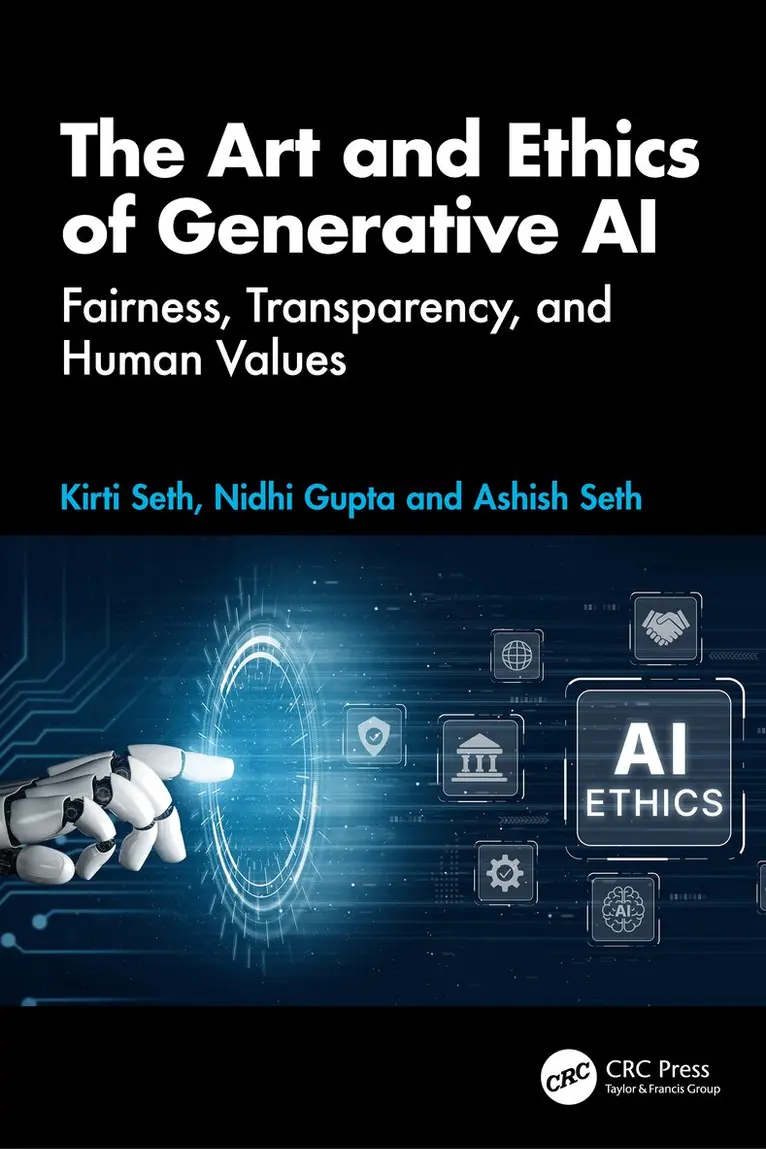
    Art and Ethics of Generative AI

    Fairness, Transparency, and Human Values

    AvKirti Seth,Nidhi Gupta

    Inbunden, Engelska, 2026

    1 466 kr

    Beställningsvara. Skickas inom 10-15 vardagar. Fri frakt över 249 kr.

    Beskrivning

    Generative artifical intelligence (AI) technologies are reshaping the way we create, communicate, and compute, presenting both unprecedented opportunities and profound challenges. As these systems increasingly influence decisions that shape our lives, it becomes clear that performance metrics alone cannot define their success. A deeper understanding of the intersection between technical innovation and human values is essential to navigate this transformative era.The Art and Ethics of Generative AI: Fairness, Transparency, and Human Values provides a balanced exploration of generative AI, combining technical insights with ethical considerations. It explains generative model architectures and learning paradigms in an accessible way while addressing critical issues such as algorithmic bias, explainability challenges, and emerging regulatory approaches. Practical frameworks for responsible AI development are offered, alongside multidisciplinary perspectives that bridge technical and humanistic viewpoints. Abstract concepts are brought to life through practical illustrations, demonstrating how ethical considerations play out in real-world AI applications.Designed for a wide audience, the book serves AI practitioners seeking actionable guidance for building responsible systems, researchers exploring nuanced ethical dimensions, educators and students looking for comprehensive learning materials, and policymakers needing governance insights. It is an essential resource for anyone engaged in the rapidly evolving AI ecosystem.

    Produktinformation

    • Utgivningsdatum:2026-07-09
    • Mått:156 x 234 x 13 mm
    • Vikt:530 g
    • Format:Inbunden
    • Språk:Engelska
    • Antal sidor:180
    • Förlag:Taylor & Francis Ltd
    • ISBN:9781041197355

    Utforska kategorier

    • Elektronik och kommunikationer inom Naturvetenskap och teknik

    Mer om författaren

    Kirti Seth is currently working as a Professor in the School of Computer and Information Engineering at INHA University in Tashkent, Uzbekistan. She is a researcher and academician in the field of Computer Science and Engineering with over twenty years of experience in teaching and research. Her research interests include Component-Based Systems, Service-Oriented Architecture, Bio-Inspired Optimization Techniques, Neural Networks, Artificial Intelligence, and Computer Security.Nidhi Gupta is an Associate Professor in the Department of Computer Science and Engineering, Sharda University, Greater Noida, India. She has over 20 years of academic experience, with a strong emphasis on research and scholarly publishing. Her research interests include Artificial Intelligence & Machine Learning, Computer Vision, and Information Retrieval.Ashish Seth is a Teacher, Consultant, Researcher, and an Author. He is a Professor at the School of Computer & Information Engineering, Inha University in Tashkent, Uzbekistan. He has been into research and academics for more than 22 years. He has worked at various Universities in India and abroad, holding different positions and responsibilities. He has organized and participated very actively in various conferences, workshops, and seminars.

    Innehållsförteckning

    • Chapter 1. Foundations of Generative AI. 1.1 AI and its Evolution. 1.2 Understanding Generative AI, Fairness, and Explainability. 1.3 Historical Development of Generative AI. 1.4 AI and GenAI. 1.5 AI Pillars: ML, DL, GenAI and LLM. 1.6 GenAI Blueprint. 1.7 Core Foundations of GenAI: Mathematics, Models, and Metrics. 1.8 GenAI Engine : Transformers. 1.9 Loss Functions in GenAI Models. 1.10 Metrics for Evaluating Generative Models. 1.11 Ethical and Societal Considerations. Exercise. References. Chapter 2.The Ethical Landscape of GenAI. 2.1 The Promise of GenAI. 2.2 Ethical Challenges and Implications. 2.3 Pros and Cons of AI Adoption across Industries. 2.4 Ethical Implications Across Industries. 2.5 Conclusion. Exercise. References. Chapter 3. Exploring AI Learning Paradigms: From Supervised to Generative Learning. 3.1 AI Learning Paradigms. 3.2 Supervised Learning. 3.3 Unsupervised Learning. 3.4 Semi-Supervised Learning. 3.5 Reinforcement Learning 3.6 Self-Supervised Learning. 3.7 Generative Learning. 3.8 Summarization and Comparison of Different Learning Paradigms. 3.9 Emerging and Hybrid learning Paradigms 3.10 Case Studies. Exercise. References. Chapter 4. GenAI: Models and Architecture. 4.1 GenAI Five-Layer Framework Architecture. 4.2 GenAI Architecture Models. 4.3 Real-World Applications and Use Cases of GenAI. 4.4 Conclusion. Exercise. References. Chapter 5. Fairness in GenAI. 5.1 Bias in Training Data Description. 5.2. Approaches to Promote Fairness. 5.3 Fairness Measuring Techniques. 5.4 Case Studies of Bias in GenAI. 5.5 Metrics to Evaluate Fairness in GenAI. 5.6 Legal, Ethical, And Policy Dimensions Of Fairness in GenAI. Exercises. References. Chapter 6. Opening the Black Box: Explainability in GenAI. 6.1. Importance Of Explainability in GenAI. 6.2. Challenges In Explaining GenAI. 6.3. Methods of Explainability in GenAI. 6.4. Research Aspects in Explainability for GenAI. Exercises. References. Chapter7. Bridging Fairness and Explainability in AI. 7.1 The Interplay between Bias and Opacity. 7.2 Explainability as a Tool for Fairness Audits. 7.3 Socio-Technical Perspective on Fair and Explainable AI. 7.4 Technical Methods Bridging Fairness and Explainability. 7.5 Real-World Case Studies. 7.6 Evaluation Metric and Benchmarking Fair-Explainable AI System. Exercises. References. Chapter 8. Challenges and Limitations. 8.1 Trade-offs Between Fairness, Explainability, and Accuracy. 8.2 Computational Barriers. 8.3 Legal Barriers. 8.4 Social Barriers. 8.5 Standardization Gaps in Evaluation. 8.6 Conclusion and Future Outlook. Exercise. References. Chapter 9. Future Directions and Responsible AI. 9.1 Research Opportunities: Hybrid Models and Symbolic Reasoning. 9.2 Scalable Solutions for Fairness-Aware Systems. 9.3 Multidisciplinary Frameworks for Ethical AI. 9.4 Governance, Policy, and User-Centric Design. 9.5 Future Outlook and Open Challenges. 9.6 Conclusion. Exercises. References