• Fri frakt över 249 kr
  • •
  • Snabba leveranser
  • •
  • Billiga böcker
Kundservice

Du är på sajten för privatpersoner.

Företag, bibliotek eller offentlig verksamhet?

Du handlar på classic.bokus.com, där alla dina funktioner finns intakta.
Till classic.bokus.com
Bokus logotyp. Gå till startsidan.
  • Erbjudanden
  • Nyheter
  • Student
  • Topplistor
  • Barn & ungdom
  • Bokus Play
  • E-böcker
  • Pocketböcker
  • Spel & pussel

10% rabatt på allt med kod NYSTART10 →

Sidfot

Mina sidor

    Hjälp

    • Kundservice
    • Vanliga frågor och svar
    • Frakt och leverans
    • Retur vid ångerrätt
    • Reklamera vara
    • Betalning
    • Köpvillkor
    • Allmänna villkor
    • Information om webbplatsens tillgänglighet

    Om Bokus

    • Om oss
    • Pressrum
    • För studenter
    • För företag
    • För bibliotek och offentlig verksamhet
    • För leverantörer
    • Hållbarhet

    Populärt

    • Aktuella erbjudanden
    • Presentkort
    • Studentlitteratur
    • Nya böcker
    • Topplistor
    • Signerade böcker
    • Engelska böcker

    Inspiration

    • Boktips
    • BookTok
    • Populära bokserier
    • Barnbokskaraktärer
    • Populära författare
    Logotyp för Bokus
    Följ oss på Facebook (extern länk)Följ oss på Instagram (extern länk)Följ oss på YouTube (extern länk)Följ oss på TikTok (extern länk)
    bokus @ CookiesAnpassa cookiesIntegritetspolicyKöpvillkor
    Till Citymail hemsida (extern länk)Till Budbee hemsida (extern länk)Till Postnord hemsida (extern länk)Till Schenker hemsida (extern länk)Till Early Bird hemsida (extern länk)Till Walleys hemsida (extern länk)
    1. Språk och ordböcker
    2. Språkvetenskap och lingvistik

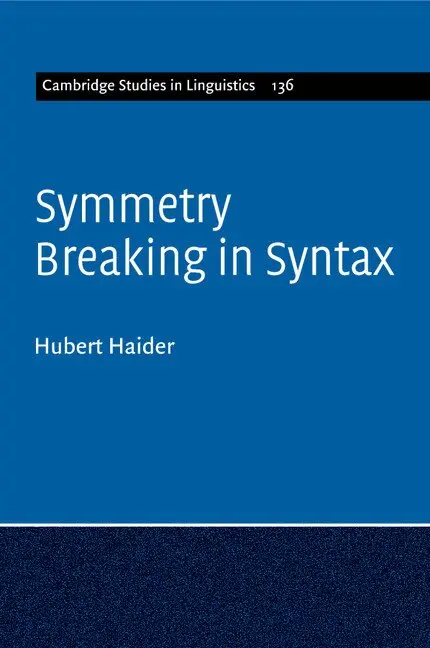
    Symmetry Breaking in Syntax

    AvHubert Haider

    Inbunden, Engelska, 2012

    Del 136 i serien Cambridge Studies in Linguistics

    1 389 kr

    Beställningsvara. Skickas inom 10-15 vardagar. Fri frakt över 249 kr.

    Fler format och utgåvor

    Häftad

    477 kr

    Beskrivning

    In this illuminating new theory of grammar, Hubert Haider demonstrates that there is a basic asymmetry in the phrase structure of any language, whatever sentence structure it takes. Moreover, he argues that understanding this asymmetry is the key to understanding the grammatical causality underlying a broad range of core syntactic phenomena. Until now, Germanic languages have been seen to fall into two distinct classes: those which take an object-verb sentence structure (OV) or a verb-object one (VO). However, by examining the nature of this universal underlying asymmetry, Hubert Haider reveals a third syntactic type: 'Type III'. In particular, he employs the third type to explore the cognitive evolution of grammar which gave rise to the structural asymmetry and its typological implications. Symmetry Breaking in Syntax will appeal to academic researchers and graduate students involved in comparative and theoretical syntax and the cognitive evolution of grammar.

    Produktinformation

    • Utgivningsdatum:2012-12-13
    • Mått:150 x 231 x 20 mm
    • Vikt:550 g
    • Format:Inbunden
    • Språk:Engelska
    • Serie:Cambridge Studies in Linguistics
    • Antal sidor:284
    • Förlag:Cambridge University Press
    • ISBN:9781107017757

    Utforska kategorier

    • Språkvetenskap och lingvistik inom Språk och ordböcker

    Mer om författaren

    Hubert Haider is Professor of Linguistics at the University of Salzburg. He specializes in the theory of syntax, comparative syntax and syntax and the brain. His previous publications include The Syntax of German (Cambridge, 2010).

    Recensioner i media

    'Professor Haider's Basic Branching Constraint is a bold solution to the problem of word order and word order correlations in language … should be read and taken seriously by grammarians of all stripes.' Frederick J. Newmeyer, Professor Emeritus, University of Washington

    Innehållsförteckning

    • 1. What breaks the symmetry in syntactic structures; 2. Linearizations are public, structures are private; 3. BBC - asymmetry in phrase structuring; 4. The cross-linguistic impact of the BBC; 5. The Germanic OV/VO split; 6. Adverbial positions in VO and in OV; 7. Elements of the third kind - resultative predicates and particles - in OV and VO; 8. Asymmetry in nominal structures - word and phrase structure; 9. BBC or LCA? - fact finding and evaluation.