• Fri frakt över 249 kr
  • •
  • Snabba leveranser
  • •
  • Billiga böcker
Kundservice

Du är på sajten för privatpersoner.

Företag, bibliotek eller offentlig verksamhet?

Du handlar på classic.bokus.com, där alla dina funktioner finns intakta.
Till classic.bokus.com
Bokus logotyp. Gå till startsidan.
  • Erbjudanden
  • Nyheter
  • Student
  • Topplistor
  • Barn & ungdom
  • Bokus Play
  • E-böcker
  • Pocketböcker
  • Spel & pussel

10% rabatt på allt med kod: NYSTART10 →

Sidfot

Mina sidor

    Hjälp

    • Kundservice
    • Vanliga frågor och svar
    • Frakt och leverans
    • Retur vid ångerrätt
    • Reklamera vara
    • Betalning
    • Köpvillkor
    • Allmänna villkor
    • Information om webbplatsens tillgänglighet

    Om Bokus

    • Om oss
    • Pressrum
    • För studenter
    • För företag
    • För bibliotek och offentlig verksamhet
    • För leverantörer
    • Hållbarhet

    Populärt

    • Aktuella erbjudanden
    • Presentkort
    • Studentlitteratur
    • Nya böcker
    • Topplistor
    • Signerade böcker
    • Engelska böcker

    Inspiration

    • Boktips
    • BookTok
    • Populära bokserier
    • Barnbokskaraktärer
    • Populära författare
    Logotyp för Bokus
    Följ oss på Facebook (extern länk)Följ oss på Instagram (extern länk)Följ oss på YouTube (extern länk)Följ oss på TikTok (extern länk)
    bokus @ CookiesAnpassa cookiesIntegritetspolicyKöpvillkor
    Till Citymail hemsida (extern länk)Till Budbee hemsida (extern länk)Till Postnord hemsida (extern länk)Till Schenker hemsida (extern länk)Till Early Bird hemsida (extern länk)Till Walleys hemsida (extern länk)
    1. Språk och ordböcker
    2. Språkvetenskap och lingvistik

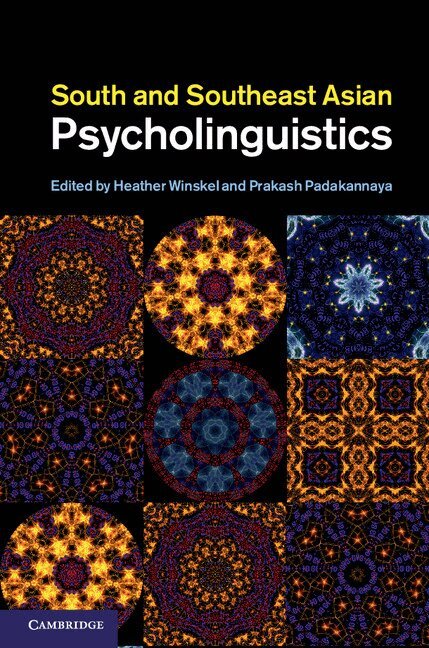
    South and Southeast Asian Psycholinguistics

    AvHeather Winskel,Prakash Padakannaya

    Inbunden, Engelska, 2013

    1 085 kr

    Beställningsvara. Skickas inom 10-15 vardagar. Fri frakt över 249 kr.

    Beskrivning

    A large body of knowledge has accumulated in recent years on the cognitive processes underlying language, much of which comes from studies of Indo-European languages, in particular English. This groundbreaking volume explores the languages of South and Southeast Asia, which differ significantly from Indo-European languages in their grammar, lexicon and spoken forms. This book raises new questions in psycholinguistics and enables readers to re-evaluate previous models in light of new research. With thirty-six chapters divided into three parts - Language Acquisition, Language Processing and Language and Brain - it examines contemporary topics alongside new findings in areas such as first and second language acquisition, the development of literacy, the diagnosis of language and reading disorders, and the relationship between language, brain, culture and cognition. It will be invaluable to all those interested in the languages of South and Southeast Asia, as well as psychologists, linguists, educationalists, speech therapists and neuroscientists.

    Produktinformation

    • Utgivningsdatum:2013-11-28
    • Mått:156 x 234 x 27 mm
    • Vikt:900 g
    • Format:Inbunden
    • Språk:Engelska
    • Antal sidor:487
    • Förlag:Cambridge University Press
    • ISBN:9781107017764

    Utforska kategorier

    • Språkvetenskap och lingvistik inom Språk och ordböcker

    Mer om författaren

    Heather Winskel is a Senior Lecturer in Psychology at Southern Cross University, Australia. Prakash Padakannaya is Professor of Psychology at the University of Mysore, India.

    Recensioner i media

    'The 'anglocentrism' of traditional psycholinguistics has undermined a full understanding of both the universal and language-specific aspects of language processing. This book provides a desperately needed remedy, an invaluable resource on language processing in some of the richest and most diverse languages spoken by millions of people.' Johannes Ziegler, CNRS and Aix-Marseille University

    Innehållsförteckning

    • Introduction Heather Winskel; Part I. Language Acquisition: Section 1. Spoken Language: 1. Studying language acquisition cross-linguistically Sabine Stoll and Elena Lieven; 2. Infant directed speech: social and linguistic pathways in tonal and non-tonal languages Christine Kitamura; 3. Pragmatic development of Mandarin-speaking young children: focus on communicative acts between children and their mothers Jing Zhou; 4. Referential forms in Thai children's narratives Theeraporn Ratitamkul; 5. The acquisition of tense and aspect Yasuhiro Shirai; 6. The acquisition of Malay numeral classifiers Khazriyati Salehuddin; 7. The acquisition of Vietnamese numeral classifiers Jennie Tran; 8. An overview of the acquisition of Malay wh-questions Norhaida Aman; 9. Marking plurals: the acquisition of nominal number inflection in Marathi Shalmalee Pitale and Vaiyayanthi M. Sarma; 10. Issues in the acquisition of Tamil verb morphology Vaijayanthi M. Sarma; 11. Fast mapping of novel words in bi/multilinguals Vishnu K. K. Nair, Sunil Kumar Ravi, Sapna Bhat and Shyamala K. Chengappa; 12. Studies on the acquisition of morphology and syntax among Malay children in Malaysia: issues, challenges and needs Rogayah A. Razak; 13. Issues in developing grammatical assessment tools in Chinese and Malay for speech and language therapy Lixian Jin, Rogayah A. Razak, Jannet Wright and John Song; Section 2. Written Language: 14. Reading and reading acquisition in European languages Brian Byrne, Stefan Samuelsson and Richard K. Olson; 15. Learning to read and write in Thai Heather Winskel; 16. Learning to read and write in Indonesian/Malaysian: a transparent alphabetic orthography Heather Winskel and Lay Wah Lee; 17. Literacy in Kannada, an alpha-syllabic orthography R. Malatesha Joshi; 18. Reading in Tamil: a more alphabetic and less syllabic akshara based orthography Bhuvaneshwari B. and Prakash Padakannaya; 19. Akshara-syllable mappings in Bengali: a language-specific skill for reading Shruti Sircar and Sonali Nag; 20. Diversity in bilingual children's spelling skill development: the case of Singapore Susan Rickard Liow; Part II. Language Processing: 21. Tones and voice registers Arthur S. Abramson; 22. How to compare tones Nan Xu, Virginie Attina, Benjawan Kasisopa and Denis Burnham; 23. Studying sentence generation during scene viewing in Hindi with eye tracking Ramesh Mishra; 24. Thai specific and general reading processes in developing and skilled Thai readers Jeesun Kim and Chris Davis; 25. Eye movement guidance in reading unspaced text in Thai and Chinese Jie-Li Tsai; 26. SE Asian writing systems: a challenge to current models of visual information processing in reading Ronan Reilly; 27. Preferred argument structure and Thai varieties of English: evidence of cognitive processing limitations? Thom Huebner; 28. Cross-language perception of word-final stops Kimiko Tsukada; 29. Uncovering bilingual memory representations Winston D. Goh, Lidia Suárez and Kelly Yeo; 30. Eye movements and reading in the alphasyllabic scripts of South and Southeast Asia Heather Winskel, Prakash Padakannaya and Aparna Pandey; Part III. Language and Brain: 31. Aphasia to imaging: the neurolinguistic endeavor as it reflects on South and Southeast Asian languages Loraine K. Obler and Avanthi Niranjan Paplikar; 32. Neural bases of lexical tones Jackson T. Gandour and Ananthanarayan Krishnan; 33. Hemispheric asymmetry in word recognition for a right-to-left script: the case of Urdu Chaitra Rao, Jyotsna Vaid and Hsin-Chin Chen; 34. The declarative procedural model of language: a new framework for studying the non-inflecting languages of Southeast Asia? Tomasina Oh; 35. Language mixing in bilingual aphasia: an Indian perspective Sapna Bhat and Shyamala Chengappa; 36. The relationship between language and cognition Heather Winskel and Sudaporn Luksaneeyanawin.