• Fri frakt över 249 kr
  • •
  • Snabba leveranser
  • •
  • Billiga böcker
Kundservice

Du är på sajten för privatpersoner.

Företag, bibliotek eller offentlig verksamhet?

Du handlar på classic.bokus.com, där alla dina funktioner finns intakta.
Till classic.bokus.com
Bokus logotyp. Gå till startsidan.
  • Erbjudanden
  • Nyheter
  • Student
  • Topplistor
  • Barn & ungdom
  • Bokus Play
  • E-böcker
  • Pocketböcker
  • Spel & pussel

10% rabatt på allt med kod: NYSTART10 →

Sidfot

Mina sidor

    Hjälp

    • Kundservice
    • Vanliga frågor och svar
    • Frakt och leverans
    • Retur vid ångerrätt
    • Reklamera vara
    • Betalning
    • Köpvillkor
    • Allmänna villkor
    • Information om webbplatsens tillgänglighet

    Om Bokus

    • Om oss
    • Pressrum
    • För studenter
    • För företag
    • För bibliotek och offentlig verksamhet
    • För leverantörer
    • Hållbarhet

    Populärt

    • Aktuella erbjudanden
    • Presentkort
    • Studentlitteratur
    • Nya böcker
    • Topplistor
    • Signerade böcker
    • Engelska böcker

    Inspiration

    • Boktips
    • BookTok
    • Populära bokserier
    • Barnbokskaraktärer
    • Populära författare
    Logotyp för Bokus
    Följ oss på Facebook (extern länk)Följ oss på Instagram (extern länk)Följ oss på YouTube (extern länk)Följ oss på TikTok (extern länk)
    bokus @ CookiesAnpassa cookiesIntegritetspolicyKöpvillkor
    Till Citymail hemsida (extern länk)Till Budbee hemsida (extern länk)Till Postnord hemsida (extern länk)Till Schenker hemsida (extern länk)Till Early Bird hemsida (extern länk)Till Walleys hemsida (extern länk)
    1. Naturvetenskap och teknik
    2. Geovetenskap
    3. Miljövetenskap och miljöpolitik

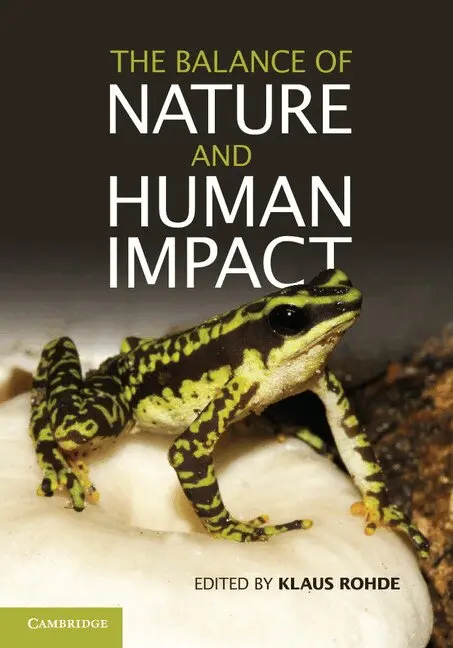
    The Balance of Nature and Human Impact

    AvKlaus Rohde

    Inbunden, Engelska, 2013

    959 kr

    Beställningsvara. Skickas inom 10-15 vardagar. Fri frakt över 249 kr.

    Beskrivning

    It is clear that nature is undergoing rapid changes as a result of human activities such as industry, agriculture, travel, fisheries and urbanisation. What effects do these activities have? Are they disturbing equilibria in ecological populations and communities, thus upsetting the balance of nature, or are they enhancing naturally occurring disequilibria, perhaps with even worse consequences? It is often argued that large-scale fluctuations in climate and sea-levels have occurred over and over again in the geological past, long before human activities could possibly have had any impact, and that human effects are very small compared to those that occur naturally. Should we conclude that human activity cannot significantly affect the environment, or are these naturally occurring fluctuations actually being dangerously enhanced by humans? This book examines these questions, first by providing evidence for equilibrium and non-equilibrium conditions in relatively undisturbed ecosystems, and second by examining human-induced effects.

    Produktinformation

    • Utgivningsdatum:2013-02-14
    • Mått:178 x 254 x 24 mm
    • Vikt:1 010 g
    • Format:Inbunden
    • Språk:Engelska
    • Antal sidor:426
    • Förlag:Cambridge University Press
    • ISBN:9781107019614

    Utforska kategorier

    • Miljövetenskap och miljöpolitik inom Naturvetenskap och teknik

    Mer om författaren

    Klaus Rohde is Professor Emeritus at the University of New England, Armidale, Australia. He is well known for his work on the ecology, biogeography and ultrastructure of parasites, particularly marine parasites, and on latitudinal gradients in biodiversity. He had published extensively on parasite ecology, nonequilibrium ecology and marine parasitology.

    Recensioner i media

    'This book summarizes ecological responses to global environmental change; it is relevant to interested readers of different backgrounds trying to understand why scientists are worried about current environmental change.' Integrative and Comparative Biology

    Innehållsförteckning

    • Preface; Introduction Klaus Rohde; Part I. Nonequilibrium and Equilibrium in Populations and Metapopulations: 1. Reef fishes: density dependence and equilibrium in populations? Graham Forrester and Mark Steele; 2. Population dynamics of ectoparasites of terrestrial hosts Boris Krasnov and Annapaola Rizzoli; 3. Metapopulation dynamics in marine parasites Ana Perez del Omo, Aneta Kostadinova and Serge Morand; Part II. Nonequilibrium and Equilibrium in Communities: 4. The paradox of the plankton Klaus Rohde; 5. A burning issue: community stability and alternative stable states in relation to fire Peter J. Clarke and Mike J. Lawes; 6. Community stability and instability in ectoparasites of marine and freshwater fish Andrea Simkova and Klaus Rohde; 7. Ectoparasites of small mammals: interactive saturated and unsaturated communities Boris Krasnov; 8. A macroecological approach to the equilibrial vs. nonequilibrial debate using bird populations and communities Brian McGill; Part III. Equilibrium and Nonequilibrium on Geographical Scales: 9. Island flora and fauna: equilibrium and nonequilibrium Lloyd Morrison; 10. The turbulent past and future of arctic vascular plants: climate change, spatial variation, and genetic diversity Christian Brochmann, Mary E. Edwards and Inger G. Alsos; Part IV. Latitudinal Gradients: 11. Latitudinal diversity gradients: equilibrium and nonequilibrium explanations Klaus Rohde; 12. Effective evolutionary time and the latitudinal diversity gradient Len Gillman and Shane Wright; Part V. Effects Due to Invading Species, Habitat Loss and Climate Change: 13. The physics of climate: equilibrium, disequilibrium and chaos Michael Box; 14. Episodic processes, invasion and faunal mosaics in evolutionary and ecological time Eric Hoberg and Daniel R. Brooks; 15. The emerging infectious diseases crisis and pathogen pollution Daniel R. Brooks and Eric Hoberg; 16. Establishment or vanishing: fate of an invasive species based on mathematical models Yihong Du; 17. Anthropogenic footprints on biodiversity Camilo Mora and Fernando Zapata; 18. Worldwide decline and extinction of amphibians Harold Heatwole; 19. Climatic change and reptiles Harvey B. Lillywhite; 20. Equilibrium and non-equilibrium in Australian bird communities - the impact of natural and anthropogenic effects Hugh Ford; 21. Population dynamics of insects: impacts of a changing climate Nigel Andrew; 22. The futures of coral reefs Peter Sale; Part VI. Autecological Studies: 23. Autecology and the balance of nature-ecological laws and human induced invasions Gimme Walter; 24. The intricacy of structural and ecological adaptations: micromorphology and ecology of some Aspidogastrea Klaus Rohde; Part VII. An Overall View: 25. The importance of interspecific competition in regulating communities, equilibrium vs. nonequilibrium Klaus Rohde; 26. Evolutionarily stable strategies: how common are they? Klaus Rohde; 27. How to conserve biodiversity in a nonequilibrium world Klaus Rohde, Hugh Ford, Nigel R. Andrew and Harold Heatwole; Index.