• Fri frakt över 249 kr
  • •
  • Snabba leveranser
  • •
  • Billiga böcker
Kundservice

Du är på sajten för privatpersoner.

Företag, bibliotek eller offentlig verksamhet?

Du handlar på classic.bokus.com, där alla dina funktioner finns intakta.
Till classic.bokus.com
Bokus logotyp. Gå till startsidan.
  • Erbjudanden
  • Nyheter
  • Student
  • Topplistor
  • Barn & ungdom
  • Bokus Play
  • E-böcker
  • Pocketböcker
  • Spel & pussel

10% rabatt på allt med kod: NYSTART10 →

Sidfot

Mina sidor

    Hjälp

    • Kundservice
    • Vanliga frågor och svar
    • Frakt och leverans
    • Retur vid ångerrätt
    • Reklamera vara
    • Betalning
    • Köpvillkor
    • Allmänna villkor
    • Information om webbplatsens tillgänglighet

    Om Bokus

    • Om oss
    • Pressrum
    • För studenter
    • För företag
    • För bibliotek och offentlig verksamhet
    • För leverantörer
    • Hållbarhet

    Populärt

    • Aktuella erbjudanden
    • Presentkort
    • Studentlitteratur
    • Nya böcker
    • Topplistor
    • Signerade böcker
    • Engelska böcker

    Inspiration

    • Boktips
    • BookTok
    • Populära bokserier
    • Barnbokskaraktärer
    • Populära författare
    Logotyp för Bokus
    Följ oss på Facebook (extern länk)Följ oss på Instagram (extern länk)Följ oss på YouTube (extern länk)Följ oss på TikTok (extern länk)
    bokus @ CookiesAnpassa cookiesIntegritetspolicyKöpvillkor
    Till Citymail hemsida (extern länk)Till Budbee hemsida (extern länk)Till Postnord hemsida (extern länk)Till Schenker hemsida (extern länk)Till Early Bird hemsida (extern länk)Till Walleys hemsida (extern länk)
    1. Språk och ordböcker
    2. Språkvetenskap och lingvistik

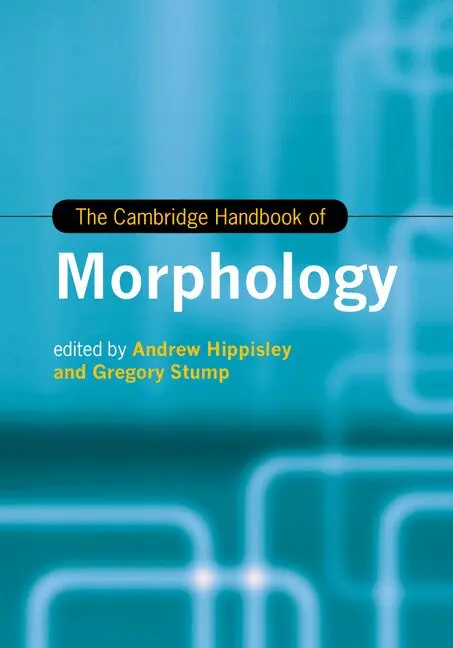
    The Cambridge Handbook of Morphology

    AvAndrew Hippisley,Gregory Stump

    Inbunden, Engelska, 2016

    Del i serien Cambridge Handbooks in Language and Linguistics

    2 197 kr

    Beställningsvara. Skickas inom 10-15 vardagar. Fri frakt över 249 kr.

    Beskrivning

    The Cambridge Handbook of Morphology describes the diversity of morphological phenomena in the world's languages, surveying the methodologies by which these phenomena are investigated and the theoretical interpretations that have been proposed to explain them. The Handbook provides morphologists with a comprehensive account of the interlocking issues and hypotheses that drive research in morphology; for linguists generally, it presents current thought on the interface of morphology with other grammatical components and on the significance of morphology for understanding language change and the psychology of language; for students of linguistics, it is a guide to the present-day landscape of morphological science and to the advances that have brought it to its current state; and for readers in other fields (psychology, philosophy, computer science, and others), it reveals just how much we know about systematic relations of form to content in a language's words - and how much we have yet to learn.

    Produktinformation

    • Utgivningsdatum:2016-11-24
    • Mått:182 x 255 x 42 mm
    • Vikt:1 860 g
    • Format:Inbunden
    • Språk:Engelska
    • Serie:Cambridge Handbooks in Language and Linguistics
    • Antal sidor:878
    • Förlag:Cambridge University Press
    • ISBN:9781107038271

    Utforska kategorier

    • Språkvetenskap och lingvistik inom Språk och ordböcker

    Mer om författaren

    Andrew Hippisley is a professor of linguistics at the University of Kentucky, where he serves as Linguistics Program Director. His books include Network Morphology: A Defaults-Based Theory of Word Structure (with Dunstan Brown, Cambridge, 2012), Deponency and Morphological Mismatches (co-edited, 2007), and Defaults in Morphological Theory (co-edited, forthcoming). Gregory Stump is a professor of linguistics at the University of Kentucky. His books include Inflectional Morphology: A Theory of Paradigm Structure (Cambridge, 2001) and Morphological Typology: From Word to Paradigm (with Raphael A. Finkel, Cambridge, 2013), and Inflectional Paradigms: Content and Form at the Syntax-Morphology Interface (Cambridge, 2015).

    Recensioner i media

    'Wide-ranging and comprehensive, this volume is a welcome addition to the reference volumes currently available in the field of linguistic morphology. Covering everything from general theoretical issues, contemporary frameworks, and interfaces with phonology and syntax to computational, experimental, and psycholinguistic approaches, it will be a valuable resource to linguists and scholars in related fields.' Rochelle Lieber, University of New Hampshire

    Innehållsförteckning

    • 1. Introduction Andrew Hippisley and Gregory Stump; Part I. Foundations of Morphological Theory: 2. Two morphologies or one? Inflection versus word-formation Andrew Spencer; 3. The minimal sign: morpheme or lexeme James Blevins; 4. Productivity Georgette Dal and Fiammetta Namer; Part II. Issues in Morphological Theory: 5. Alternations: stems and allomorphy Mary Paster; 6. Morphological semantics Paolo Acquaviva; 7. Affix ordering: motivation and interpretation Marianne Mithun; 8. The place of morphology Mark Aronoff; 9. The status of paradigms Gilles Boyé and Gauvain Schalchli; Part III. Morphological Principles: 10. Lexicalism, the principles of morphology-free syntax and syntax-free morphology Paul O'Neill; 11. Defaults and overrides in morphological description Dunstan Brown; 12. Implicative relations in word-based morphological systems Farrell Ackerman and Rob Malouf; Part IV. Morphological Frameworks: 13. Classical morphemics: assumptions, extensions and alternatives Laurie Bauer; 14. Natural morphology Wolfgang U. Dressler and Marianne Kilani-Schoch; 15. Distributed morphology Martha McGinnis-Archibald; 16. Construction morphology Geert Booij; 17. Paradigm function morphology Olivier Bonami and Gregory Stump; 18. Network morphology Andrew Hippisley; Part V. The Role of Morphology in Theories of Phonology and Syntax: 19. The role of morphology in generative phonology, autosegmental phonology and prosodic morphology Sharon Inkelas; 20. The role of morphology in optimality theory Zheng Xu; 21. The role of morphology in transformational grammar and its descendants Stephen Anderson; 22. The role of morphology in constraint-based lexical grammars Olivier Bonami and Berthold Crysmann; 23. The role of morphology in dependency grammar Richard Hudson; Part VI. Domains for the Evaluation of Morphological Theories: 24. Frequency and corpora Péter Rácz, Viktória Papp and Jennifer Hay; 25. Morphology in linguistic typology Johanna Nichols; 26. Morphology in language change Brian Joseph; 27. Morphology and language acquisition Constantine Lignos and Charles Yang; 28. Experimental morphology Harald Clahsen; 29. Computational morphology Lynne Cahill.