• Fri frakt över 249 kr
  • •
  • Snabba leveranser
  • •
  • Billiga böcker
Kundservice

Du är på sajten för privatpersoner.

Företag, bibliotek eller offentlig verksamhet?

Du handlar på classic.bokus.com, där alla dina funktioner finns intakta.
Till classic.bokus.com
Bokus logotyp. Gå till startsidan.
  • Erbjudanden
  • Nyheter
  • Student
  • Topplistor
  • Barn & ungdom
  • Bokus Play
  • E-böcker
  • Pocketböcker
  • Spel & pussel

10% rabatt på allt med kod: NYSTART10 →

Sidfot

Mina sidor

    Hjälp

    • Kundservice
    • Vanliga frågor och svar
    • Frakt och leverans
    • Retur vid ångerrätt
    • Reklamera vara
    • Betalning
    • Köpvillkor
    • Allmänna villkor
    • Information om webbplatsens tillgänglighet

    Om Bokus

    • Om oss
    • Pressrum
    • För studenter
    • För företag
    • För bibliotek och offentlig verksamhet
    • För leverantörer
    • Hållbarhet

    Populärt

    • Aktuella erbjudanden
    • Presentkort
    • Studentlitteratur
    • Nya böcker
    • Topplistor
    • Signerade böcker
    • Engelska böcker

    Inspiration

    • Boktips
    • BookTok
    • Populära bokserier
    • Barnbokskaraktärer
    • Populära författare
    Logotyp för Bokus
    Följ oss på Facebook (extern länk)Följ oss på Instagram (extern länk)Följ oss på YouTube (extern länk)Följ oss på TikTok (extern länk)
    bokus @ CookiesAnpassa cookiesIntegritetspolicyKöpvillkor
    Till Citymail hemsida (extern länk)Till Budbee hemsida (extern länk)Till Postnord hemsida (extern länk)Till Schenker hemsida (extern länk)Till Early Bird hemsida (extern länk)Till Walleys hemsida (extern länk)
    1. Naturvetenskap och teknik
    2. Geovetenskap
    3. Geovetenskap

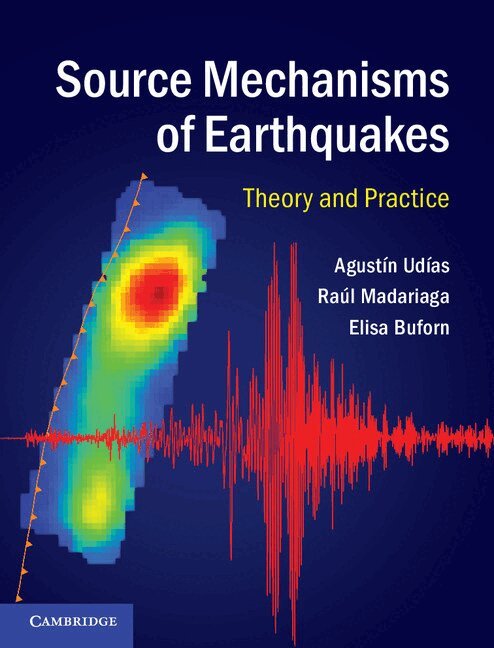
    Source Mechanisms of Earthquakes

    Theory and Practice

    AvAgustín Udías,Raúl Madariaga

    Inbunden, Engelska, 2014

    1 000 kr

    Beställningsvara. Skickas inom 10-15 vardagar. Fri frakt över 249 kr.

    Beskrivning

    This book presents an innovative new approach to studying source mechanisms of earthquakes, combining theory and observation in a unified methodology, with a key focus on the mechanics governing fault failures. It explains source mechanisms by building from fundamental concepts such as the equations of elasticity theory to more advanced problems including dislocation theory, kinematic models and fracture dynamics. The theory is presented first in student-friendly form using consistent notation throughout, and with full, detailed mathematical derivations that enable students to follow each step. Later chapters explain the widely-used practical modelling methods for source mechanism determination, linking clearly to the theoretical foundations, and highlighting the processing of digital seismological data. Providing a unique balance between application techniques and theory, this is an ideal guide for graduate students and researchers in seismology, tectonophysics, geodynamics and geomechanics, and a valuable practical resource for professionals working in seismic hazard assessment and seismic engineering.

    Produktinformation

    • Utgivningsdatum:2014-04-24
    • Mått:193 x 253 x 18 mm
    • Vikt:830 g
    • Format:Inbunden
    • Språk:Engelska
    • Antal sidor:311
    • Förlag:Cambridge University Press
    • ISBN:9781107040274

    Utforska kategorier

    • Geovetenskap inom Naturvetenskap och teknik

    Mer om författaren

    Agustín Udías is Emeritus Professor at the Universidad Complutense de Madrid (UCM). He is the author of many papers about seismicity, seismotectonics of the Azores-Gibraltar, and the physics of seismic sources, and has also written several textbooks including Principles of Seismology (Cambridge University Press, 1999). Professor Udías has served as Editor-in-Chief of Física de la Tierra and the Journal of Seismology, and earlier as the Vice-President of the European Seismological Commission. He is a member of the Accademia Europeae, the Seismological Society of America, the American Geophysical Union, amongst other societies, and is a Fellow of the Royal Astronomical Society. Raúl Madariaga is Emeritus Professor of Geophysics at the École Normale Supérieure (ENS) in Paris. During his career he has served as Director of the Seismological Laboratory of the Institut de Physique du Globe (IPG), and Director of the Geology Laboratory of ENS. Professor Madariaga is a Fellow of the American Geophysical Union and has been awarded the Stefan Muller medal of the European Geophysical Society and also the H. F. Reid Medal, the highest award of the Seismological Society of America. He has been an editor of several journals a well as a member of the Board of Science, and he is the author of 140 papers in leading scientific journals as well as several articles in Earth Science encyclopaedias. Elisa Buforn is a Professor of Geophysics at the Universidad Complutense, Madrid, teaching courses on geophysics, seismology, physics and numerical methods. She has published papers on topics ranging from source fracture processes and seismicity to the seismotectonics of the Ibero-Maghrebian region and Azores-Gibraltar, and is the author of various textbooks including Solved Problems in Geophysics (Cambridge University Press, 2012). Professor Buforn currently serves as Editor-in-Chief of Física de la Tierra, and is on the editorial board of the Journal of Seismology. She has participated on many international scientific committees and is a member of the Seismological Society of America, American Geophysical Union, Royal Astronomical Society, and other distinguished societies.

    Recensioner i media

    'An excellent and timely book - the first textbook to provide such a detailed and complete overview on the theory of earthquake source mechanisms, and to combine the classical continuum mechanics approach with concepts of kinematic and dynamic rupture models. This book will become an essential reference and valuable resource for researchers, professionals and graduate students.' Professor Dr Torsten Dahm, Helmholtz Centre Potsdam, GFZ German Research Centre for Geosciences

    Innehållsförteckning

    • Preface; 1. Earthquakes and fault motion; 2. Processing and analysis of recorded seismic signals; 3. Mathematical representation of the source; 4. Point source models; 5. The seismic moment tensor; 6. Determination of point sources; 7. Kinematic extended sources; 8. Determination of source dimensions; 9. Simple dynamic models; 10. Dynamics of fractures. Homogeneous models; 11. Dynamics of fractures. Heterogeneous models; 12. Determination of dynamic parameters; References; Index.