• Fri frakt över 249 kr
  • •
  • Snabba leveranser
  • •
  • Billiga böcker
Kundservice

Du är på sajten för privatpersoner.

Företag, bibliotek eller offentlig verksamhet?

Du handlar på classic.bokus.com, där alla dina funktioner finns intakta.
Till classic.bokus.com
Bokus logotyp. Gå till startsidan.
  • Erbjudanden
  • Nyheter
  • Student
  • Topplistor
  • Barn & ungdom
  • Bokus Play
  • E-böcker
  • Pocketböcker
  • Spel & pussel

10% studentrabatt med kod TERM26

Sidfot

Mina sidor

    Hjälp

    • Kundservice
    • Vanliga frågor och svar
    • Frakt och leverans
    • Retur vid ångerrätt
    • Reklamera vara
    • Betalning
    • Köpvillkor
    • Allmänna villkor
    • Information om webbplatsens tillgänglighet

    Om Bokus

    • Om oss
    • Pressrum
    • För studenter
    • För företag
    • För bibliotek och offentlig verksamhet
    • För leverantörer
    • Hållbarhet

    Populärt

    • Aktuella erbjudanden
    • Presentkort
    • Studentlitteratur
    • Nya böcker
    • Topplistor
    • Signerade böcker
    • Engelska böcker

    Inspiration

    • Boktips
    • BookTok
    • Populära bokserier
    • Barnbokskaraktärer
    • Populära författare
    Logotyp för Bokus
    Följ oss på Facebook (extern länk)Följ oss på Instagram (extern länk)Följ oss på YouTube (extern länk)Följ oss på TikTok (extern länk)
    bokus @ CookiesAnpassa cookiesIntegritetspolicyKöpvillkor
    Till Citymail hemsida (extern länk)Till Budbee hemsida (extern länk)Till Postnord hemsida (extern länk)Till Schenker hemsida (extern länk)Till Early Bird hemsida (extern länk)Till Walleys hemsida (extern länk)
    1. Historia och arkeologi
    2. Historia

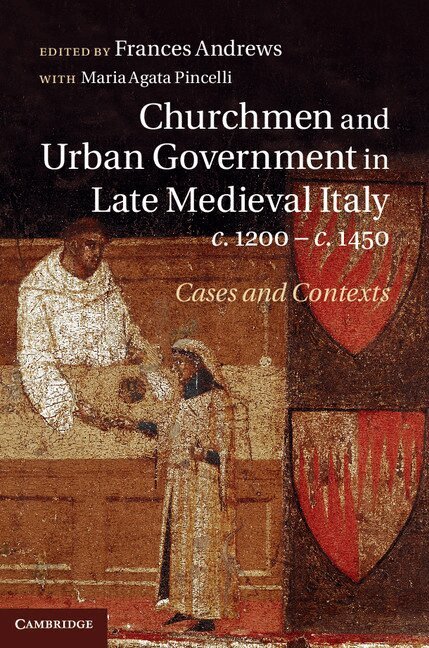
    Churchmen and Urban Government in Late Medieval Italy, c.1200-c.1450

    Cases and Contexts

    AvFrances Andrews

    Inbunden, Engelska, 2013

    1 582 kr

    Beställningsvara. Skickas inom 10-15 vardagar. Fri frakt över 249 kr.

    Beskrivning

    Why, when so driven by the impetus for autonomy, did the city elites of thirteenth-century Italy turn to men bound to religious orders whose purpose and reach stretched far beyond the boundaries of their often disputed territories? Churchmen and Urban Government in Late Medieval Italy, c.1200-c.1450 brings together a team of international contributors to provide the first comparative response to this pivotal question. Presenting a series of urban cases and contexts, the book explores the secular-religious boundaries of the period and evaluates the role of the clergy in the administration and government of Italy's city-states. With an extensive introduction and epilogue, it exposes for consideration the beginnings of the phenomenon, the varying responses of churchmen, the reasons why practices changed and how politics and religious identity relate to each other. This important new study has significant implications for our understanding of power, negotiation, bureaucracy and religious identity.

    Produktinformation

    • Utgivningsdatum:2013-11-28
    • Mått:157 x 235 x 32 mm
    • Vikt:760 g
    • Format:Inbunden
    • Språk:Engelska
    • Antal sidor:426
    • Förlag:Cambridge University Press
    • ISBN:9781107044265

    Utforska kategorier

    • Historia inom Historia och arkeologi

    Mer om författaren

    Professor Frances Andrews has taught Mediaeval History at the University of St Andrews since 1995. In 2007 she founded the St Andrews Institute for Mediaeval Studies.

    Innehållsförteckning

    • 1. Introduction Frances Andrews; 2. Bishop and commune in twelfth-century Cremona: the interface of secular and ecclesiastical power Edward Coleman; Part I. Urban Case Studies: 3. Ut inde melius fiat: the commune of Parma and its religious personnel Frances Andrews; 4. The employment of religious orders in Piacenza between the thirteenth and the fourteenth century Caterina Bruschi; 5. Cremona: a case study Christoph Friedrich Weber; 6. Employment of religious in the administration of the Modena commune from the twelfth to the fifteenth century Pierpaolo Bonacini; 7. Verona: a model case in the study of relationships between members of religious orders and the government of the city Maria Agata Pincelli; 8. The tasks assigned to the Humiliati by the commune of Bergamo (twelfth–fourteenth centuries) Maria Teresa Brolis and Andrea Beneggi; 9. Religious and public life: Lucca, a case study Ignazio del Punta; 10. Pistoia: a case study Sarah Tiboni; 11. Religious in the service of the commune: the case of thirteenth- and fourteenth-century Perugia Giovanna Casagrande; 12. On the trail of religious in the medieval communes of Viterbo and Tuscia Eleonora Rava; 13. Venetian exceptionalism? Lay and religious in Venetian communal governance Dennis Romano; Part II. Ecclesiastial Perspectives: 14. Cistercians as administrators in the thirteenth-century Italian communes Paolo Grillo; 15. The Cistercian monk and the casting counter William R. Day, Jr; 16. Hermits for communes: the Camaldolese in the service of the communes of central and northern Italy in the thirteenth to fifteenth centuries Cécile Caby; 17. Cooperative intervention: sermons supporting the governing authority in fifteenth-century Italy Stefan Visnjevac; Part III. Comparisons beyond Central and Northern Italy: 18. Religious in secular offices in late medieval southern Italy Hubert Houben; 19. Interactions between lay and ecclesiastical offices in Sardinia Andrea Puglia; 20. The abbot and public life in late medieval England Martin Heale; 21. Epilogue Frances Andrews.