• Fri frakt över 249 kr
  • •
  • Snabba leveranser
  • •
  • Billiga böcker
Kundservice

Du är på sajten för privatpersoner.

Företag, bibliotek eller offentlig verksamhet?

Du handlar på classic.bokus.com, där alla dina funktioner finns intakta.
Till classic.bokus.com
Bokus logotyp. Gå till startsidan.
  • Erbjudanden
  • Nyheter
  • Student
  • Topplistor
  • Barn & ungdom
  • Bokus Play
  • E-böcker
  • Pocketböcker
  • Spel & pussel

10% rabatt på allt med kod NYSTART10 →

Sidfot

Mina sidor

    Hjälp

    • Kundservice
    • Vanliga frågor och svar
    • Frakt och leverans
    • Retur vid ångerrätt
    • Reklamera vara
    • Betalning
    • Köpvillkor
    • Allmänna villkor
    • Information om webbplatsens tillgänglighet

    Om Bokus

    • Om oss
    • Pressrum
    • För studenter
    • För företag
    • För bibliotek och offentlig verksamhet
    • För leverantörer
    • Hållbarhet

    Populärt

    • Aktuella erbjudanden
    • Presentkort
    • Studentlitteratur
    • Nya böcker
    • Topplistor
    • Signerade böcker
    • Engelska böcker

    Inspiration

    • Boktips
    • BookTok
    • Populära bokserier
    • Barnbokskaraktärer
    • Populära författare
    Logotyp för Bokus
    Följ oss på Facebook (extern länk)Följ oss på Instagram (extern länk)Följ oss på YouTube (extern länk)Följ oss på TikTok (extern länk)
    bokus @ CookiesAnpassa cookiesIntegritetspolicyKöpvillkor
    Till Citymail hemsida (extern länk)Till Budbee hemsida (extern länk)Till Postnord hemsida (extern länk)Till Schenker hemsida (extern länk)Till Early Bird hemsida (extern länk)Till Walleys hemsida (extern länk)
    1. Ekonomi och Ledarskap
    2. Företagsekonomi
    3. Redovisning och finansiering
    4. Finansiering

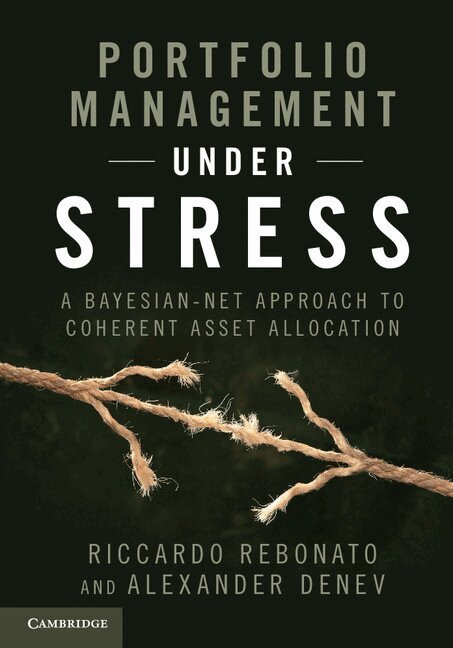
    Portfolio Management under Stress

    A Bayesian-Net Approach to Coherent Asset Allocation

    AvRiccardo Rebonato,Alexander Denev

    Inbunden, Engelska, 2014

    974 kr

    Beställningsvara. Skickas inom 10-15 vardagar. Fri frakt över 249 kr.

    Beskrivning

    Portfolio Management under Stress offers a novel way to apply the well-established Bayesian-net methodology to the important problem of asset allocation under conditions of market distress or, more generally, when an investor believes that a particular scenario (such as the break-up of the Euro) may occur. Employing a coherent and thorough approach, it provides practical guidance on how best to choose an optimal and stable asset allocation in the presence of user specified scenarios or 'stress conditions'. The authors place causal explanations, rather than association-based measures such as correlations, at the core of their argument, and insights from the theory of choice under ambiguity aversion are invoked to obtain stable allocations results. Step-by-step design guidelines are included to allow readers to grasp the full implementation of the approach, and case studies provide clarification. This insightful book is a key resource for practitioners and research academics in the post-financial crisis world.

    Produktinformation

    • Utgivningsdatum:2014-01-09
    • Mått:170 x 244 x 29 mm
    • Vikt:1 070 g
    • Format:Inbunden
    • Språk:Engelska
    • Antal sidor:518
    • Förlag:Cambridge University Press
    • ISBN:9781107048119

    Utforska kategorier

    • Finansiering inom Ekonomi och Ledarskap

    Mer om författaren

    Riccardo Rebonato is Global Head of Rates and FX Analytics at PIMCO, and a visiting lecturer in Mathematical Finance at Oxford University (OCIAM). He has previously held positions as Head of Risk Management and Head of Derivatives Trading at several major international financial institutions. Dr Rebonato has been on the Board of ISDA (2002-2011) and still serves on the Board of GARP (2001 to present). He is the author of several books in finance and an editor for several journals (International Journal of Theoretical and Applied Finance, Journal of Risk, Applied Mathematical Finance, Journal of Risk for Financial Institutions). Alexander Denev is a Senior Team Leader in the Risk Models department at The Royal Bank of Scotland. He is specialised in Credit Risk, Regulations, Asset Allocation and Stress Testing, and has previously worked in management roles at the European Investment Bank, Société Générale and the National Bank of Greece.

    Recensioner i media

    'Rebonato and Denev have demolished the status quo with their radical extension of best-practice portfolio management. The key is to integrate realistic 'extreme' scenarios into risk assessment, and they show how to use Bayesian networks to characterize precisely those scenarios. The book is rigorous yet completely practical, and reading it is a pleasure, with the 'Rebonato touch' evident throughout.' Francis X. Diebold, Paul F. and Warren S. Miller Professor of Economics, and Professor of Finance and Statistics, University of Pennsylvania

    Innehållsförteckning

    • Part I. Our Approach in Its Context: 1. How this book came about; 2. Correlation and causation; 3. Definitions and notation; Part II. Dealing with Extreme Events: 4. Predictability and causality; 5. Econophysics; 6. Extreme value theory; Part III. Diversification and Subjective Views; 7. Diversification in modern portfolio theory; 8. Stability: a first look; 9. Diversification and stability in the Black–Litterman model; 10. Specifying scenarios: the Meucci approach; Part IV. How We Deal with Exceptional Events: 11. Bayesian nets; 12. Building scenarios for causal Bayesian nets; Part V. Building Bayesian Nets in Practice: 13. Applied tools; 14. More advanced topics: elicitation; 15. Additional more advanced topics; 16. A real-life example: building a realistic Bayesian net; Part VI. Dealing with Normal-Times Returns: 17. Identification of the body of the distribution; 18. Constructing the marginals; 19. Choosing and fitting the copula; Part VII. Working with the Full Distribution: 20. Splicing the normal and exceptional distributions; 21. The links with CAPM and private valuations; Part VIII. A Framework for Choice: 22. Applying expected utility; 23. Utility theory: problems and remedies; Part IX. Numerical Implementation: 24. Optimizing the expected utility over the weights; 25. Approximations; Part X. Analysis of Portfolio Allocation: 26. The full allocation procedure: a case study; 27. Numerical analysis; 28. Stability analysis; 29. How to use Bayesian nets: our recommended approach; 30. Appendix I. The links with the Black–Litterman approach; 31. Appendix II. Marginals, copulae and the symmetry of return distributions; Index.