Inbunden, Engelska, 2014
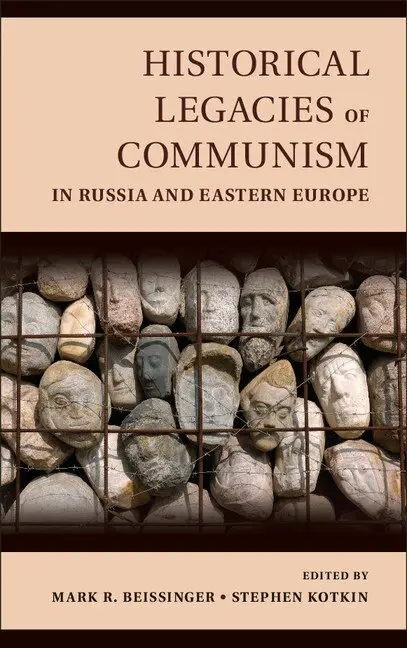
Historical Legacies of Communism in Russia and Eastern Europe
Av Mark Beissinger, Stephen Kotkin
1628 kr
Beställningsvara. Skickas inom 5-8 vardagar. Fri frakt över 249 kr.
Beskrivning
Produktinformation
- Utgivningsdatum: 2014-07-07
- Mått: 152 x 229 x 16 mm
- Vikt: 450 g
- Format: Inbunden
- Språk: Engelska
- Antal sidor: 258
- Förlag: Cambridge University Press
- ISBN: 9781107054172
Utforska kategorier
Mer om författaren
Mark R. Beissinger is Henry W. Putnam Professor of Politics at Princeton University and Director of the Princeton Institute for International and Regional Studies. He served on the faculties of Harvard University and the University of Wisconsin, Madison. Beissinger served as the founding Director of Wisconsin's Center for Russia, East Europe, and Central Asia and later as Chair of Wisconsin's Political Science Department, where he also held a Glenn B. and Cleone Orr Hawkins Chair. He has served as President of the American Association for the Advancement of Slavic Studies and as Vice-Chair of the National Council for Eurasian and East European Research. He is the author or editor of four books and numerous journal articles. His book Nationalist Mobilization and the Collapse of the Soviet State (Cambridge, 2002) won three awards: the 2003 Woodrow Wilson Foundation Award, presented by the American Political Science Association; the 2003 Mattei Dogan Award, presented by the Society for Comparative Research; and the 2003 Award for Best Book on European Politics, presented by the Organized Section on European Politics and Society of the American Political Science Association. Stephen Kotkin holds a joint appointment in the history department and the Woodrow Wilson School for Public and International Affairs at Princeton University. He has served as Vice Dean of the Woodrow Wilson School, and he established Princeton's Global History initiative. From 1996 until 2009 Kotkin directed Princeton's Program in Russian and Eurasian Studies. From 2003 until 2007, he was a member and then chair of the editorial board of Princeton University Press. He currently serves on the core editorial committee of the flagship journal World Politics. He has published four books and has worked as the regular book reviewer for the New York Times Sunday Business section (2006-9) and as a consultant in post-communist higher education for various foundations.
Recensioner i media
'In the aftermath of revolutionary change, whether after the French revolution or the collapse of communism in the Soviet Union and Eastern Europe, scholars have invariably launched heated debates about whether the new order is indeed new or if it demonstrates some continuities with the past. In sharp and welcome contrast to these usually ambling discussions, this edited volume takes a rigorous approach to the assessment of historical legacies by defining the term in a precise way that makes the phenomenon both testable and falsifiable and by identifying factors and mechanisms that account for when, where, how, and to what extent such legacies have shaped the institutions and practices of post-communist Europe and Eurasia.' Valerie Bunce, Aaron Binenkorb Professor of International Studies and Professor of Government, Cornell University
Betyg & recensioner
0 recensioner
Inga recensioner tillgängliga.