• Fri frakt över 249 kr
  • •
  • Snabba leveranser
  • •
  • Billiga böcker
Kundservice

Du är på sajten för privatpersoner.

Företag, bibliotek eller offentlig verksamhet?

Du handlar på classic.bokus.com, där alla dina funktioner finns intakta.
Till classic.bokus.com
Bokus logotyp. Gå till startsidan.
  • Erbjudanden
  • Nyheter
  • Student
  • Topplistor
  • Barn & ungdom
  • Bokus Play
  • E-böcker
  • Pocketböcker
  • Spel & pussel

10% rabatt på allt med kod: NYSTART10 →

Sidfot

Mina sidor

    Hjälp

    • Kundservice
    • Vanliga frågor och svar
    • Frakt och leverans
    • Retur vid ångerrätt
    • Reklamera vara
    • Betalning
    • Köpvillkor
    • Allmänna villkor
    • Information om webbplatsens tillgänglighet

    Om Bokus

    • Om oss
    • Pressrum
    • För studenter
    • För företag
    • För bibliotek och offentlig verksamhet
    • För leverantörer
    • Hållbarhet

    Populärt

    • Aktuella erbjudanden
    • Presentkort
    • Studentlitteratur
    • Nya böcker
    • Topplistor
    • Signerade böcker
    • Engelska böcker

    Inspiration

    • Boktips
    • BookTok
    • Populära bokserier
    • Barnbokskaraktärer
    • Populära författare
    Logotyp för Bokus
    Följ oss på Facebook (extern länk)Följ oss på Instagram (extern länk)Följ oss på YouTube (extern länk)Följ oss på TikTok (extern länk)
    bokus @ CookiesAnpassa cookiesIntegritetspolicyKöpvillkor
    Till Citymail hemsida (extern länk)Till Budbee hemsida (extern länk)Till Postnord hemsida (extern länk)Till Schenker hemsida (extern länk)Till Early Bird hemsida (extern länk)Till Walleys hemsida (extern länk)
    1. Naturvetenskap och teknik
    2. Geovetenskap
    3. Geovetenskap

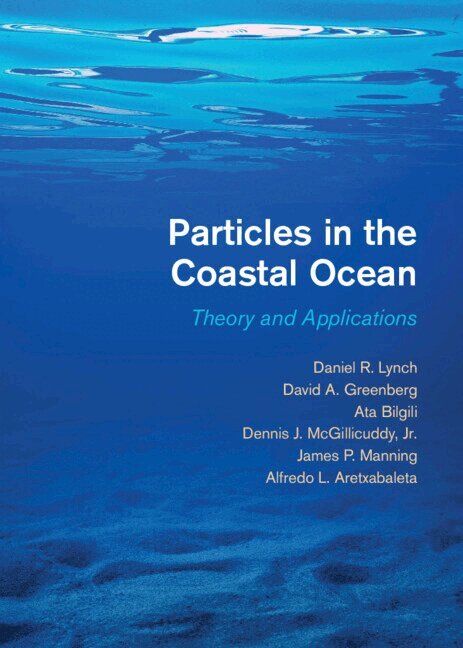
    Particles in the Coastal Ocean

    Theory and Applications

    AvDaniel R. Lynch,David A. Greenberg

    Inbunden, Engelska, 2014

    1 469 kr

    Beställningsvara. Skickas inom 10-15 vardagar. Fri frakt över 249 kr.

    Beskrivning

    The coastal ocean comprises the semi-enclosed seas on the continental shelf, including estuaries and extending to the shelf break. This region is the focus of many serious concerns, including coastal inundation by tides, storm surges or sea level change; fisheries and aquaculture management; water quality; harmful algal blooms; planning of facilities (such as power stations); port development and maintenance; and oil spills. This book addresses modeling and simulation of the transport, evolution and fate of particles (physical and biological) in the coastal ocean. It is the first to summarize the state of the art in this field and direct it toward diverse applications, for example in measuring and monitoring sediment motion, oil spills and larval ecology. This is an invaluable textbook and reference work for advanced students and researchers in oceanography, geophysical fluid dynamics, marine and civil engineering, computational science and environmental science.

    Produktinformation

    • Utgivningsdatum:2014-12-22
    • Mått:184 x 260 x 28 mm
    • Vikt:1 320 g
    • Format:Inbunden
    • Språk:Engelska
    • Antal sidor:560
    • Förlag:Cambridge University Press
    • ISBN:9781107061750

    Utforska kategorier

    • Geovetenskap inom Naturvetenskap och teknik

    Mer om författaren

    Daniel R. Lynch is MacLean Professor of Engineering at Dartmouth College and Adjunct Scientist at the Woods Hole Oceanographic Institution. He has published extensively on simulation methods in coastal oceanography. He co-founded the Gordon Research Conference in Coastal Ocean Modeling, was executive director of the Regional Association for Research on the Gulf of Maine, and served on the executive committee of the US GLOBEC Northwest Atlantic Program. He developed the Numerical Methods Laboratory at Dartmouth around the theme of interdisciplinary computational engineering and authored the textbook Numerical Solution of Partial Differential Equations for Environmental Scientists and Engineers (2005). He is co-editor of Professions and the Common Good (2006), a contributor to the Civil Engineering Body of Knowledge for the 21st Century (2008), and author of Sustainable Natural Resource Management for Scientists and Engineers (Cambridge University Press, 2009). David A. Greenberg is a research scientist at the Canadian Department of Fisheries and Oceans, Bedford Institute of Oceanography. His research includes model development and application for tidal circulation and resonance, sediment transport, intertidal flooding, sea level rise, tidal power, biological productivity, and aquaculture. Major shelf areas he covers include the Fundy-Maine region, the Newfoundland shelf, the Scotian shelf, and the Canadian Arctic Archipelago. Ata Bilgili is Associate Professor of Coastal and Ocean Engineering at Istanbul Technical University. His research includes the application of particle techniques to wind-dominated coastal systems, the optimization of particle-tracking methods on high-performance computing platforms, particle applications to sediment and water-quality problems, and simulation of intertidal inundation processes. His additional interests include unstructured mesh generation, environmental contingency planning for ports and harbors, and the advancement of maritime-engineering education. Dennis J. McGillicuddy, Jr is a senior scientist in the department of applied ocean physics and engineering at the Woods Hole Oceanographic Institution. His primary research interest is the interface between fluid dynamics and the biology of the sea. He is a recipient of the Office of Naval Research Young Investigator Award (1998), the American Society of Limnology and Oceanography's Lindeman Award (2000) and the University of Miami's Rosenstiel Award (2008). He is author or co-author of more than one hundred refereed publications. Dr McGillicuddy has been very active in the oversight of large interdisciplinary oceanographic programs on both national and international levels, having served on the scientific steering committees of the Joint Global Ocean Flux Study, the Global Ecosystem Dynamics Program, and the Global Ecology and Oceanography of Harmful Algal Blooms. He currently serves as deputy director of the Woods Hole Center for Oceans and Human Health. James P. Manning has been at National Oceanic and Atmospheric Administration's (NOAA) Northeast Fisheries Science Center for more than twenty-five years. He has been responsible for building and deploying low-cost observation systems throughout the Gulf of Maine and the southern New England shelf. His web-served data archive includes more than five million hourly values of moored bottom temperatures and more than a million kilometers of surface-drifter tracks and is used in data assimilation and validation for coastal models. These efforts have assisted in describing the physical oceanographic environments of critical offshore spawning grounds, helping biologists explain the variability in recruitment of larvae and its relationship to physical conditions. He conceived and coordinates the eMOLT program, a partnership with New England fishermen's associations to monitor the sea floor by instrumenting lobster traps. Alfredo L. Aretxabaleta is a physical oceanographer with Integrated Statistics, Inc., of Woods Hole, MA. He is working with the US Geological Survery (USGS) Science Center in Woods Hole on sediment transport problems in the coastal ocean, including cohesion and resuspension processes. He has worked on observation, data assimilation, and real-time forecasting relative to harmful algal blooms and groundfish recruitment in the western Atlantic, and he has worked with Institut de Ciencias del Mar (Barcelona) in the satellite sensing of ocean salinity. He is one of the authors of Project Earth Science: Physical Oceanography (2011).

    Recensioner i media

    'Particles in the Coastal Ocean deserves a place on the reference bookshelves of every oceanographer, and others such as advanced undergraduate and graduate students, fisheries and pollution researchers, coastal engineers, and fluid modeling simulation experts. This excellent book reveals the gap that existed previously, in both its subject and its quality.' J. J. P. Smith, CMOS Bulletin

    Innehållsförteckning

    • Part I. Background: 1. The coastal ocean; 2. Drifters and their numerical simulation; 3. Probability and statistics – a primer; 4. Dispersion by random walk; 5. BCs, boundary layers, sources; 6. Turbulence closure; Part II. Elements: 7. Meshes: interpolation, navigation, and fields; 8. Particles and fields; Part III. Applications: 9. Noncohesive sediment – dense particles; 10. Oil – chemically active particles; 11. Individual-based models – biotic particles; Part IV. Appendixes.