• Fri frakt över 249 kr
  • •
  • Snabba leveranser
  • •
  • Billiga böcker
Kundservice

Du är på sajten för privatpersoner.

Företag, bibliotek eller offentlig verksamhet?

Du handlar på classic.bokus.com, där alla dina funktioner finns intakta.
Till classic.bokus.com
Bokus logotyp. Gå till startsidan.
  • Erbjudanden
  • Nyheter
  • Student
  • Topplistor
  • Barn & ungdom
  • Bokus Play
  • E-böcker
  • Pocketböcker
  • Spel & pussel

10% studentrabatt med kod TERM26

Sidfot

Mina sidor

    Hjälp

    • Kundservice
    • Vanliga frågor och svar
    • Frakt och leverans
    • Retur vid ångerrätt
    • Reklamera vara
    • Betalning
    • Köpvillkor
    • Allmänna villkor
    • Information om webbplatsens tillgänglighet

    Om Bokus

    • Om oss
    • Pressrum
    • För studenter
    • För företag
    • För bibliotek och offentlig verksamhet
    • För leverantörer
    • Hållbarhet

    Populärt

    • Aktuella erbjudanden
    • Presentkort
    • Studentlitteratur
    • Nya böcker
    • Topplistor
    • Signerade böcker
    • Engelska böcker

    Inspiration

    • Boktips
    • BookTok
    • Populära bokserier
    • Barnbokskaraktärer
    • Populära författare
    Logotyp för Bokus
    Följ oss på Facebook (extern länk)Följ oss på Instagram (extern länk)Följ oss på YouTube (extern länk)Följ oss på TikTok (extern länk)
    bokus @ CookiesAnpassa cookiesIntegritetspolicyKöpvillkor
    Till Citymail hemsida (extern länk)Till Budbee hemsida (extern länk)Till Postnord hemsida (extern länk)Till Schenker hemsida (extern länk)Till Early Bird hemsida (extern länk)Till Walleys hemsida (extern länk)
    1. Språk och ordböcker
    2. Språkvetenskap och lingvistik

    The Social Life of the Japanese Language

    Cultural Discourse and Situated Practice

    AvShigeko Okamoto,Janet S. Shibamoto-Smith

    Inbunden, Engelska, 2016

    1 669 kr

    Beställningsvara. Skickas inom 10-15 vardagar. Fri frakt över 249 kr.

    Beskrivning

    Why are different varieties of the Japanese language used differently in social interaction, and how are they perceived? How do honorifics operate to express diverse affective stances, such as politeness? Why have issues of gendered speech been so central in public discourse, and how are they reflected and refracted in language use as social practice? This book examines Japanese sociolinguistic phenomena from a fascinating new perspective, focusing on the historical construction of language norms and its relationship to actual language use in contemporary Japan. This socio-historically sensitive account stresses the different choices which have shaped Japanese and Western sociolinguistics and how varieties of Japanese, honorifics and politeness, and gendered language have emerged in response to the socio-political landscape in which a modernizing Japan found itself.

    Produktinformation

    • Utgivningsdatum:2016-08-04
    • Mått:158 x 235 x 23 mm
    • Vikt:650 g
    • Format:Inbunden
    • Språk:Engelska
    • Antal sidor:352
    • Förlag:Cambridge University Press
    • ISBN:9781107072268

    Utforska kategorier

    • Språkvetenskap och lingvistik inom Språk och ordböcker

    Mer om författaren

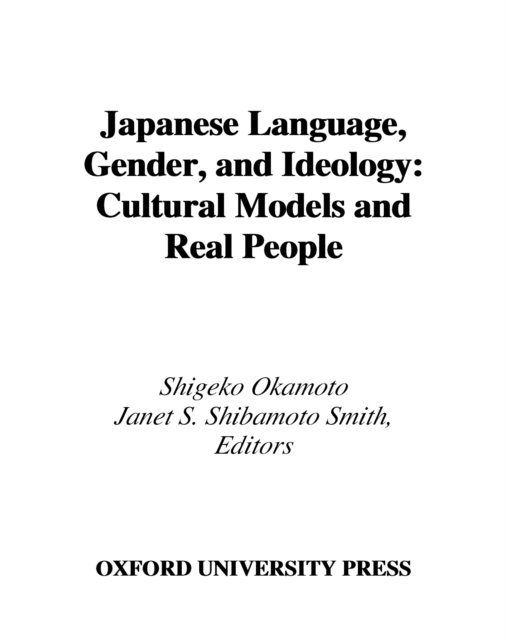
    Shigeko Okamoto is a Professor in the Department of Languages and Applied Linguistics at the University of California, Santa Cruz. She received her PhD in Linguistics from the University of California, Berkeley, in 1986. Her areas of research include sociolinguistics, discourse analysis, pragmatics and functional grammar. She has published numerous articles on Japanese language and gender, honorifics, regional dialects, grammaticization and grammatical constructions. She is a co-editor of the volume Japanese Language, Gender, and Ideology (with Janet S. Shibamoto-Smith, 2004). Her latest interest is in semiotic diversity and multiplicity and its relationship to language ideologies. Janet S. Shibamoto-Smith is Professor Emerita in the Department of Anthropology at the University of California, Davis. She is a specialist in Japanese language, society and culture, with an emphasis on the interaction between ideology and practice. Publications include Japanese Women's Language (1985) and the edited volume Japanese Language, Gender, and Ideology (with Shigeko Okamoto, 2004). Her latest long-time interest in language and gender has merged with studies of contemporary cultural models of femininity/masculinity and romantic love through textual analyses of popular print and televisual materials.

    Innehållsförteckning

    • Introduction: toward a dynamic model of Japanese language and social meaning; Part I. The Notion of Nihongo; 1. Standard Japanese and its others: building the national language; 1.1 Standard Japanese: a building block in the making of modern Japan; 1.2 Representations of standard and regional Japanese in the media; 2. Standard and regional Japanese: diversity in attitudes and practice; 2.1 Diversity in attitudes toward standard and regional Japanese; 2.2 Meanings of standard and regional Japanese in practice: negotiating norms; Part II. Japanese Honorifics and Japanese 'Politeness': 3. Keigo: from official policy to popular pedagogy; 3.1 Institutional policy on honorific form and use: constructing the Japanese essence; 3.2 Keigo for the public: authoritative accounts by linguists; 3.3 Honorifics: popular pedagogy; 4. Keigo: diversity in attitudes and practice; 4.1 Diversity in attitudes toward honorifics; 4.2 Honorifics in practice: negotiating norms; Part III. Japanese Language and Gender: 5. Gendered Japanese: normative linguistic femininity and masculinity; 5.1 Dominant narratives of gendered Japanese: a historical perspective; 5.2 Media representations of gendered speech in contemporary Japan; 6. Gendered Japanese: diversity in attitudes and practice; 6.1 Diversity in attitude toward gendered speech; 6.2 Meanings of gendered speech in practice: negotiating norms; Reflections: looking backward, looking forward.