• Fri frakt över 249 kr
  • •
  • Snabba leveranser
  • •
  • Billiga böcker
Kundservice

Du är på sajten för privatpersoner.

Företag, bibliotek eller offentlig verksamhet?

Du handlar på classic.bokus.com, där alla dina funktioner finns intakta.
Till classic.bokus.com
Bokus logotyp. Gå till startsidan.
  • Erbjudanden
  • Nyheter
  • Student
  • Topplistor
  • Barn & ungdom
  • Bokus Play
  • E-böcker
  • Pocketböcker
  • Spel & pussel

10% rabatt på allt med kod: NYSTART10 →

Sidfot

Mina sidor

    Hjälp

    • Kundservice
    • Vanliga frågor och svar
    • Frakt och leverans
    • Retur vid ångerrätt
    • Reklamera vara
    • Betalning
    • Köpvillkor
    • Allmänna villkor
    • Information om webbplatsens tillgänglighet

    Om Bokus

    • Om oss
    • Pressrum
    • För studenter
    • För företag
    • För bibliotek och offentlig verksamhet
    • För leverantörer
    • Hållbarhet

    Populärt

    • Aktuella erbjudanden
    • Presentkort
    • Studentlitteratur
    • Nya böcker
    • Topplistor
    • Signerade böcker
    • Engelska böcker

    Inspiration

    • Boktips
    • BookTok
    • Populära bokserier
    • Barnbokskaraktärer
    • Populära författare
    Logotyp för Bokus
    Följ oss på Facebook (extern länk)Följ oss på Instagram (extern länk)Följ oss på YouTube (extern länk)Följ oss på TikTok (extern länk)
    bokus @ CookiesAnpassa cookiesIntegritetspolicyKöpvillkor
    Till Citymail hemsida (extern länk)Till Budbee hemsida (extern länk)Till Postnord hemsida (extern länk)Till Schenker hemsida (extern länk)Till Early Bird hemsida (extern länk)Till Walleys hemsida (extern länk)
    1. Språk och ordböcker
    2. Språkvetenskap och lingvistik

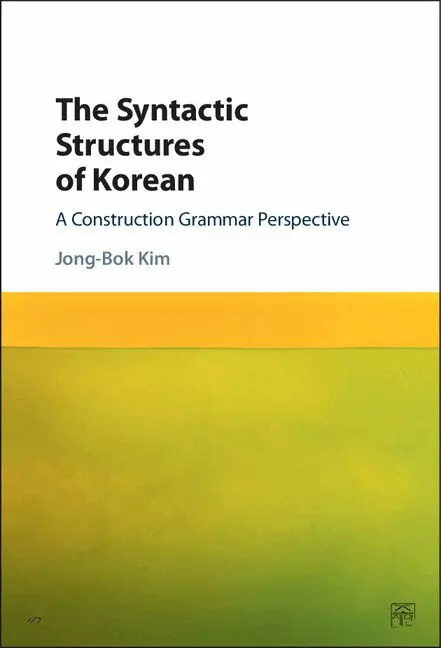
    The Syntactic Structures of Korean

    A Construction Grammar Perspective

    AvJong-Bok Kim

    Inbunden, Engelska, 2016

    1 665 kr

    Beställningsvara. Skickas inom 10-15 vardagar. Fri frakt över 249 kr.

    Fler format och utgåvor

    Häftad

    408 kr

    Beskrivning

    Covering both core and peripheral phenomena, The Syntactic Structures of Korean is a concrete and precise grammar of the language. Based on the framework of Sign-based Construction Grammar, it provides a grammar of Korean which is computationally implementable and cognitively viable. Remarkably broad, yet in-depth, it is an outstanding analysis of Korean syntax and semantics which will be welcomed by those working in linguistics and the Korean language.

    Produktinformation

    • Utgivningsdatum:2016-07-28
    • Mått:160 x 237 x 26 mm
    • Vikt:660 g
    • Format:Inbunden
    • Språk:Engelska
    • Antal sidor:360
    • Förlag:Cambridge University Press
    • ISBN:9781107103757

    Utforska kategorier

    • Språkvetenskap och lingvistik inom Språk och ordböcker

    Mer om författaren

    Professor Jong-Bok Kim teaches at the School of English at Kyung Hee University, Seoul. He received his PhD in Linguistics from Stanford University, California in 1996 and works on the syntax and semantics of Korean and English. He has published numerous papers and is also co-author of English Syntax: An Introduction (2008), which is used worldwide as an undergraduate and graduate textbook.

    Innehållsförteckning

    • 1. Theoretical foundations; 1.1 Derivational vs constraint-based views; 1.2 Linguistic signs and feature structures; 1.3 Constructions and multiple inheritance hierarchy; 1.4 Korean phrase structure grammar; 1.5 Conclusion; 2. Noun phrases; 2.1 Basic properties; 2.2 Basic ordering restrictions; 2.3 Simple NP structures; 2.4 NPs with phrasal determinants; 2.5 Conclusion; 3. Case system; 3.1 Two basic issues; 3.2 Forming case-marked nominal expressions; 3.3 A construction-based case assignment system; 3.4 Complex case phenomena and predictions; 3.5 Case assignments in the auxiliary constructions; 3.6 Case assignments to the non-nominal expression; 3.7 Conclusion; 4. Auxiliary and complex predicate constructions; 4.1 Types of auxiliary verbs and morphosyntactic properties; 4.2 Three possible analyses; 4.3 Syntactic properties of complex predicates; 4.4 A construction-based analysis; 4.5 Conclusion; 5. Gerundive phrases and mixed categories; 5.1 Verbal and nominal properties; 5.2 Derivational analyses; 5.3 Inflectional treatment of the gerundive nominalizers; 5.4 A mixed-category analysis; 5.5 Consequences and further issues; 5.6 Conclusion; 6. Verbal nouns and light verb construction; 6.1 Basic properties; 6.2 On the properties of the light verb; 6.3 On the mixed properties of the verbal nouns; 6.4 Mixed properties within a multiple inheritance system; 6.5 Argument composition and syntactic structures; 6.6 Dissolving variations; 6.7 Conclusion; 7. Serial verb construction; 7.1 Serial verbs and general properties; 7.2 Grammatical properties of the SVCs; 7.3 Types of serial verb constructions; 7.4 A construction-based view; 7.5 Conclusion; 8. Negation and related phenomena; 8.1 Short form and long form negation; 8.2 Reviews on the derivational view; 8.3 Short form negation; 8.4 Long form negation; 8.5 Implications of the analysis; 8.6 Conclusion; 9. Coordination; 9.1 Two main types of nominal and verbal coordination; 9.2 Lexical properties of the coordinators; 9.3 More on the syntactic aspects; 9.4 Symmetric and asymmetric verbal coordination; 9.5 Conclusion; 10. Passive constructions; 10.1 Lexical vs syntactic passive; 10.2 Auxiliary syntactic passive; 10.3 A construction-based analysis; 10.4 Light-verb syntactic passive; 10.5 Inchoative and stative pseudo syntactic passive; 10.6 Conclusion; 11. Wh-questions; 11.1 Dependency between Wh-question and Q-particle; 11.2 Wh-questions and indefiniteness; 11.3 A construction-based analysis; 11.4 Key predictions; 11.5 Conclusion; 12. Topic and focus constructions; 12.1 Topic constructions; 12.2 Encoding focus; 12.3 Focus constructions; 12.4 Conclusion; 13. Relative clause constructions; 13.1 Some key properties; 13.2 Morpho-syntax of Korean relatives; 13.3 Standard relative clauses: externally headed; 13.4 Double relative clauses; 13.5 Internally headed relative clauses; 13.6 Pseudo-relative clauses; 13.7 Concluding remarks; 14. Honorification; 14.1 Basic properties of honorific agreement; 14.2 Honorification in a constraint-based grammar; 14.3 Conclusion.