• Fri frakt över 249 kr
  • •
  • Snabba leveranser
  • •
  • Billiga böcker
Kundservice

Du är på sajten för privatpersoner.

Företag, bibliotek eller offentlig verksamhet?

Du handlar på classic.bokus.com, där alla dina funktioner finns intakta.
Till classic.bokus.com
Bokus logotyp. Gå till startsidan.
  • Erbjudanden
  • Nyheter
  • Student
  • Topplistor
  • Barn & ungdom
  • Bokus Play
  • E-böcker
  • Pocketböcker
  • Spel & pussel

10% rabatt på allt med kod: NYSTART10 →

Sidfot

Mina sidor

    Hjälp

    • Kundservice
    • Vanliga frågor och svar
    • Frakt och leverans
    • Retur vid ångerrätt
    • Reklamera vara
    • Betalning
    • Köpvillkor
    • Allmänna villkor
    • Information om webbplatsens tillgänglighet

    Om Bokus

    • Om oss
    • Pressrum
    • För studenter
    • För företag
    • För bibliotek och offentlig verksamhet
    • För leverantörer
    • Hållbarhet

    Populärt

    • Aktuella erbjudanden
    • Presentkort
    • Studentlitteratur
    • Nya böcker
    • Topplistor
    • Signerade böcker
    • Engelska böcker

    Inspiration

    • Boktips
    • BookTok
    • Populära bokserier
    • Barnbokskaraktärer
    • Populära författare
    Logotyp för Bokus
    Följ oss på Facebook (extern länk)Följ oss på Instagram (extern länk)Följ oss på YouTube (extern länk)Följ oss på TikTok (extern länk)
    bokus @ CookiesAnpassa cookiesIntegritetspolicyKöpvillkor
    Till Citymail hemsida (extern länk)Till Budbee hemsida (extern länk)Till Postnord hemsida (extern länk)Till Schenker hemsida (extern länk)Till Early Bird hemsida (extern länk)Till Walleys hemsida (extern länk)
    1. Naturvetenskap och teknik
    2. Matematik och naturvetenskap
    3. Astronomi

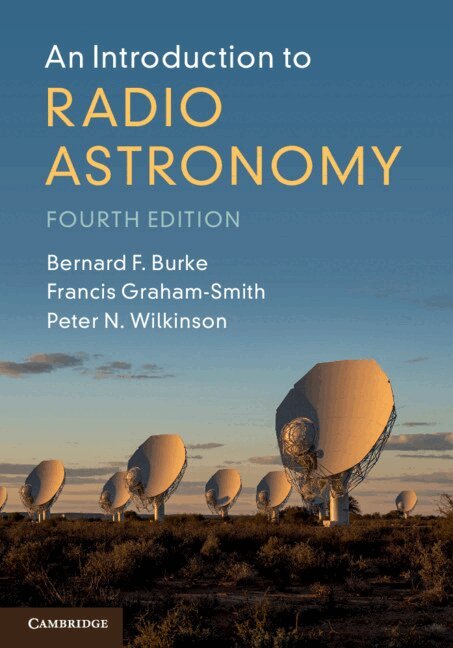
    An Introduction to Radio Astronomy

    AvBernard F. Burke,Francis Graham-Smith

    Inbunden, Engelska, 2019

    1 002 kr

    Beställningsvara. Skickas inom 10-15 vardagar. Fri frakt över 249 kr.

    Fler format och utgåvor

    Häftad

    740 kr

    Beskrivning

    Radio astronomy is an active and rapidly expanding field due to advances in computing techniques, with several important new instruments on the horizon. This text provides a thorough introduction to radio astronomy and its contribution to our understanding of the universe, bridging the gap between basic introductions and research-level treatments. It begins by covering the fundamentals physics of radio techniques, before moving on to single-dish telescopes and aperture synthesis arrays. Fully updated and extensively rewritten, the fourth edition places greater emphasis on techniques, with detailed discussion of interferometry in particular, and comprehensive coverage of digital techniques in the appendices. The science sections are fully revised, with new author Peter N. Wilkinson bringing added expertise to the sections on pulsars, quasars and active galaxies. Spanning the entirety of radio astronomy, this is an engaging introduction for students and researchers approaching radio astronomy for the first time.

    Produktinformation

    • Utgivningsdatum:2019-08-22
    • Mått:178 x 253 x 27 mm
    • Vikt:1 200 g
    • Format:Inbunden
    • Språk:Engelska
    • Antal sidor:540
    • Upplaga:4
    • Förlag:Cambridge University Press
    • ISBN:9781107189416

    Utforska kategorier

    • Astronomi inom Naturvetenskap och teknik

    Mer om författaren

    Bernard F. Burke was William A. M. Burden Professor of Astrophysics, formerly of the Radio Astronomy Group of the Massachusetts Institute of Technology (MIT) Research Laboratory of Electronics, and principal investigator at the MIT Kavli Institute for Astrophysics and Space Research. He was elected a member of the United States National Academy of Sciences in 1970, and served as the American Astronomical Society (AAS) President from 1986 to 1988. He and Kenneth Franklin discovered Jupiter as a source of radio waves while working at the Carnegie Institution for Science; and he was part of the 6-member team credited with the 1988 discovery of the first Einstein ring. Francis Graham-Smith, FRS is Emeritus Professor at the University of Manchester. He was Astronomer Royal from 1982 to 1990 and Director of Jodrell Bank Observatory between 1981 and 1988. As Director of the Royal Greenwich Observatory between 1975 and 1981, Graham-Smith instituted the UK optical observatory on La Palma. In his student days at the University of Cambridge he made the first accurate locations for cosmic radio sources, leading to their identification. At Jodrell Bank he discovered radio emission from cosmic ray showers, and continues to work on pulsars, in which he discovered the polarization of the radio pulses. He is a co-author of Pulsar Astronomy (Cambridge, 4th edition, 2012). Peter N. Wilkinson is Emeritus Professor of Radio Astronomy at the University of Manchester. He has been involved in the development of radio telescopes at Jodrell Bank Observatory since 1967, including five years spent at a combination of the California Institute of Technology and the US National Radio Astronomy Observatory. In 1991 he wrote the first published paper describing the scientific rationale and outline structure of a radio interferometer array which developed into the Square Kilometre Array (SKA) project. He is now working on a novel radio telescope to map the sky with a precision ten times better than achieved by the discoverers of the Cosmic Microwave Background. He is a leading member of the UK's Newton Project, which teaches radio astronomy to students world-wide.

    Recensioner i media

    'An engaging introduction for students and researchers approaching this observational field for the first time.' All About Space

    Innehållsförteckning

    • Preface; Acknowledgements; Part I. The Emission, Propagation, and Detection of Radio Waves: 1. The role of radio observations in astronomy; 2. Emission and general properties of radio waves; 3. Spectral lines; 4. Radio wave propagation; 5. The nature of the received radio signal; 6. Radiometers; 7. Spectrometers and polarimeters; Part II. Radio Telescopes and Aperture Synthesis: 8. Single-aperture radio telescopes; 9. The basics of interferometry; 10. Aperture synthesis; 11. Further interferometric techniques; Part III. The Radio Cosmos: 12. The Sun and the planets; 13. Stars and nebulae; 14. The Milky Way galaxy; 15. Pulsars; 16. Active galaxies; 17. The radio contributions to cosmology; Appendix 1. Fourier transforms; Appendix 2. Celestial coordinates and time; Appendix 3. Digitization; Appendix 4. Calibrating polarimeters; Appendix 5. Spherical harmonics; References; Index.