• Fri frakt över 249 kr
  • •
  • Snabba leveranser
  • •
  • Billiga böcker
Kundservice

Du är på sajten för privatpersoner.

Företag, bibliotek eller offentlig verksamhet?

Du handlar på classic.bokus.com, där alla dina funktioner finns intakta.
Till classic.bokus.com
Bokus logotyp. Gå till startsidan.
  • Erbjudanden
  • Student
  • Topplistor
  • Barn & ungdom
  • Bokus Play
  • E-böcker
  • Ljudböcker
  • Pocketböcker
  • Spel och pussel

5% studentrabatt – använd koden KURSBOK27 →

Sidfot

Mina sidor

    Hjälp

    • Kundservice
    • Vanliga frågor och svar
    • Frakt och leverans
    • Retur vid ångerrätt
    • Reklamera vara
    • Betalning
    • Köpvillkor
    • Allmänna villkor
    • Information om webbplatsens tillgänglighet

    Om Bokus

    • Om oss
    • Pressrum
    • För studenter
    • För företag
    • För bibliotek och offentlig verksamhet
    • För leverantörer
    • Hållbarhet

    Populärt

    • Aktuella erbjudanden
    • Presentkort
    • Studentlitteratur
    • Nya böcker
    • Topplistor
    • Signerade böcker
    • Engelska böcker

    Inspiration

    • Boktips
    • BookTok
    • Barnbokskaraktärer
    • Populära författare
    Logotyp för Bokus
    Följ oss på Facebook (extern länk)Följ oss på Instagram (extern länk)Följ oss på YouTube (extern länk)Följ oss på TikTok (extern länk)
    bokus @ CookiesAnpassa cookiesIntegritetspolicyKöpvillkor
    Till Citymail hemsida (extern länk)Till Budbee hemsida (extern länk)Till Postnord hemsida (extern länk)Till Schenker hemsida (extern länk)Till Early Bird hemsida (extern länk)Till Walleys hemsida (extern länk)
    1. Språk och ordböcker
    2. Språkvetenskap och lingvistik

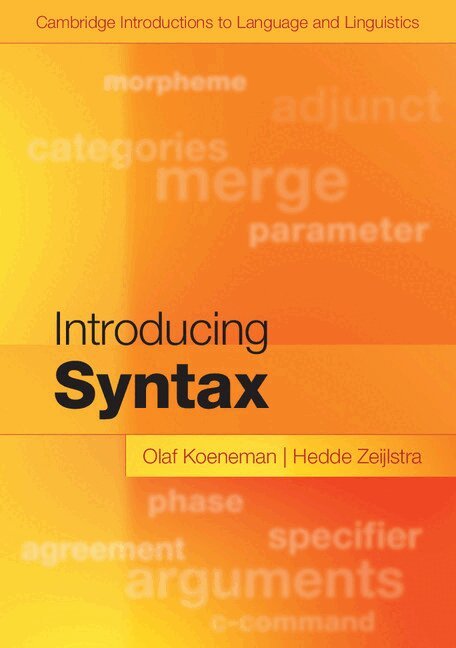
    Introducing Syntax

    AvOlaf Koeneman,Hedde Zeijlstra

    Häftad, Engelska, 2017

    Del i serien Cambridge Introductions to Language and Linguistics

    365 kr

    Beställningsvara. Skickas inom 7-10 vardagar. Fri frakt över 249 kr.

    Fler format och utgåvor

    Inbunden

    1 028 kr

    Beskrivning

    Syntax is the system of rules that we subconsciously follow when we build sentences. Whereas the grammar of English (or other languages) might look like a rather chaotic set of arbitrary patterns, linguistic science has revealed that these patterns can actually be understood as the result of a small number of grammatical principles. This lively introductory textbook is designed for undergraduate students in linguistics, English and modern languages with relatively little background in the subject, offering the necessary tools for the analysis of phrases and sentences while at the same time introducing state-of-the-art syntactic theory in an accessible and engaging way. Guiding students through a variety of intriguing puzzles, striking facts and novel ideas, Introducing Syntax presents contemporary insights into syntactic theory in one clear and coherent narrative, avoiding unnecessary detail and enabling readers to understand the rationale behind technicalities. Aids to learning include highlighted key terms, suggestions for further reading and numerous exercises, placing syntax in a broader grammatical perspective.

    Produktinformation

    • Utgivningsdatum:2017-04-13
    • Mått:174 x 247 x 15 mm
    • Vikt:630 g
    • Format:Häftad
    • Språk:Engelska
    • Serie:Cambridge Introductions to Language and Linguistics
    • Antal sidor:314
    • Förlag:Cambridge University Press
    • ISBN:9781107480643

    Utforska kategorier

    • Språkvetenskap och lingvistik inom Språk och ordböcker

    Mer om författaren

    Olaf Koeneman is Assistant Professor of English Linguistics at Radboud Universiteit Nijmegen. Hedde Zeijlstra is Professor of English Syntax at Georg-August-Universität Göttingen.

    Recensioner i media

    'A lucid, accessible, and deeply informed introduction that leads carefully to substantial understanding of language and linguistics. A very welcome contribution.' Noam Chomsky, Massachusetts Institute of Technology

    Innehållsförteckning

    • Introduction. The language machine; 1. Categories and features; 2. Merge; 3. Theta theory; 4. Case theory; 5. Agreement and uninterpretable features; 6. Movement and remerge; 7. Unifying movement and agreement; 8. Syntax and morphology; 9. Syntax and phonology; 10. Syntax and semantics; Afterword; Glossary; References; Index.