• Fri frakt över 249 kr
  • •
  • Snabba leveranser
  • •
  • Billiga böcker
Kundservice

Du är på sajten för privatpersoner.

Företag, bibliotek eller offentlig verksamhet?

Du handlar på classic.bokus.com, där alla dina funktioner finns intakta.
Till classic.bokus.com
Bokus logotyp. Gå till startsidan.
  • Erbjudanden
  • Nyheter
  • Student
  • Topplistor
  • Barn & ungdom
  • Bokus Play
  • E-böcker
  • Pocketböcker
  • Spel & pussel

10% rabatt på allt med kod: NYSTART10 →

Sidfot

Mina sidor

    Hjälp

    • Kundservice
    • Vanliga frågor och svar
    • Frakt och leverans
    • Retur vid ångerrätt
    • Reklamera vara
    • Betalning
    • Köpvillkor
    • Allmänna villkor
    • Information om webbplatsens tillgänglighet

    Om Bokus

    • Om oss
    • Pressrum
    • För studenter
    • För företag
    • För bibliotek och offentlig verksamhet
    • För leverantörer
    • Hållbarhet

    Populärt

    • Aktuella erbjudanden
    • Presentkort
    • Studentlitteratur
    • Nya böcker
    • Topplistor
    • Signerade böcker
    • Engelska böcker

    Inspiration

    • Boktips
    • BookTok
    • Populära bokserier
    • Barnbokskaraktärer
    • Populära författare
    Logotyp för Bokus
    Följ oss på Facebook (extern länk)Följ oss på Instagram (extern länk)Följ oss på YouTube (extern länk)Följ oss på TikTok (extern länk)
    bokus @ CookiesAnpassa cookiesIntegritetspolicyKöpvillkor
    Till Citymail hemsida (extern länk)Till Budbee hemsida (extern länk)Till Postnord hemsida (extern länk)Till Schenker hemsida (extern länk)Till Early Bird hemsida (extern länk)Till Walleys hemsida (extern länk)
    1. Ekonomi och Ledarskap
    2. Nationalekonomi

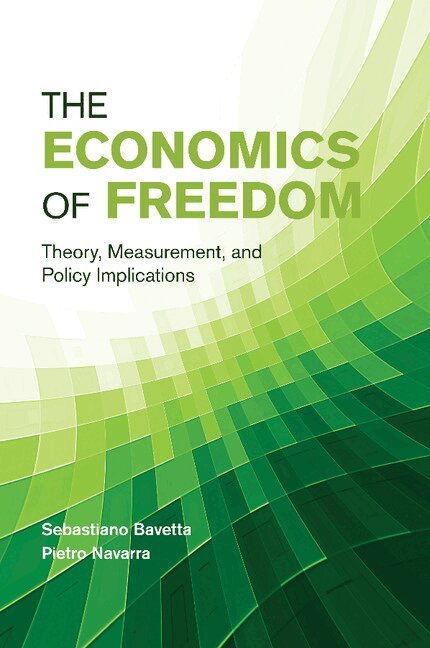
    The Economics of Freedom

    Theory, Measurement, and Policy Implications

    AvSebastiano Bavetta,Pietro Navarra

    Häftad, Engelska, 2015

    477 kr

    Beställningsvara. Skickas inom 10-15 vardagar. Fri frakt över 249 kr.

    Fler format och utgåvor

    Inbunden

    1 458 kr

    Beskrivning

    What is freedom? Can we measure it? Does it affect policy? This book develops an original measure of freedom called 'Autonomy Freedom', consistent with J. S. Mill's view of autonomy, and applies it to issues in policy and political design. The work pursues three aims. First, it extends classical liberalism beyond exclusive reliance on negative freedom so as to take autonomous behavior explicitly into account. Second, it grounds on firm conceptual foundations a new standard in the measurement of freedom that can be fruitfully coupled with existing gauges. Third, it shows empirically that individual preferences for redistribution and cross-country differences in welfare spending in Organisation for Economic Co-operation and Development (OECD) countries are driven by the degree of 'autonomy freedom' that individuals enjoy. By means of an interdisciplinary approach and a sophisticated econometric methodology, the book takes an explicit stand in defense of freedom and sets the basis for a liberalism based upon people's actions and institutions.

    Produktinformation

    • Utgivningsdatum:2015-03-05
    • Mått:152 x 229 x 13 mm
    • Vikt:330 g
    • Format:Häftad
    • Språk:Engelska
    • Antal sidor:222
    • Förlag:Cambridge University Press
    • ISBN:9781107507241

    Utforska kategorier

    • Nationalekonomi inom Ekonomi och Ledarskap

    Mer om författaren

    Sebastiano Bavetta is Professor of Economics at the University of Palermo, Italy and visiting professor of Economics and Philosophy at the University of Pennsylvania, USA. He is a research associate at the Centre for Philosophy of Natural and Social Science (CPNSS) at the London School of Economics (UK), where he obtained his Ph.D. in Philosophy of Economics. He has published in The Journal of Theoretical Politics, Social Choice and Welfare, Theory and Decision, Constitutional Political Economy and Economic Affairs, among others. He co-authored a book in Italian (Liberalism in the Era of Conflict, 2008). His research interests focus on policy and institutional design and on the measurement of freedom and its policy and political implications. He has extensive political and administrative experiences in the government of the city of Palermo as well as in Italian local governmental agencies. Pietro Navarra is Professor of Public Economics at the University of Messina, Italy, where he is also Deputy Vice-Chancellor in charge of the budget. He is also visiting professor at the University of Pennsylvania, USA and a research associate at the Centre for Philosophy of Natural and Social Science (CPNSS) at the London School of Economics. He holds a Ph.D. in Economics from the University of Buckingham. Professor Navarra co-edited with Ram Mudambi and Giuseppe Sobbrio Rules and Reason: Perspectives on Constitutional Political Economy (Cambridge University Press, 2001) and coauthored with them Rules, Choice, and Strategy: The Political Economy of Italian Electoral Reform (2001). He has published more than fifty articles in journals such as the Journal of International Business Studies, Public Choice, the European Journal of Political Economy, Oxford Bulletin of Economics and Statistics, Economics of Governance and Applied Economics. His research interests embrace the measurement of freedom, the relation between political institutions and economic reform and the interplay between individual empowerment, entrepreneurship and economic growth.

    Recensioner i media

    'The Economics of Freedom is an interesting work of both philosophically inspired social science and empirically informed political philosophy. The authors construct a measure of autonomy freedom on the basis of data in the World Value Survey and compare how worldwide differences in attitudes correlate with social welfare policies. This book will intrigue researchers in comparative politics, welfare economics, political economy, and political philosophy.' Luc Bovens, London School of Economics

    Innehållsförteckning

    • 1. Introduction; Part I. Concepts and Tools: 2. Choice and freedom; 3. Measuring autonomy freedom; 4. The empirical measure of autonomy; Part II. Autonomy Freedom and the Welfare State: 5. Why redistribute?; 6. Autonomy freedom and redistribution; 7. Autonomy freedom and welfare spending; 8. Conclusion.