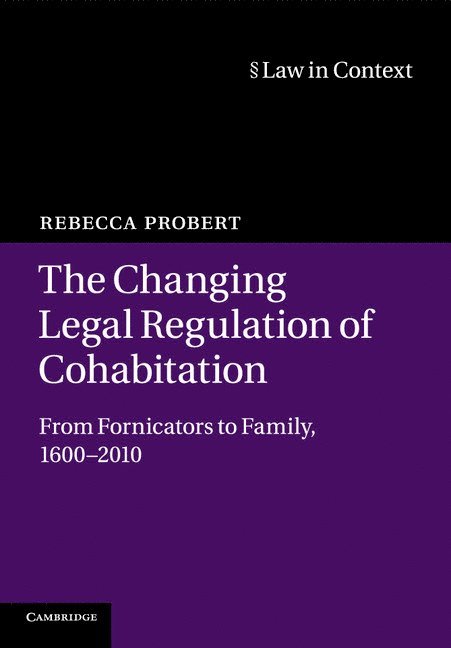
Häftad, Engelska, 2015
The Changing Legal Regulation of Cohabitation
From Fornicators to Family, 1600-2010
Del i serien Law in Context
643 kr
Beställningsvara. Skickas inom 5-8 vardagar. Fri frakt över 249 kr.
Beskrivning
This book has three key aims: first, to show how the legal treatment of cohabiting couples has changed over the past four centuries, from punishment as fornicators in the seventeenth century to eventual acceptance as family in the late twentieth; second, to chart how the language used to refer to cohabitation has changed over time and how different terms influenced policy debates and public perceptions; and, third, to estimate the extent of cohabitation in earlier centuries. To achieve this it draws on hundreds of reported and unreported cases as well as legislation, policy papers and debates in Parliament; thousands of newspaper reports and magazine articles; and innovative cohort studies that provide new and more reliable evidence as to the incidence (or rather the rarity) of cohabitation in eighteenth- and nineteenth-century England. It concludes with a consideration of the relationship between legal regulation and social trends.
Produktinformation
- Utgivningsdatum: 2015-07-02
- Mått: 170 x 243 x 17 mm
- Vikt: 520 g
- Format: Häftad
- Språk: Engelska
- Serie: Law in Context
- Antal sidor: 300
- Förlag: Cambridge University Press
- ISBN: 9781107536302
Utforska kategorier
Mer om författaren
Rebecca Probert is Professor of Law at the University of Warwick. She has taught family law for over a decade and published widely on both contemporary family law and its history.
Recensioner i media
'Rebecca Probert's scholarly account of the law's response to heterosexual cohabitation over the past four centuries is both a very important contribution to cohabitation scholarship and a great pleasure to read … Probert displays great resourcefulness in her determination to clarify the difficult questions that she addresses.' John Mee, Legal Studies
Betyg & recensioner
0 recensioner
Inga recensioner tillgängliga.