• Fri frakt över 249 kr
  • •
  • Snabba leveranser
  • •
  • Billiga böcker
Kundservice

Du är på sajten för privatpersoner.

Företag, bibliotek eller offentlig verksamhet?

Du handlar på classic.bokus.com, där alla dina funktioner finns intakta.
Till classic.bokus.com
Bokus logotyp. Gå till startsidan.
  • Erbjudanden
  • Student
  • Topplistor
  • Barn & ungdom
  • Bokus Play
  • E-böcker
  • Ljudböcker
  • Pocketböcker
  • Spel & pussel

Upp till 25% på utvalda nyheter →

Sidfot

Mina sidor

    Hjälp

    • Kundservice
    • Vanliga frågor och svar
    • Frakt och leverans
    • Retur vid ångerrätt
    • Reklamera vara
    • Betalning
    • Köpvillkor
    • Allmänna villkor
    • Information om webbplatsens tillgänglighet

    Om Bokus

    • Om oss
    • Pressrum
    • För studenter
    • För företag
    • För bibliotek och offentlig verksamhet
    • För leverantörer
    • Hållbarhet

    Populärt

    • Aktuella erbjudanden
    • Presentkort
    • Studentlitteratur
    • Nya böcker
    • Topplistor
    • Signerade böcker
    • Engelska böcker

    Inspiration

    • Boktips
    • BookTok
    • Populära bokserier
    • Barnbokskaraktärer
    • Populära författare
    Logotyp för Bokus
    Följ oss på Facebook (extern länk)Följ oss på Instagram (extern länk)Följ oss på YouTube (extern länk)Följ oss på TikTok (extern länk)
    bokus @ CookiesAnpassa cookiesIntegritetspolicyKöpvillkor
    Till Citymail hemsida (extern länk)Till Budbee hemsida (extern länk)Till Postnord hemsida (extern länk)Till Schenker hemsida (extern länk)Till Early Bird hemsida (extern länk)Till Walleys hemsida (extern länk)
    1. Samhälle och politik
    2. Politik och statsskick

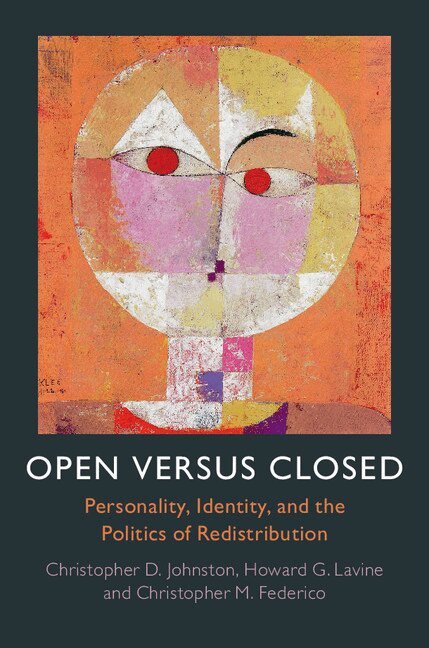
    Open versus Closed

    Personality, Identity, and the Politics of Redistribution

    AvChristopher D. Johnston,Howard G. Lavine

    Häftad, Engelska, 2017

    353 kr

    Beställningsvara. Skickas inom 7-10 vardagar. Fri frakt över 249 kr.

    Fler format och utgåvor

    Inbunden

    1 161 kr

    Beskrivning

    Debates over redistribution, social insurance, and market regulation are central to American politics. Why do some citizens prefer a large role for government in the economic life of the nation while others wish to limit its reach? In Open versus Closed, the authors argue that these preferences are not always what they seem. They show how deep-seated personality traits underpinning the culture wars over race, immigration, law and order, sexuality, gender roles, and religion shape how citizens think about economics, binding cultural and economic inclinations together in unexpected ways. Integrating insights from both psychology and political science - and twenty years of observational and experimental data - the authors reveal the deeper motivations driving attitudes toward government. They find that for politically active citizens these attitudes are not driven by self-interest, but by a desire to express the traits and cultural commitments that define their identities.

    Produktinformation

    • Utgivningsdatum:2017-02-20
    • Mått:152 x 228 x 18 mm
    • Vikt:440 g
    • Format:Häftad
    • Språk:Engelska
    • Antal sidor:294
    • Förlag:Cambridge University Press
    • ISBN:9781107546424

    Utforska kategorier

    • Politik och statsskick inom Samhälle och politik

    Mer om författaren

    Christopher D. Johnston is Assistant Professor of Political Science at Duke University, North Carolina. He is co-author of The Ambivalent Partisan: How Critical Loyalty Promotes Democracy (with Howard G. Lavine and Marco R. Steenbergen, 2012), which won both the David O. Sears award from the International Society of Political Psychology and the Robert E. Lane award from the American Political Science Association. His peer-reviewed research has been published in the American Journal of Political Science, the Journal of Politics, Public Opinion Quarterly, Political Psychology, American Politics Research, and elsewhere. Howard G. Lavine is Arleen C. Carlson Professor of Political Science at the University of Minnesota and Director of the Center for the Study of Political Psychology. He is co-author of The Ambivalent Partisan: How Critical Loyalty Promotes Democracy (with Christopher D. Johnston and Marco R. Steenbergen, 2012), which won both the David O. Sears award from the International Society of Political Psychology and the Robert E. Lane award from the American Political Science Association. He has published articles in The American Political Science Review, the American Journal of Political Science, the Journal of Personality and Social Psychology, the New York Times, and elsewhere. He is past editor of Political Psychology and current editor of Advances in Political Psychology and Routledge Studies in Political Psychology. Christopher M. Federico is Professor of Psychology and Political Science at the University of Minnesota. His research interests include ideology and belief systems, the psychological foundations of political preferences, and intergroup attitudes. He is the recipient of numerous awards, including the 2007 International Society of Political Psychology (ISPP) Erik Erikson Award for Early Career Achievements, the 2007 ISPP Roberta Sigel Junior Scholar Paper Award, and the International Society for Justice Research's 2009 Morton Deutsch Award. His research has been published in the Journal of Personality and Social Psychology, the American Journal of Political Science, Public Opinion Quarterly, Political Psychology, and elsewhere.

    Recensioner i media

    'A creative and original investigation into the puzzling, polarizing and often contradictory personality-based forces driving economic policy preferences. It's a fascinating read and a major contribution to the field of political psychology.' Kevin Smith, University of Nebraska, Lincoln

    Innehållsförteckning

    • List of tables; List of figures; Acknowledgements; 1. Personality and the foundations of economic preferences; 2. The psychology of ideology; 3. A dual-pathway model of openness and economic preferences; 4. Testing the reversal hypothesis; 5. Openness and partisan-ideological sorting; 6. Openness and elite influence; 7. Political engagement and self-interest; 8. Personality and American democracy; Appendices; Bibliography; Index.