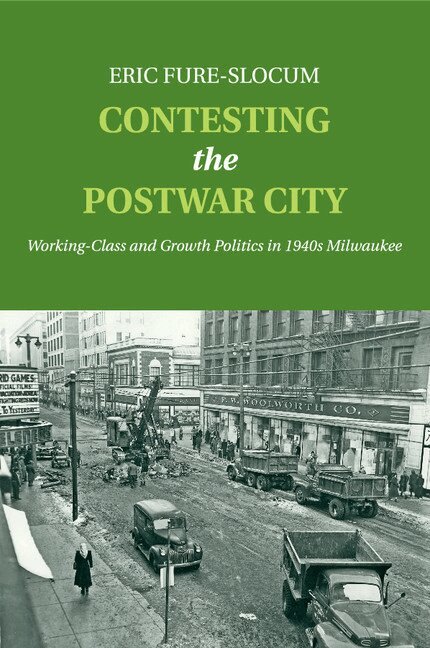
Häftad, Engelska, 2015
Contesting the Postwar City
Working-Class and Growth Politics in 1940s Milwaukee
649 kr
Beställningsvara. Skickas inom 5-8 vardagar. Fri frakt över 249 kr.
Beskrivning
Produktinformation
- Utgivningsdatum: 2015-08-06
- Mått: 153 x 230 x 24 mm
- Vikt: 600 g
- Format: Häftad
- Språk: Engelska
- Antal sidor: 412
- Förlag: Cambridge University Press
- ISBN: 9781107554849
Utforska kategorier
Mer om författaren
Eric Fure-Slocum teaches History and American Studies at St Olaf College. His research and writing focuses on twentieth-century US urban and working-class history, with an interest in the shaping of American political culture and the political economy.
Recensioner i media
'Eric Fure-Slocum takes an in-depth look at the politics and public life of 1940s Milwaukee. He resurrects the history of long-forgotten struggles over public entertainment, housing shortages, and downtown modernization, and uses them to illustrate two very different visions of postwar urban development: what he calls 'working-class' versus 'growth' politics. Related analyses should be written for many US cities, but Milwaukee is a particularly good site for such study. The city had a powerful and vibrant socialist governing tradition dating from 1910, as well as an emerging energetic business coalition committed to reshaping what it saw as an outmoded, inefficient city. Fure-Slocum has us rethink the periodization of twentieth-century urban history as he seamlessly takes us from the depression era to wartime to reconversion, showing how Milwaukeeans reshaped their city and their lives.' Margo Anderson, University of Wisconsin, Milwaukee
Betyg & recensioner
0 recensioner
Inga recensioner tillgängliga.