• Fri frakt över 249 kr
  • •
  • Snabba leveranser
  • •
  • Billiga böcker
Kundservice

Du är på sajten för privatpersoner.

Företag, bibliotek eller offentlig verksamhet?

Du handlar på classic.bokus.com, där alla dina funktioner finns intakta.
Till classic.bokus.com
Bokus logotyp. Gå till startsidan.
  • Erbjudanden
  • Nyheter
  • Student
  • Topplistor
  • Barn & ungdom
  • Bokus Play
  • E-böcker
  • Pocketböcker
  • Spel & pussel

10% rabatt på allt med kod: NYSTART10 →

Sidfot

Mina sidor

    Hjälp

    • Kundservice
    • Vanliga frågor och svar
    • Frakt och leverans
    • Retur vid ångerrätt
    • Reklamera vara
    • Betalning
    • Köpvillkor
    • Allmänna villkor
    • Information om webbplatsens tillgänglighet

    Om Bokus

    • Om oss
    • Pressrum
    • För studenter
    • För företag
    • För bibliotek och offentlig verksamhet
    • För leverantörer
    • Hållbarhet

    Populärt

    • Aktuella erbjudanden
    • Presentkort
    • Studentlitteratur
    • Nya böcker
    • Topplistor
    • Signerade böcker
    • Engelska böcker

    Inspiration

    • Boktips
    • BookTok
    • Populära bokserier
    • Barnbokskaraktärer
    • Populära författare
    Logotyp för Bokus
    Följ oss på Facebook (extern länk)Följ oss på Instagram (extern länk)Följ oss på YouTube (extern länk)Följ oss på TikTok (extern länk)
    bokus @ CookiesAnpassa cookiesIntegritetspolicyKöpvillkor
    Till Citymail hemsida (extern länk)Till Budbee hemsida (extern länk)Till Postnord hemsida (extern länk)Till Schenker hemsida (extern länk)Till Early Bird hemsida (extern länk)Till Walleys hemsida (extern länk)
    1. Samhälle och politik
    2. Politik och statsskick
    3. Internationella relationer

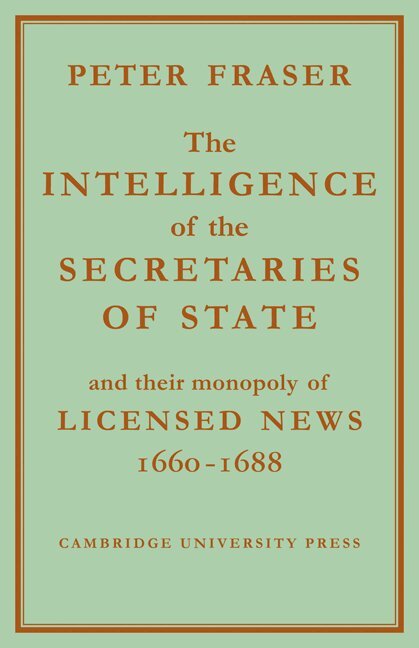
    The Intelligence of the Secretaries of State

    And their Monopoly of Licensed News

    AvPeter Fraser

    Häftad, Engelska, 2011

    463 kr

    Beställningsvara. Skickas inom 10-15 vardagar. Fri frakt över 249 kr.

    Beskrivning

    In Restoration England the Secretaries of State performed the duties not only of a Home and Foreign Secretary combined, but also of a modern news-agency. This is a 1956 study in a vital function of seventeenth-century government, in communications, the dissemination of news, and the growth of articulate public opinion. Mr Fraser first shows the scope and nature of the Secretaries' responsibility for providing the Council with intelligence, their control of the Post Office, and their use of spies among the Dissenters and in Holland during the Dutch wars. The second part covers the continental system of news exchange, the Secretaries' correspondence with ambassadors, consuls, customs officers, postmasters and other, details of posts, and the sources of news published in the London Gazette and the newsletters from Whitehall.

    Produktinformation

    • Utgivningsdatum:2011-06-30
    • Mått:140 x 216 x 12 mm
    • Vikt:260 g
    • Format:Häftad
    • Språk:Engelska
    • Antal sidor:202
    • Förlag:Cambridge University Press
    • ISBN:9781107608856

    Utforska kategorier

    • Internationella relationer inom Samhälle och politik

    Innehållsförteckning

    • Preface; List of illustrations; Introduction; Part I. The Secretaries as the Eyes of the Government: 1. The use of spies; 2. The control of the Post Office; 3. Money spent on intelligence; 4. The newsletter system; Part II. The Secretaries as the Voice of the Government: 5. The official printed news, 1660–88; 6. The earliest Continental gazettes and English newsbooks; 7. Prevailing attitude to printed news at the Restoration; 8. Henry Muddiman introduces the official newsletter; 9. Its raison d'être; 10. Continental newsletters; 11. Their connexion with the gazettes, illustrated by the example of Abraham Casteleyn; 12. Muddiman's relations with Williamson, the Under-Secretary. The latter brings out the London Gazette; 13. Both Secretaries share responsibility for the London Gazette; 14. The kind of news in the Gazette and the official newsletters; Part III. Foreign Correspondents: 15. The business of the Secretary's office; 16. Foreign posts used by the Secretaries; 17. Arlington's foreign correspondents; 18. The use of cover addresses; Part IV. The Division of the Fleet, 1666: 19. Circumstances of the division of the fleet, and the ensuing defeat; 20. Attributed by a Commons Committee to a false intelligence; 21. William Coventry and Arlington particularly blamed at Clarendon's investigation; 22. Errors in the Committee's report on the 'want of intelligence' from abroad; 23. Albemarle's information at the time the fleet was divided; 24. The political background to the investigation by the Commons into the miscarriage of the Second Dutch War; 25. Secretaries Morice and Arlington give an account of the intelligence; 26. Williamson produces Arlington's papers; 27. The effectiveness of Arlington's intelligence assessed, in detecting the state of Dutch naval preparations, and de Beaufort's movements, prior to the division; 28. Opinions as to the relative efficiency of Thurloe; Part V. The Intelligence in the Third Dutch War: 29. Williamson's journal commenced before the outbreak of war; 30. The missions of spies sent into Holland: Taylor, Langley, John Scott, Vernon, Nipho, Gelson; 31. The Dutch fail to prevent a conjunction of the French and English fleets; 32. Settled informants in Holland: Casteleyn, Timens, Hildebrand, Vlieyger, Boeckell, Tucker; 33. Operations of the packet-boats to Holland; 34. Movements of the fleets. The English and French surprised in Solebay; 35. Other spying activities in Holland; 36. Estimate of the Secretary's expenditure on intelligence in wartime; Part VI. The Secretaries and the Unlicensed News-Mongers: 37. The growth of an organized public opinion; 38. Eventual failure of the Secretaries to uphold their monopoly of licensed laws; 39. Some justification for the monopoly; 40. The growth of coffee-houses, and the attempt to suppress them; 41. The unlicensed newsletter writers; 42. Expiry of the Licensing Act, 1679, and the Whig newspapers; 43. Changing attitudes to printed parliamentary proceedings; 44. Some Whig newsletter writers; 45. Effects of the London Penny Post; 46. The increasing resources of the unlicensed newswriters: their part in the Revolution. The end of the Secretaries' monopoly of licensed news; Appendices; Bibliography; Index.