• Fri frakt över 249 kr
  • •
  • Snabba leveranser
  • •
  • Billiga böcker
Kundservice

Du är på sajten för privatpersoner.

Företag, bibliotek eller offentlig verksamhet?

Du handlar på classic.bokus.com, där alla dina funktioner finns intakta.
Till classic.bokus.com
Bokus logotyp. Gå till startsidan.
  • Erbjudanden
  • Nyheter
  • Student
  • Topplistor
  • Barn & ungdom
  • Bokus Play
  • E-böcker
  • Pocketböcker
  • Spel & pussel

Må bättre, för mindre! Upp till 50% rabatt på hälsoböcker

Sidfot

Mina sidor

    Hjälp

    • Kundservice
    • Vanliga frågor och svar
    • Frakt och leverans
    • Retur vid ångerrätt
    • Reklamera vara
    • Betalning
    • Köpvillkor
    • Allmänna villkor
    • Information om webbplatsens tillgänglighet

    Om Bokus

    • Om oss
    • Pressrum
    • För studenter
    • För företag
    • För bibliotek och offentlig verksamhet
    • För leverantörer
    • Hållbarhet

    Populärt

    • Aktuella erbjudanden
    • Presentkort
    • Studentlitteratur
    • Nya böcker
    • Topplistor
    • Signerade böcker
    • Engelska böcker

    Inspiration

    • Boktips
    • BookTok
    • Populära bokserier
    • Barnbokskaraktärer
    • Populära författare
    Logotyp för Bokus
    Följ oss på Facebook (extern länk)Följ oss på Instagram (extern länk)Följ oss på YouTube (extern länk)Följ oss på TikTok (extern länk)
    bokus @ CookiesAnpassa cookiesIntegritetspolicyKöpvillkor
    Till Citymail hemsida (extern länk)Till Budbee hemsida (extern länk)Till Postnord hemsida (extern länk)Till Schenker hemsida (extern länk)Till Early Bird hemsida (extern länk)Till Walleys hemsida (extern länk)
    1. Ekonomi och Ledarskap
    2. Nationalekonomi

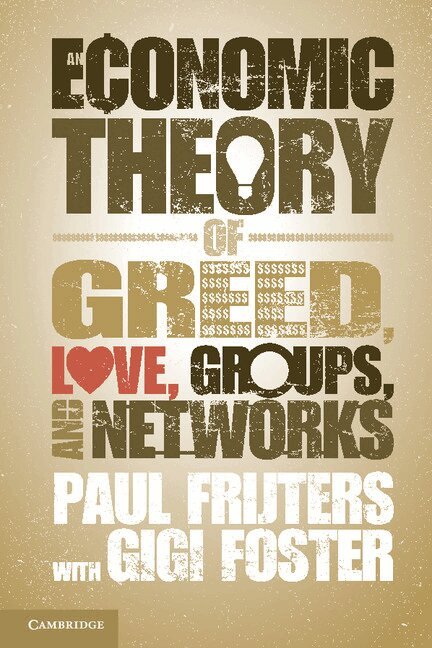
    An Economic Theory of Greed, Love, Groups, and Networks

    AvPaul Frijters

    Häftad, Engelska, 2013

    496 kr

    Beställningsvara. Skickas inom 10-15 vardagar. Fri frakt över 249 kr.

    Fler format och utgåvor

    Inbunden

    1 609 kr

    Beskrivning

    Why are people loyal? How do groups form and how do they create incentives for their members to abide by group norms? Until now, economics has only been able to partially answer these questions. In this groundbreaking work, Paul Frijters presents a new unified theory of human behaviour. To do so, he incorporates comprehensive yet tractable definitions of love and power, and the dynamics of groups and networks, into the traditional mainstream economic view. The result is an enhanced view of human societies that nevertheless retains the pursuit of self-interest at its core. This book provides a digestible but comprehensive theory of our socioeconomic system, which condenses its immense complexity into simplified representations. The result both illuminates humanity's history and suggests ways forward for policies today, in areas as diverse as poverty reduction and tax compliance.

    Produktinformation

    • Utgivningsdatum:2013-03-07
    • Mått:152 x 229 x 20 mm
    • Vikt:720 g
    • Format:Häftad
    • Språk:Engelska
    • Antal sidor:444
    • Förlag:Cambridge University Press
    • ISBN:9781107678941

    Utforska kategorier

    • Nationalekonomi inom Ekonomi och Ledarskap

    Mer om författaren

    Professor Paul Frijters is a Professor of Economics at the University of Queensland. He was elected 'Best Economist under 40 in Australia' by the Economic Society of Australia for 2009–11, and his work consistently ranks in the top 4% of downloaded and cited economic research in the world. Professor Frijters has undertaken research in a wide variety of fields, including happiness and well-being, migration in China, behavioural economics and health economics. The findings of his research feature regularly in the global media. Dr Gigi Foster is a senior lecturer in the School of Economics within the Australian School of Business at the University of New South Wales. Her research focuses primarily on decisions related to human capital, with a particular emphasis on social influence and behavioural economics.

    Recensioner i media

    'What I particularly like about this book is the serious and fruitful extension of the homo oeconomicus by including love and loyalty. An attentive reader will greatly benefit from this easy-to-read book.' Bruno S. Frey, Distinguished Professor of Behavioural Science, Warwick Business School

    Innehållsförteckning

    • Part I. Greed and Love: 1. Individual materialism, organizations, and power; 2. Love: the missing building block; Part II. Groups, Power and the Development of Institutions: 3. Groups and power; 4. Networks and markets; Part III. Implications and Examples: 5. The aggregate view; 6. Theoretical appendix.