• Fri frakt över 249 kr
  • •
  • Snabba leveranser
  • •
  • Billiga böcker
Kundservice

Du är på sajten för privatpersoner.

Företag, bibliotek eller offentlig verksamhet?

Du handlar på classic.bokus.com, där alla dina funktioner finns intakta.
Till classic.bokus.com
Bokus logotyp. Gå till startsidan.
  • Erbjudanden
  • Nyheter
  • Student
  • Topplistor
  • Barn & ungdom
  • Bokus Play
  • E-böcker
  • Pocketböcker
  • Spel & pussel

10% rabatt på allt med kod NYSTART10 →

Sidfot

Mina sidor

    Hjälp

    • Kundservice
    • Vanliga frågor och svar
    • Frakt och leverans
    • Retur vid ångerrätt
    • Reklamera vara
    • Betalning
    • Köpvillkor
    • Allmänna villkor
    • Information om webbplatsens tillgänglighet

    Om Bokus

    • Om oss
    • Pressrum
    • För studenter
    • För företag
    • För bibliotek och offentlig verksamhet
    • För leverantörer
    • Hållbarhet

    Populärt

    • Aktuella erbjudanden
    • Presentkort
    • Studentlitteratur
    • Nya böcker
    • Topplistor
    • Signerade böcker
    • Engelska böcker

    Inspiration

    • Boktips
    • BookTok
    • Populära bokserier
    • Barnbokskaraktärer
    • Populära författare
    Logotyp för Bokus
    Följ oss på Facebook (extern länk)Följ oss på Instagram (extern länk)Följ oss på YouTube (extern länk)Följ oss på TikTok (extern länk)
    bokus @ CookiesAnpassa cookiesIntegritetspolicyKöpvillkor
    Till Citymail hemsida (extern länk)Till Budbee hemsida (extern länk)Till Postnord hemsida (extern länk)Till Schenker hemsida (extern länk)Till Early Bird hemsida (extern länk)Till Walleys hemsida (extern länk)
    1. Naturvetenskap och teknik
    2. Matematik och naturvetenskap
    3. Fysik
    4. Materietillstånd

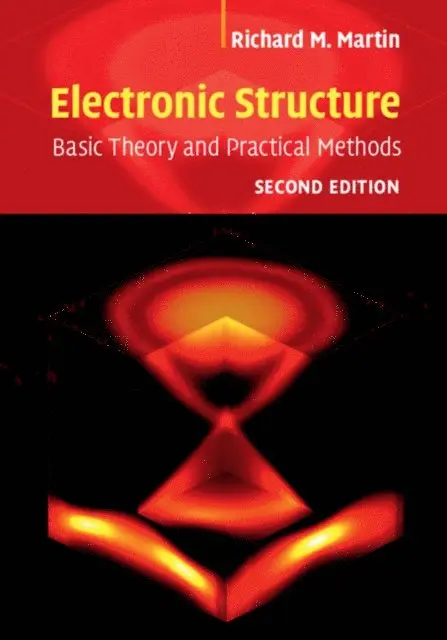
    Electronic Structure

    Basic Theory and Practical Methods

    AvRichard M. Martin

    Inbunden, Engelska, 2020

    1 029 kr

    Beställningsvara. Skickas inom 10-15 vardagar. Fri frakt över 249 kr.

    Fler format och utgåvor

    E-bok

    1 200 kr

    E-bok

    1 203 kr

    Beskrivning

    The study of electronic structure of materials is at a momentous stage, with new computational methods and advances in basic theory. Many properties of materials can be determined from the fundamental equations, and electronic structure theory is now an integral part of research in physics, chemistry, materials science and other fields. This book provides a unified exposition of the theory and methods, with emphasis on understanding each essential component. New in the second edition are recent advances in density functional theory, an introduction to Berry phases and topological insulators explained in terms of elementary band theory, and many new examples of applications. Graduate students and research scientists will find careful explanations with references to original papers, pertinent reviews, and accessible books. Each chapter includes a short list of the most relevant works and exercises that reveal salient points and challenge the reader.
    Produktinformation

    • Utgivningsdatum:2020-08-27
    • Mått:178 x 250 x 39 mm
    • Vikt:1 630 g
    • Format:Inbunden
    • Språk:Engelska
    • Antal sidor:788
    • Upplaga:2
    • Förlag:Cambridge University Press
    • ISBN:9781108429900

    Utforska kategorier

    • Materietillstånd inom Naturvetenskap och teknik

    Mer om författaren

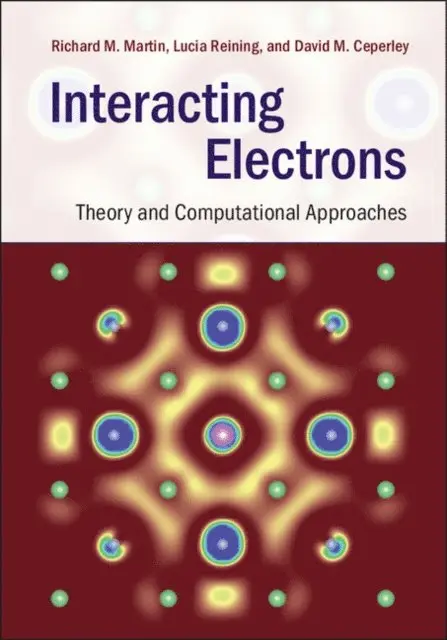
    Richard M. Martin is Emeritus Professor of Physics at the University of Illinois Urbana-Champaign and Adjunct Professor of Applied Physics at Stanford University. He has made important contributions to many areas of modern electronic structure, including over 200 papers and is a co-author of another major book in the field, Interacting Electrons: Theory and Computational Approaches. (Cambridge University Press, 2016)

    Recensioner i media

    '… this 2nd edition is … very welcome and timely, as it has been significantly expanded to cover the 'new' topics. The core of the book remains unchanged in scope, focusing on 'independent particle methods' such as DFT and Hartree-Fock theory, and their extensions. This is … a worthy … and is strongly recommended for anyone working in the field of electronic structure.' Matt Probert, Contemporary Physics

    Innehållsförteckning

    • Preface; Acknowledgments; Notation; Part I. Overview and background topics: 1. Introduction; 2. Overview; 3. Theoretical background; 4. Periodic solids and electron bands; 5. Uniform electron gas and sp-bonded metals; Part II. Density functional theory: 6. Density functional theory: foundations; 7. The Kohn–Sham auxiliary system; 8. Functionals for exchange and correlation I; 9. Functionals for exchange and correlation II; Part III. Important preliminaries on atoms: 10. Electronic structure of atoms; 11. Pseudopotentials; Part IV. Determination of electronic structure: the basic methods: 12. Plane waves and grids: basics; 13. Plane waves and real space methods: full calculations; 14. Localized orbitals: tight-binding; 15. Localized orbitals: full calculations; 16. Augmented functions: APW, KKR, MTO; 17. Augmented functions: linear methods; 18. Locality and linear scaling O(N) methods; Part V. From Electronic Structure to Properties of Matter: 19. Quantum molecular dynamics (QMD); 20. Response functions: phonons, magnons, . . .; 21. Excitation spectra and optical properties; 22. Surfaces, interfaces, and lower dimensional systems; 23. Wannier functions; 24. Polarization, localization, and Berry phases; Part VI. Electronic Structure and Topology: 25. Topology of the electronic structure of a crystal: introduction; 26. Two band models: Berry phase, winding and topology; 27. Topological insulators I: Two dimensions; 28. Topological insulators II: Three dimensions; Part VII. APPENDICES: A. Functional equations; B. LSDA and GGA functionals; C. Adiabatic approximation; D. Perturbation Theory, response functions and Green's functions; E. Dielectric functions and optical properties; F. Coulomb interactions in extended systems; G. Stress from electronic structure; H. Energy and stress densities; I. Alternative force expressions; J. Scattering and phase shifts; K. Useful relations and formulas; L. Numerical methods; M. Iterative methods in electronic structure; N. Two-center matrix elements: expressions for arbitrary angular momentum l; O. Dirac equation and spin-orbit interaction; P. Berry phase, curvature and Chern numbers; Q. Quantum Hall effect and edge conductivity; R. Codes for electronic structure calculations for solids; References; Index.