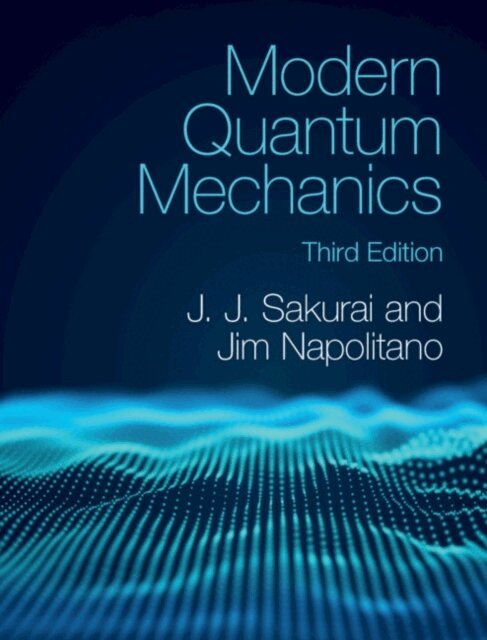
Modern Quantum Mechanics
AvJ. J. Sakurai,Jim Napolitano
1 155 kr
Beställningsvara. Skickas inom 3-6 vardagar. Fri frakt över 249 kr.
Du är på sajten för privatpersoner.
AvJ. J. Sakurai,Jim Napolitano
1 155 kr
Beställningsvara. Skickas inom 3-6 vardagar. Fri frakt över 249 kr.
J. J. Sakurai was a noted theorist in particle physics and Professor of Physics at UCLA (1970–1982) and University of Chicago (1964–1970). He received his Ph.D. from Cornell University, New York in 1958. He contributed greatly to the field of particle physics before passing away at the age of 49 in 1982, while he was visiting CERN in Geneva. In addition he had held visiting staff appointments at the California Institute of Technology, Universities of Tokyo and Nagoya, University of Paris d'Orsay, Scuola Normale Superiore at Pisa, Stanford Linear Accelerator, CERN at Geneva, and Max Planck Institute at Munich. He was a Sloan Fellow (1962–1966), Fellow of the American Physical Society (1964–1982), a Guggenheim Fellow (1975–1976) and a von Humboldt Fellow (1981–1982). Jim Napolitano is Professor of Physics and Department Chair at the College of Science and Technology, Temple University. He is an experimental nuclear physicist, with over 320 articles published in refereed journals and an h-index of 81. He shared in the 2016 Breakthrough Prize in Fundamental Physics and currently works on experiments using parity violating electron scattering. An innovative educator, he has developed coursework and curricula at Rensselaer Polytechnic Institute and Temple University. In all cases, his teaching and instructional development make use of modern techniques. Professor Napolitano has also published textbooks on quantum mechanics, experimental physics, and using Mathematica for physics.
'A truly wonderful introduction to quantum mechanics. Sakurai's original text was elegant, simple, and full of insight. It taught me much as a graduate student. Napolitano's update adds context with applications from today's research, explained simply and beautifully. The problems are exceptionally well chosen. This book can be used for graduate quantum courses from one quarter to a year in length, in physics, materials science, or even physical chemistry.' Kieron Burke, University of California-Irvine
Du är på sajten för privatpersoner.
AvJ. J. Sakurai,Jim Napolitano
1 155 kr
Beställningsvara. Skickas inom 3-6 vardagar. Fri frakt över 249 kr.
J. J. Sakurai was a noted theorist in particle physics and Professor of Physics at UCLA (1970–1982) and University of Chicago (1964–1970). He received his Ph.D. from Cornell University, New York in 1958. He contributed greatly to the field of particle physics before passing away at the age of 49 in 1982, while he was visiting CERN in Geneva. In addition he had held visiting staff appointments at the California Institute of Technology, Universities of Tokyo and Nagoya, University of Paris d'Orsay, Scuola Normale Superiore at Pisa, Stanford Linear Accelerator, CERN at Geneva, and Max Planck Institute at Munich. He was a Sloan Fellow (1962–1966), Fellow of the American Physical Society (1964–1982), a Guggenheim Fellow (1975–1976) and a von Humboldt Fellow (1981–1982). Jim Napolitano is Professor of Physics and Department Chair at the College of Science and Technology, Temple University. He is an experimental nuclear physicist, with over 320 articles published in refereed journals and an h-index of 81. He shared in the 2016 Breakthrough Prize in Fundamental Physics and currently works on experiments using parity violating electron scattering. An innovative educator, he has developed coursework and curricula at Rensselaer Polytechnic Institute and Temple University. In all cases, his teaching and instructional development make use of modern techniques. Professor Napolitano has also published textbooks on quantum mechanics, experimental physics, and using Mathematica for physics.
'A truly wonderful introduction to quantum mechanics. Sakurai's original text was elegant, simple, and full of insight. It taught me much as a graduate student. Napolitano's update adds context with applications from today's research, explained simply and beautifully. The problems are exceptionally well chosen. This book can be used for graduate quantum courses from one quarter to a year in length, in physics, materials science, or even physical chemistry.' Kieron Burke, University of California-Irvine