• Fri frakt över 249 kr
  • •
  • Snabba leveranser
  • •
  • Billiga böcker
Kundservice

Du är på sajten för privatpersoner.

Företag, bibliotek eller offentlig verksamhet?

Du handlar på classic.bokus.com, där alla dina funktioner finns intakta.
Till classic.bokus.com
Bokus logotyp. Gå till startsidan.
  • Erbjudanden
  • Nyheter
  • Student
  • Topplistor
  • Barn & ungdom
  • Bokus Play
  • E-böcker
  • Pocketböcker
  • Spel & pussel

10% rabatt på allt med kod NYSTART10 →

Sidfot

Mina sidor

    Hjälp

    • Kundservice
    • Vanliga frågor och svar
    • Frakt och leverans
    • Retur vid ångerrätt
    • Reklamera vara
    • Betalning
    • Köpvillkor
    • Allmänna villkor
    • Information om webbplatsens tillgänglighet

    Om Bokus

    • Om oss
    • Pressrum
    • För studenter
    • För företag
    • För bibliotek och offentlig verksamhet
    • För leverantörer
    • Hållbarhet

    Populärt

    • Aktuella erbjudanden
    • Presentkort
    • Studentlitteratur
    • Nya böcker
    • Topplistor
    • Signerade böcker
    • Engelska böcker

    Inspiration

    • Boktips
    • BookTok
    • Populära bokserier
    • Barnbokskaraktärer
    • Populära författare
    Logotyp för Bokus
    Följ oss på Facebook (extern länk)Följ oss på Instagram (extern länk)Följ oss på YouTube (extern länk)Följ oss på TikTok (extern länk)
    bokus @ CookiesAnpassa cookiesIntegritetspolicyKöpvillkor
    Till Citymail hemsida (extern länk)Till Budbee hemsida (extern länk)Till Postnord hemsida (extern länk)Till Schenker hemsida (extern länk)Till Early Bird hemsida (extern länk)Till Walleys hemsida (extern länk)
    1. Ekonomi och Ledarskap
    2. Företagsekonomi

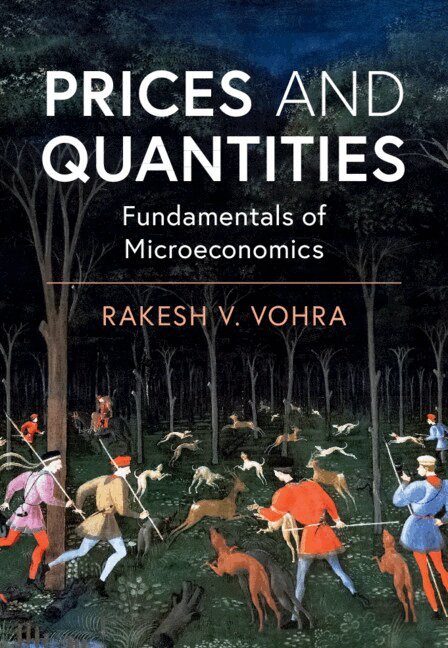
    Prices and Quantities

    Fundamentals of Microeconomics

    AvRakesh V. Vohra

    Inbunden, Engelska, 2020

    1 191 kr

    Beställningsvara. Skickas inom 10-15 vardagar. Fri frakt över 249 kr.

    Fler format och utgåvor

    Häftad

    416 kr

    E-bok

    488 kr

    E-bok

    488 kr

    Beskrivning

    Rakesh V. Vohra offers a unique approach to studying and understanding intermediate microeconomics by reversing the conventional order of treatment, starting with topics that are mathematically simpler and progressing to the more complex. The book begins with monopoly, which requires single variable rather than multivariable calculus and allows students to focus clearly on the fundamental trade-off at the heart of economics: margin versus volume. Imperfect competition and the contrast with monopoly follows, introducing the notion of Nash equilibrium. Perfect competition is addressed toward the end of the book, and framed as a model of non-strategic behavior by firms and agents. The last chapter is devoted to externalities, with an emphasis on how one might design competitive markets to price externalities and linking the difficulties to the problem of efficient provision of public goods. Real-life examples engage the reader while encouraging them to think critically about the interplay between model and reality.

    Produktinformation

    • Utgivningsdatum:2020-02-20
    • Mått:176 x 250 x 19 mm
    • Vikt:560 g
    • Format:Inbunden
    • Språk:Engelska
    • Antal sidor:220
    • Förlag:Cambridge University Press
    • ISBN:9781108488938

    Utforska kategorier

    • Företagsekonomi inom Ekonomi och Ledarskap

    Mer om författaren

    Rakesh V. Vohra is the George A. Weiss and Lydia Bravo Weiss University Professor at the University of Pennsylvania. He is the author of Principles of Pricing: An Analytical Approach (with Lakshman Krishnamurthi, 2012) and Mechanism Design: A Linear Programming Approach (2011).

    Recensioner i media

    'A leader in the field provides a readable but rigorous introduction to microeconomics with clear, mathematical arguments that students will depend on to fill conceptual gaps in their understanding of economic markets.' Paul Klemperer, Edgeworth Professor of Economics, University of Oxford

    Innehållsförteckning

    • Preface; 1. Introduction; 2. Margin vs volume; 3. Price discrimination; 4. Competition; 5. Preferences and utility; 6. Perfect competition; 7. Externalities and public goods; Appendix A. Optimization; Index.