• Fri frakt över 249 kr
  • •
  • Snabba leveranser
  • •
  • Billiga böcker
Kundservice

Du är på sajten för privatpersoner.

Företag, bibliotek eller offentlig verksamhet?

Du handlar på classic.bokus.com, där alla dina funktioner finns intakta.
Till classic.bokus.com
Bokus logotyp. Gå till startsidan.
  • Erbjudanden
  • Nyheter
  • Student
  • Topplistor
  • Barn & ungdom
  • Bokus Play
  • E-böcker
  • Pocketböcker
  • Spel & pussel

10% rabatt på allt med kod: NYSTART10 →

Sidfot

Mina sidor

    Hjälp

    • Kundservice
    • Vanliga frågor och svar
    • Frakt och leverans
    • Retur vid ångerrätt
    • Reklamera vara
    • Betalning
    • Köpvillkor
    • Allmänna villkor
    • Information om webbplatsens tillgänglighet

    Om Bokus

    • Om oss
    • Pressrum
    • För studenter
    • För företag
    • För bibliotek och offentlig verksamhet
    • För leverantörer
    • Hållbarhet

    Populärt

    • Aktuella erbjudanden
    • Presentkort
    • Studentlitteratur
    • Nya böcker
    • Topplistor
    • Signerade böcker
    • Engelska böcker

    Inspiration

    • Boktips
    • BookTok
    • Populära bokserier
    • Barnbokskaraktärer
    • Populära författare
    Logotyp för Bokus
    Följ oss på Facebook (extern länk)Följ oss på Instagram (extern länk)Följ oss på YouTube (extern länk)Följ oss på TikTok (extern länk)
    bokus @ CookiesAnpassa cookiesIntegritetspolicyKöpvillkor
    Till Citymail hemsida (extern länk)Till Budbee hemsida (extern länk)Till Postnord hemsida (extern länk)Till Schenker hemsida (extern länk)Till Early Bird hemsida (extern länk)Till Walleys hemsida (extern länk)
    1. Språk och ordböcker
    2. Språkundervisning och språkinlärning

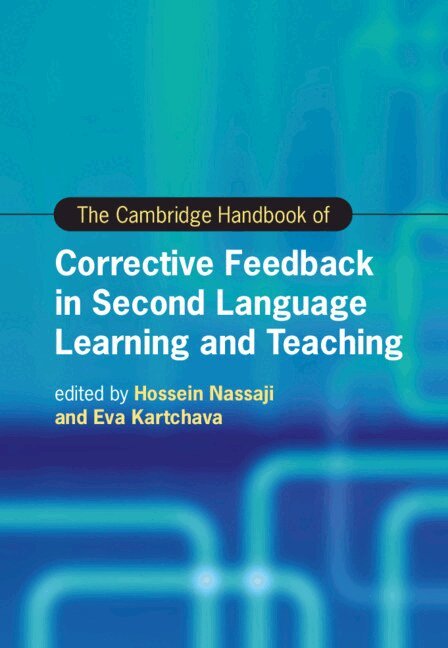
    The Cambridge Handbook of Corrective Feedback in Second Language Learning and Teaching

    AvHossein Nassaji,Eva Kartchava

    Inbunden, Engelska, 2021

    Del i serien Cambridge Handbooks in Language and Linguistics

    2 069 kr

    Beställningsvara. Skickas inom 10-15 vardagar. Fri frakt över 249 kr.

    Beskrivning

    Corrective feedback is a vital pedagogical tool in language learning. This is the first volume to provide an in-depth analysis and discussion of the role of corrective feedback in second and foreign language learning and teaching. Written by leading scholars, it assembles cutting-edge research and state-of-the-art articles that address recent developments in core areas of corrective feedback including oral, written, computer-mediated, nonverbal, and peer feedback. The chapters are a combination of both theme-based and original empirical studies carried out in diverse second and foreign language contexts. Each chapter provides a concise review of its own topic, discusses theoretical and empirical issues not adequately addressed before, and identifies their implications for classroom instruction and future research. It will be an essential resource for all those interested in the role of corrective feedback in second and foreign language learning and how they can be used to enhance classroom teaching.

    Produktinformation

    • Utgivningsdatum:2021-03-11
    • Mått:180 x 250 x 51 mm
    • Vikt:1 560 g
    • Format:Inbunden
    • Språk:Engelska
    • Serie:Cambridge Handbooks in Language and Linguistics
    • Antal sidor:820
    • Förlag:Cambridge University Press
    • ISBN:9781108499101

    Utforska kategorier

    • Språkundervisning och språkinlärning inom Språk och ordböcker

    Mer om författaren

    Hossein Nassaji is Professor of Applied Linguistics in the Department of Linguistics at the University of Victoria, Canada. He maintains active research agenda across various areas of second language teaching and learning and has authored numerous publications on these topics. Eva Kartchava is Associate Professor in the School of Linguistics and Language Studies at Carleton University, Canada. She has published research on the relationship between corrective feedback and second language learning, noticeability of feedback, and the role of individual differences in the language learning process.

    Innehållsförteckning

    • Introduction. Corrective feedback in second language teaching and learning Hossein Nassaji and Eva Kartchava; Part I. Theoretical Perspectives on Corrective Feedback: 1. Corrective feedback from behaviorist and innatist perspectives ZhaoHong Han; 2. Interactionist approach to corrective feedback in second language acquisition Rebekha Abbuhl; 3. Cognitive theoretical perspectives of corrective feedback Ronald Leow and Meagan Driver; 4. Corrective feedback from a sociocultural perspective Hossein Nassaji; Part II. Methodological Approaches in the Study of Corrective Feedback: 5. Tools to measure the effectiveness of feedback Alison Mackey, Lara Bryfonski, Özgür Parlak, Ashleigh Pipes, Ayşenur Sağdıç and Bo-Ram Suh; 6. Laboratory-based oral corrective feedback Shawn Loewen and Susan M. Gass; 7. Classroom-based research in corrective feedback Antonella Valeo; 8. Meta-analysis and research synthesis Daniel Brown; Part III. Different Delivery Modes of Corrective Feedback: 9. Oral corrective feedback Rhonda Oliver and Rebecca Adams; 10. Written corrective feedback John Bitchener; 11. Technology-mediated corrective feedback Trude Heift, Phuong Nguyen and Volker Hegelheimer; 12. Gestures, corrective feedback, and second language development Kimi Nakatsukasa; Part IV. Feedback Provider, Feedback Focus, and Feedback Timing: 13. Peer feedback in second language oral interaction Noriko Iwashita and Phung Dao; 14. Focused versus unfocused corrective feedback Catherine van Beuningen; 15. Corrective feedback timing and second language grammatical development: research, theory, and practice Paul Gregory Quinn; 16. Explicit versus implicit oral corrective feedback Rod Ellis; Part V. Corrective Feedback and Language Skills: 17. Corrective feedback and the development of second language grammar Helen Basturkmen and Mengxia Fu; 18. Corrective feedback and the development of second language vocabulary Nobuhiro Kamiya and Tatsuya Nakata; 19. Effects of corrective feedback on second language pronunciation development Kazuya Saito; 20. Corrective feedback in instructional pragmatics Kathleen Bardovi-Harlig and Yucel Yilmaz; 21. Alphabetic print literacy level and the noticing of oral corrective feedback in SLA Elaine Tarone; Part VI. Contexts of Corrective Feedback and their Effects: 22. Corrective feedback in second versus foreign language contexts Maria de Pilar Garcia Mayo and Ruth Milla; 23. Corrective feedback in computer-mediated versus face-to-face environments Luis Cerezo; 24. Corrective feedback in mobile technology-mediated contexts Eva Kartchava and Hossein Nassaji; 25. Corrective feedback in content-based contexts Susan Ballinger; Part VII. Learners' and Teachers' Feedback Perspectives and Preferences: 26. Teacher and student beliefs and perspectives towards corrective feedback YouJin Kim and Tamanna Mostafa; 27. Written corrective feedback and learners' objects, beliefs and emotions Neomy Storch; 28. The role of training in feedback provision and effectiveness Eva Kartchava; 29. Perceptions and noticing of corrective feedback Reiko Yoshida; Part VIII. Individual Differences, Tasks, and Other Language and Learner-Related Factors: 30. Age and corrective feedback Alyssa Vuono and Shaofeng Li; 31. Gender effects Rebecca Adams and Lauren Ross-Feldman; 32. Feedback, aptitude, and multilingualism Beatriz Lado and Cristina Sanz; 33. Corrective feedback and affect Jaemyung Goo and Takaaki Takeuchi; 34. Corrective feedback, developmental readiness and language proficiency Miroslaw Pawlak; 35. Corrective feedback and grammatical complexity: a research synthesis Gisela Granena and Yucel Yilmaz; 36. The role of task in the efficacy of corrective feedback Pauline Foster and Martyn McGettigan.