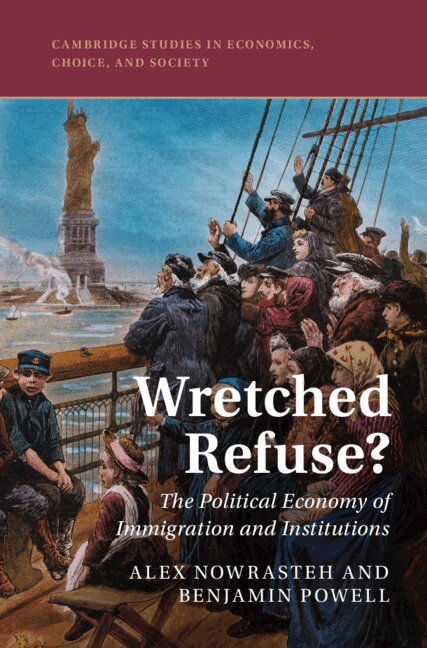
Wretched Refuse?
The Political Economy of Immigration and Institutions
AvAlex Nowrasteh,Benjamin Powell
Del i serien Cambridge Studies in Economics, Choice, and Society
574 kr
Beställningsvara. Skickas inom 5-8 vardagar. Fri frakt över 249 kr.
Du är på sajten för privatpersoner.
AvAlex Nowrasteh,Benjamin Powell
Del i serien Cambridge Studies in Economics, Choice, and Society
574 kr
Beställningsvara. Skickas inom 5-8 vardagar. Fri frakt över 249 kr.
Alex Nowrasteh is the director of immigration studies at the Cato Institute's Center for Global Liberty and Prosperity. He is a native of Southern California and received a BA in economics from George Mason University and his MSc in economic history from the London School of Economics. Nowrasteh is one of the most commonly cited experts on immigration policy in the United States. His research has been cited widely in the press and he is the author of numerous opinion pieces that have appeared in the Wall Street Journal, USA Today, the Washington Post, and most other major publications in the United States. He also regularly appears on Fox News, MSNBC, Bloomberg, National Public Radio, and numerous television and radio stations across the United States. His peer-reviewed academic publications have appeared in the World Bank Economic Review, the Journal of Economic Behavior and Organization, Economic Affairs, the Fletcher Security Review, the Journal of Bioeconomics, and Public Choice. Benjamin Powell is the Executive Director of the Free Market Institute and a Professor of Economics in the Rawls College of Business at Texas Tech University and a Senior Fellow with the Independent Institute. He is the secretary-treasurer of the Southern Economic Association and the Association of Private Enterprise Education. He earned his BS in economics and finance from the University of Massachusetts at Lowell, and his MA and PhD in economics from George Mason University. Powell is the author of Out of Poverty: Sweatshops in the Global Economy (Cambridge, 2014), coauthor of Socialism Sucks: Two Economists Drink Their Way through the Unfree World (2019), and editor or coeditor of four other books, including The Economics of Immigration: Market-Based Approaches, Social Science, and Public Policy (2015). He is the author of more than seventy-five scholarly articles and policy studies. Powell's research findings have been reported in hundreds of popular press outlets, including the Wall Street Journal and the New York Times. He also writes frequently for the popular press. His popular writing has appeared in the Chicago Tribune, New York Post, the Dallas Morning News, and many other outlets. He has appeared on numerous radio and television shows, including Fox News Channel, CNN, MSNBC, Showtime, and CNBC, and he was a regular guest commentator on Fox Business's Freedom Watch and Stossel.
'This book tackles the most important academic question confronting recommendations for 'free labor' - whether too much of a good thing at the margin becomes a bad thing. The book consolidates all of the existing research - and then adds more, and then adds more, and then adds even more. It will be a standard work on this question for some time.' Lant Pritchett, Blavatnik School of Government, University of Oxford
Du är på sajten för privatpersoner.
AvAlex Nowrasteh,Benjamin Powell
Del i serien Cambridge Studies in Economics, Choice, and Society
574 kr
Beställningsvara. Skickas inom 5-8 vardagar. Fri frakt över 249 kr.
Alex Nowrasteh is the director of immigration studies at the Cato Institute's Center for Global Liberty and Prosperity. He is a native of Southern California and received a BA in economics from George Mason University and his MSc in economic history from the London School of Economics. Nowrasteh is one of the most commonly cited experts on immigration policy in the United States. His research has been cited widely in the press and he is the author of numerous opinion pieces that have appeared in the Wall Street Journal, USA Today, the Washington Post, and most other major publications in the United States. He also regularly appears on Fox News, MSNBC, Bloomberg, National Public Radio, and numerous television and radio stations across the United States. His peer-reviewed academic publications have appeared in the World Bank Economic Review, the Journal of Economic Behavior and Organization, Economic Affairs, the Fletcher Security Review, the Journal of Bioeconomics, and Public Choice. Benjamin Powell is the Executive Director of the Free Market Institute and a Professor of Economics in the Rawls College of Business at Texas Tech University and a Senior Fellow with the Independent Institute. He is the secretary-treasurer of the Southern Economic Association and the Association of Private Enterprise Education. He earned his BS in economics and finance from the University of Massachusetts at Lowell, and his MA and PhD in economics from George Mason University. Powell is the author of Out of Poverty: Sweatshops in the Global Economy (Cambridge, 2014), coauthor of Socialism Sucks: Two Economists Drink Their Way through the Unfree World (2019), and editor or coeditor of four other books, including The Economics of Immigration: Market-Based Approaches, Social Science, and Public Policy (2015). He is the author of more than seventy-five scholarly articles and policy studies. Powell's research findings have been reported in hundreds of popular press outlets, including the Wall Street Journal and the New York Times. He also writes frequently for the popular press. His popular writing has appeared in the Chicago Tribune, New York Post, the Dallas Morning News, and many other outlets. He has appeared on numerous radio and television shows, including Fox News Channel, CNN, MSNBC, Showtime, and CNBC, and he was a regular guest commentator on Fox Business's Freedom Watch and Stossel.
'This book tackles the most important academic question confronting recommendations for 'free labor' - whether too much of a good thing at the margin becomes a bad thing. The book consolidates all of the existing research - and then adds more, and then adds more, and then adds even more. It will be a standard work on this question for some time.' Lant Pritchett, Blavatnik School of Government, University of Oxford