• Fri frakt över 249 kr
  • •
  • Snabba leveranser
  • •
  • Billiga böcker
Kundservice

Du är på sajten för privatpersoner.

Företag, bibliotek eller offentlig verksamhet?

Du handlar på classic.bokus.com, där alla dina funktioner finns intakta.
Till classic.bokus.com
Bokus logotyp. Gå till startsidan.
  • Erbjudanden
  • Nyheter
  • Student
  • Topplistor
  • Barn & ungdom
  • Bokus Play
  • E-böcker
  • Pocketböcker
  • Spel & pussel

10% rabatt på allt med kod: NYSTART10 →

Sidfot

Mina sidor

    Hjälp

    • Kundservice
    • Vanliga frågor och svar
    • Frakt och leverans
    • Retur vid ångerrätt
    • Reklamera vara
    • Betalning
    • Köpvillkor
    • Allmänna villkor
    • Information om webbplatsens tillgänglighet

    Om Bokus

    • Om oss
    • Pressrum
    • För studenter
    • För företag
    • För bibliotek och offentlig verksamhet
    • För leverantörer
    • Hållbarhet

    Populärt

    • Aktuella erbjudanden
    • Presentkort
    • Studentlitteratur
    • Nya böcker
    • Topplistor
    • Signerade böcker
    • Engelska böcker

    Inspiration

    • Boktips
    • BookTok
    • Populära bokserier
    • Barnbokskaraktärer
    • Populära författare
    Logotyp för Bokus
    Följ oss på Facebook (extern länk)Följ oss på Instagram (extern länk)Följ oss på YouTube (extern länk)Följ oss på TikTok (extern länk)
    bokus @ CookiesAnpassa cookiesIntegritetspolicyKöpvillkor
    Till Citymail hemsida (extern länk)Till Budbee hemsida (extern länk)Till Postnord hemsida (extern länk)Till Schenker hemsida (extern länk)Till Early Bird hemsida (extern länk)Till Walleys hemsida (extern länk)
    1. Filosofi och religion
    2. Filosofi
    3. Filosofiska discipliner

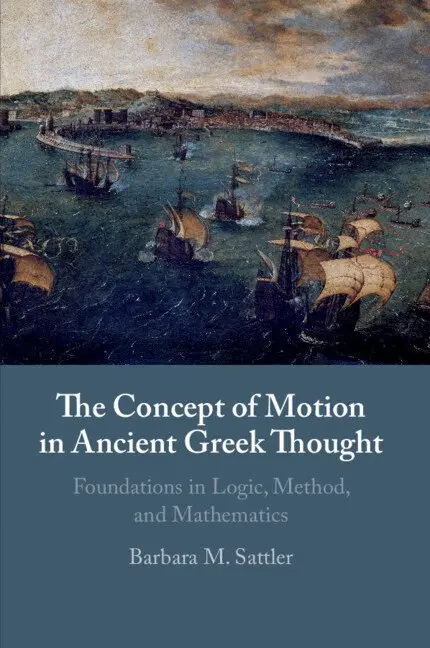
    The Concept of Motion in Ancient Greek Thought

    Foundations in Logic, Method, and Mathematics

    AvBarbara M. Sattler

    Häftad, Engelska, 2021

    544 kr

    Beställningsvara. Skickas inom 10-15 vardagar. Fri frakt över 249 kr.

    Fler format och utgåvor

    Inbunden

    1 844 kr

    Beskrivning

    This book examines the birth of the scientific understanding of motion. It investigates which logical tools and methodological principles had to be in place to give a consistent account of motion, and which mathematical notions were introduced to gain control over conceptual problems of motion. It shows how the idea of motion raised two fundamental problems in the 5th and 4th century BCE: bringing together being and non-being, and bringing together time and space. The first problem leads to the exclusion of motion from the realm of rational investigation in Parmenides, the second to Zeno's paradoxes of motion. Methodological and logical developments reacting to these puzzles are shown to be present implicitly in the atomists, and explicitly in Plato who also employs mathematical structures to make motion intelligible. With Aristotle we finally see the first outline of the fundamental framework with which we conceptualise motion today.

    Produktinformation

    • Utgivningsdatum:2021-11-04
    • Mått:152 x 228 x 22 mm
    • Vikt:634 g
    • Format:Häftad
    • Språk:Engelska
    • Antal sidor:438
    • Förlag:Cambridge University Press
    • ISBN:9781108745215

    Utforska kategorier

    • Filosofiska discipliner inom Filosofi och religion

    Mer om författaren

    Barbara Sattler is Senior Lecturer in Philosophy at the University of St Andrews. She works mainly on metaphysics and natural philosophy in the ancient Greek world, with a particular focus on the Presocratics, Plato and Aristotle.

    Recensioner i media

    "Barbara Sattler's book is engaging, sophisticated and full of stimulating ideas. It traces the development of crucial presuppositions of natural science from their earliest roots in Parmenides to their fruition in Aristotle. The perspective and expertise which Sattler brings to these issues will be of great interest and value to those working in ancient philosophy or in the history of science.” Stephen Makin, University of Sheffield

    Innehållsförteckning

    • Introduction; 1. Conceptual Foundations; 2. Parmenides's account of the object of philosophy; 3. Zeno's Paradoxes of Motion and Plurality; 4. The atomistic foundation for an account of motion; 5. The Possibility of Natural Philosophy according to Plato I: The Logical Basis; 6. The Possibility of Natural Philosophy according to Plato II: Mathematical Advances and Ultimate Problems; 7. Aristotle's Notion of Continuity – the Structure underlying Motion; 8. Time and Space – the Implicit Measure of Motion in Aristotle's Physics; 9. Time as the simple measure of motion.