• Fri frakt över 249 kr
  • •
  • Snabba leveranser
  • •
  • Billiga böcker
Kundservice

Du är på sajten för privatpersoner.

Företag, bibliotek eller offentlig verksamhet?

Du handlar på classic.bokus.com, där alla dina funktioner finns intakta.
Till classic.bokus.com
Bokus logotyp. Gå till startsidan.
  • Erbjudanden
  • Nyheter
  • Student
  • Topplistor
  • Barn & ungdom
  • Bokus Play
  • E-böcker
  • Pocketböcker
  • Spel & pussel

10% studentrabatt med kod TERM26

Sidfot

Mina sidor

    Hjälp

    • Kundservice
    • Vanliga frågor och svar
    • Frakt och leverans
    • Retur vid ångerrätt
    • Reklamera vara
    • Betalning
    • Köpvillkor
    • Allmänna villkor
    • Information om webbplatsens tillgänglighet

    Om Bokus

    • Om oss
    • Pressrum
    • För studenter
    • För företag
    • För bibliotek och offentlig verksamhet
    • För leverantörer
    • Hållbarhet

    Populärt

    • Aktuella erbjudanden
    • Presentkort
    • Studentlitteratur
    • Nya böcker
    • Topplistor
    • Signerade böcker
    • Engelska böcker

    Inspiration

    • Boktips
    • BookTok
    • Populära bokserier
    • Barnbokskaraktärer
    • Populära författare
    Logotyp för Bokus
    Följ oss på Facebook (extern länk)Följ oss på Instagram (extern länk)Följ oss på YouTube (extern länk)Följ oss på TikTok (extern länk)
    bokus @ CookiesAnpassa cookiesIntegritetspolicyKöpvillkor
    Till Citymail hemsida (extern länk)Till Budbee hemsida (extern länk)Till Postnord hemsida (extern länk)Till Schenker hemsida (extern länk)Till Early Bird hemsida (extern länk)Till Walleys hemsida (extern länk)
    1. Historia och arkeologi
    2. Historia
    3. Europas historia
    • -10% student

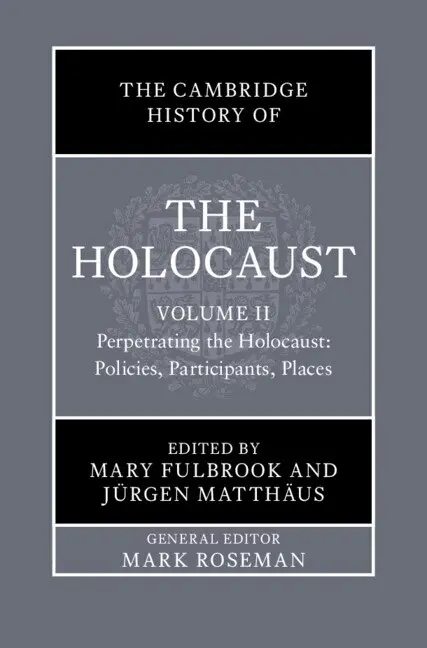
    The Cambridge History of the Holocaust: Volume 2, Perpetrating The Holocaust: Policies, Participants, Places

    AvMary Fulbrook,Jürgen Matthäus

    Inbunden, Engelska, 2025

    Del i serien The Cambridge History of the Holocaust

    1 713 kr

    Beställningsvara. Skickas inom 10-15 vardagar. Fri frakt över 249 kr.

    Beskrivning

    This ambitious pan-European overview explores the most significant causal factors, political developments, and societal forces that contributed to the perpetration of the Holocaust. Drawing on wide-ranging current scholarly expertise, this volume seeks to explain the genocidal scope and European dimensions of the crimes committed by Nazi Germany and its allies, collaborators, and facilitators across the continent during the war. It broadens the range of Holocaust research beyond the German initiators and organizers, however central these remain. Contributions look beyond simple or monocausal explanations in terms of, for example, Hitler's role or ideological antisemitism. Combining in-depth studies of specific locations and developments with overviews of thematic issues and wider questions, the second volume of the Cambridge History of the Holocaust offers concise analyses of the complex developments, varied interests, and interrelated events that were rooted in previous history and continue to influence the present within and beyond Europe. Cumulatively, this book presents a complex, multifaceted approach to understanding the uneven unfolding and escalation of the Holocaust.

    Produktinformation

    • Utgivningsdatum:2025-06-12
    • Mått:223 x 22 x 159 mm
    • Vikt:1 000 g
    • Format:Inbunden
    • Språk:Engelska
    • Serie:The Cambridge History of the Holocaust
    • Antal sidor:608
    • Förlag:Cambridge University Press
    • ISBN:9781108839389

    Ingår i kampanjer

    -10% student

    Utforska kategorier

    • Europas historia inom Historia och arkeologi
    • Förintelsen inom Historia och arkeologi

    Mer om författaren

    Mary Fulbrook, FBA, is Professor of German History at University College London. Her recent monographs include Bystander Society: Conformity and Complicity in Nazi Germany and the Holocaust (2023), the Wolfson Prize-winning Reckonings: Legacies of Nazi Persecution and the Quest for Justice (2018), and the Fraenkel Prize-winning A Small Town near Auschwitz: Ordinary Nazis and the Holocaust (2012). Jürgen Matthäus is a historian and was Director of the Applied Research branch at the Jack, Joseph and Morton Mandel Center for Advanced Holocaust Studies of the US Holocaust Memorial Museum from 2004 to 2005. He is the author or (co-)editor of more than twenty books, including, as co-editor with Martin Cüppers and Anne Lepper, From “Euthanasia” to Sobibor: An SS Officer's Photo Collection (2022).

    Innehållsförteckning

    • Part I. Structures, Players, and Processes: 1. Hitler, the Nazi leadership and the evolution of the final solution Christopher Browning; 2. The Nazi apparatus of terror: SS, SA, police Jochen Böhler; 3. Bystanders, collaboration and complicity; 4. Bystanders, collaboration and complicity Elizabeth Harvey; 5. The German economy and the exploitation and extermination of the Jews Susanne Heim; 6. The Wehrmacht, its allies, and 'partisan threats' Ben Shepherd; 7. Gender and perpetration Elissa Mailänder; 8. Perpetrator depictions of violence and the obliteration of evidence Valerie Hébert; 9. Discourses, knowledge, and disbelief in the Reich and beyond Frank Bajohr and Felix Berge; 10. 'Euthanasia', 'Germanization', and the beginnings of the Holocaust, 1939–1941 Isabel Heinemann; 11. The personnel and functioning of the extermination camps Sara Berger and Donald Bloxham; Part II. Times and Places: 12. Ghettos and other confined spaces of Jewish life in Nazi-dominated Europe Dan Michmann; 13. German and local violence in the Balkans Emil Kerenji; 14. Forced migration, flight and refuge in the West Miriam Rürup; 15. 'War of annihilation' in the occupied Soviet Union, 1941–1942 Edward Westermann; 16. Neighbors and killing in the East Tomasz Frydel; 17. 'Aktion Reinhardt' and the murder of the polish Jews Stephan Lehnstaedt; 18. Collaboration in German-dominated western Europe Peter Romijn; 19. Deportations from central and western Europe Birthe Kundrus and Jan Kreutz; 20. Remaining Jewish spaces and their liquidation, 1942–1944 Tatjana Tönsmeyer; 21. 'Operation Höss:' Auschwitz and the murder of the Hungarian Jews Gábor Kádár and Zoltán Vági; 22. Death marches of camp inmates and German atrocities at the war's end Daniel Blatman; 23. German agency and the Holocaust as a European project Jürgen Matthäus and Mary Fulbrook.