• Fri frakt över 249 kr
  • •
  • Snabba leveranser
  • •
  • Billiga böcker
Kundservice

Du är på sajten för privatpersoner.

Företag, bibliotek eller offentlig verksamhet?

Du handlar på classic.bokus.com, där alla dina funktioner finns intakta.
Till classic.bokus.com
Bokus logotyp. Gå till startsidan.
  • Erbjudanden
  • Nyheter
  • Student
  • Topplistor
  • Barn & ungdom
  • Bokus Play
  • E-böcker
  • Pocketböcker
  • Spel & pussel

10% rabatt på allt med kod: NYSTART10 →

Sidfot

Mina sidor

    Hjälp

    • Kundservice
    • Vanliga frågor och svar
    • Frakt och leverans
    • Retur vid ångerrätt
    • Reklamera vara
    • Betalning
    • Köpvillkor
    • Allmänna villkor
    • Information om webbplatsens tillgänglighet

    Om Bokus

    • Om oss
    • Pressrum
    • För studenter
    • För företag
    • För bibliotek och offentlig verksamhet
    • För leverantörer
    • Hållbarhet

    Populärt

    • Aktuella erbjudanden
    • Presentkort
    • Studentlitteratur
    • Nya böcker
    • Topplistor
    • Signerade böcker
    • Engelska böcker

    Inspiration

    • Boktips
    • BookTok
    • Populära bokserier
    • Barnbokskaraktärer
    • Populära författare
    Logotyp för Bokus
    Följ oss på Facebook (extern länk)Följ oss på Instagram (extern länk)Följ oss på YouTube (extern länk)Följ oss på TikTok (extern länk)
    bokus @ CookiesAnpassa cookiesIntegritetspolicyKöpvillkor
    Till Citymail hemsida (extern länk)Till Budbee hemsida (extern länk)Till Postnord hemsida (extern länk)Till Schenker hemsida (extern länk)Till Early Bird hemsida (extern länk)Till Walleys hemsida (extern länk)
    1. Ekonomi och Ledarskap
    2. Företagsekonomi
    3. Affärsutveckling

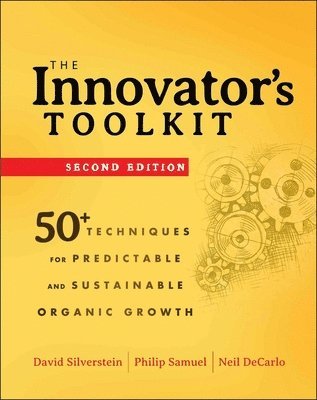
    Innovator's Toolkit

    50+ Techniques for Predictable and Sustainable Organic Growth

    AvDavid Silverstein,Philip Samuel

    Inbunden, Engelska, 2012

    295 kr

    Beställningsvara. Skickas inom 5-8 vardagar. Fri frakt över 249 kr.

    Beskrivning

    A compendium of tools and techniques that every innovator needs The Innovator's Toolkit is an essential companion for every innovator, innovation team leader, operations manager, and corporate change agent who needs to drive organic growth. Written and presented in an easy-to-use reference format, the book helps users understand why, when, and how to apply each technique for maximum benefits and results. The fifty-plus tools and techniques in this book are organized around a framework for identifying innovation opportunities, generating new and unusual ideas, selecting the best ideas for further refinement, and implementing new solutions that better meet customer expectations. This revised second edition includes significant updates to nearly two dozen techniquesAlso offers several brand new techniques, including Idea Harvesting and Treatment, Seventy-six Standard Solutions, and Six Thinking HatsThis updated and revised edition of The Innovator's Toolkit simply helps innovation leaders, managers, and specialists do their jobs better than ever before—giving them more confidence, greatly reducing the chance of expensive failures, and packing more practical innovation knowhow under one cover than ever before.

    Produktinformation

    • Utgivningsdatum:2012-11-02
    • Mått:196 x 239 x 28 mm
    • Vikt:862 g
    • Format:Inbunden
    • Språk:Engelska
    • Antal sidor:432
    • Upplaga:2
    • Förlag:John Wiley & Sons Inc
    • ISBN:9781118298107

    Utforska kategorier

    • Affärsutveckling inom Ekonomi och Ledarskap

    Mer om författaren

    DAVID SILVERSTEIN is founder/CEO of BMGI, an international firm specializing in innovation, performance improvement, and strategy. A highly regarded public speaker and executive coach, Silverstein has been featured in the Wall Street Journal, Worth magazine, Investor’s Business Daily, ComputerWorld, Chief Learning Officer, Chief Executive, Forbes.com, and BusinessWeek.DR. PHILIP SAMUEL is Chief Innovation Officer of BMGI. A frequent public speaker and thought leader in the field of strategy and innovation, he has become a trusted advisor for executives in a variety of industries. Dr. Samuel is also coauthor of Design for Lean Six Sigma: A Holistic Approach to Design and Innovation (Wiley).NEIL DECARLO is a veteran author, editor, and publishing coach whose work has ranged from Lean Six Sigma to corporate finance to strategy—partnering with such firms as BMGI, McKinsey & Company, and many others. DeCarlo is also coauthor of the bestselling Six Sigma For Dummies (Wiley).

    Innehållsförteckning

    • DOWNLOADABLE EXHIBITS xiii PREFACE xvINTRODUCTION xviiP A R T I Define the Opportunity 1TECHNIQUE 1 Jobs to be Done 3Highlight the human need you’re trying to fulfillTECHNIQUE 2 Job Mapping 13Determine how customers are getting jobs doneTECHNIQUE 3 Outcome Expectations 20Give customers more of what they desireTECHNIQUE 4 Value Quotient 27Identify opportunity gaps in the marketplaceTECHNIQUE 5 Ethnography 34Observe your customers to uncover unarticulated needsTECHNIQUE 6 Scenario Planning 41Paint visions of possible changeTECHNIQUE 7 Heuristic Redefinition 49Draw a picture of your system and its parts to focus ideationTECHNIQUE 8 Nine Windows 57Looking at your opportunity through nine different lensesTECHNIQUE 9 Job Scoping 64Broaden or narrow your innovation focusTECHNIQUE 10 Stakeholder Management 68Get key influencers involved and on your sideTECHNIQUE 11 Cognitive Style 74Leverage the diversity of your exploiters and explorersTECHNIQUE 12 Project Charter 82Keep your innovation team focused and on trackTECHNIQUE 13 Innovation Financial Management 90Constantly improve your assumption-to-knowledge ratioP A R T II Discover the Ideas 99TECHNIQUE 14 Resource Optimization 101Make sure you use all available resourcesTECHNIQUE 15 Functional Analysis 108Scrutinize your system for innovationTECHNIQUE 16 Trend Prediction 115Learn from evolution’s genetic codeTECHNIQUE 17 Creative Challenge 125Sacrifice the sacred cowsTECHNIQUE 18 HIT Matrix 130Compare existing solutions to spark new breakthroughsTECHNIQUE 19 SCAMPER 133Ask eight important questionsTECHNIQUE 20 Brainwriting 6-3-5 137Encourage equal opportunity ideationTECHNIQUE 21 Imaginary Brainstorming 140Get silly for the sake of creativityTECHNIQUE 22 Concept Tree 144Leverage current ideas to generate many ideasTECHNIQUE 23 Random Stimulus 147Use an unrelated picture or word to spawn new ideasTECHNIQUE 24 Provocation and Movement 153Bust through the roadblocks in your thinkingTECHNIQUE 25 Forced Association 159Hone in on solutions from other industriesTECHNIQUE 26 Structured Abstraction 164Guide your innovation using 40 proven principlesTECHNIQUE 27 Separation Principles 173Split your innovation problem in four waysTECHNIQUE 28 Substance Field Analysis 179Learn how substances interact with fields to form solutionsTECHNIQUE 29 Biomimicry 189Seek nature’s eons of experience to find answersTECHNIQUE 30 KJ Method 195Group and organize ideas by their natural affinitiesTECHNIQUE 31 Idea Sorting and Refinement 199Organize and shape ideas to improve their yieldTECHNIQUE 32 Six Thinking Modes 206Evaluate your solution ideas in six different waysP A R T III Develop the Designs 215TECHNIQUE 33 Functional Requirements 217Identify what customers want in your solutionTECHNIQUE 34 Axiomatic Design 223Transform what customers want into the best products and servicesTECHNIQUE 35 Function Structure 231Identify how the solution functions in its whole and its partsTECHNIQUE 36 Morphological Matrix 236Generate solution concepts by combining design alternativesTECHNIQUE 37 TILMAG 241Pair ideal solution elements to create new design conceptsTECHNIQUE 38 Work Cell Design 245Configure the workspace for flow and optimizationTECHNIQUE 39 Paired Comparison Analysis 253Rank design concepts against each other in pairsTECHNIQUE 40 Pugh Matrix 257Evaluate all your design concepts to create the invincible solutionTECHNIQUE 41 Process Capability 262Predict the performance of your new solutionTECHNIQUE 42 Robust Design 268Make your design insensitive to uncontrollable influencesTECHNIQUE 43 Design Scorecards 273Develop a dashboard to track your design and its underlying processesTECHNIQUE 44 Design Failure Mode and Effects Analysis 285Anticipate what can go wrong with your solution before it doesTECHNIQUE 45 Mistake Proofing 293Install measures to prevent human and system errorTECHNIQUE 46 Discrete Event Simulation 301Visualize and test your innovation through computer modelingTECHNIQUE 47 Rapid Prototyping 308Make a fast 3D model of your solution to explore its viabilityP A R T IV Demonstrate the Innovation 315TECHNIQUE 48 Prototyping 317Make a fully functioning model of your new product to test and perfect itTECHNIQUE 49 Piloting 322Implement your solution on a limited basis to work out any problemsTECHNIQUE 50 SIPOC Map 328Identify the key inputs and outputs of your processTECHNIQUE 51 Process Map/Value Stream Map 333Flesh out the details of your processTECHNIQUE 52 Measurement Systems Analysis 340Make sure you know your measurements are validTECHNIQUE 53 Design of Experiments 348Analyze input and output variables to identify the critical fewTECHNIQUE 54 Conjoint Analysis 354Compare solution attributes to cull out customer preferencesTECHNIQUE 55 Process Behavior Charts 360Monitor process performance to keep the new solution in controlTECHNIQUE 56 Cause & Effect Diagram 367Investigate the root causes of performance problemsTECHNIQUE 57 Cause & Effect Matrix 371Identify the key input-output relationships in need of attentionTECHNIQUE 58 Control Plan 374Ensure that your new solution becomes commercialized as plannedACKNOWLEDGMENTS 381INDEX 383