• Fri frakt över 249 kr
  • •
  • Snabba leveranser
  • •
  • Billiga böcker
Kundservice

Du är på sajten för privatpersoner.

Företag, bibliotek eller offentlig verksamhet?

Du handlar på classic.bokus.com, där alla dina funktioner finns intakta.
Till classic.bokus.com
Bokus logotyp. Gå till startsidan.
  • Erbjudanden
  • Nyheter
  • Student
  • Topplistor
  • Barn & ungdom
  • Bokus Play
  • E-böcker
  • Pocketböcker
  • Spel & pussel

10% rabatt på allt med kod NYSTART10 →

Sidfot

Mina sidor

    Hjälp

    • Kundservice
    • Vanliga frågor och svar
    • Frakt och leverans
    • Retur vid ångerrätt
    • Reklamera vara
    • Betalning
    • Köpvillkor
    • Allmänna villkor
    • Information om webbplatsens tillgänglighet

    Om Bokus

    • Om oss
    • Pressrum
    • För studenter
    • För företag
    • För bibliotek och offentlig verksamhet
    • För leverantörer
    • Hållbarhet

    Populärt

    • Aktuella erbjudanden
    • Presentkort
    • Studentlitteratur
    • Nya böcker
    • Topplistor
    • Signerade böcker
    • Engelska böcker

    Inspiration

    • Boktips
    • BookTok
    • Populära bokserier
    • Barnbokskaraktärer
    • Populära författare
    Logotyp för Bokus
    Följ oss på Facebook (extern länk)Följ oss på Instagram (extern länk)Följ oss på YouTube (extern länk)Följ oss på TikTok (extern länk)
    bokus @ CookiesAnpassa cookiesIntegritetspolicyKöpvillkor
    Till Citymail hemsida (extern länk)Till Budbee hemsida (extern länk)Till Postnord hemsida (extern länk)Till Schenker hemsida (extern länk)Till Early Bird hemsida (extern länk)Till Walleys hemsida (extern länk)
    1. Ekonomi och Ledarskap
    2. Industrier och branscher
    3. Energiindustri

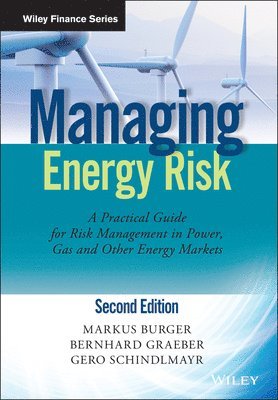
    Managing Energy Risk

    An Integrated View on Power and Other Energy Markets

    AvMarkus Burger,Bernhard Graeber

    Inbunden, Engelska, 2014

    Del i serien Wiley Finance Series

    1 318 kr

    Beställningsvara. Skickas inom 5-8 vardagar. Fri frakt över 249 kr.

    Fler format och utgåvor

    Inbunden

    1 295 kr

    Beskrivning

    An overview of today's energy markets from a multi-commodity perspective As global warming takes center stage in the public and private sectors, new debates on the future of energy markets and electricity generation have emerged around the world. The Second Edition of Managing Energy Risk has been updated to reflect the latest products, approaches, and energy market evolution. A full 30% of the content accounts for changes that have occurred since the publication of the first edition. Practitioners will appreciate this contemporary approach to energy and the comprehensive information on recent market influences.A new chapter is devoted to the growing importance of renewable energy sources, related subsidy schemes and their impact on energy markets. Carbon emissions certificates, post-Fukushima market shifts, and improvements in renewable energy generation are all included.Further, due to the unprecedented growth in shale gas production in recent years, a significant amount of material on gas markets has been added in this edition. Managing Energy Risk is now a complete guide to both gas and electricity markets, and gas-specific models like gas storage and swing contracts are given their due.The unique, practical approach to energy trading includes a comprehensive explanation of the interactions and relations between all energy commodities. Thoroughly revised to reflect recent changes in renewable energy, impacts of the financial crisis, and market fluctuations in the wake of FukushimaEmphasizes both electricity and gas, with all-new gas valuation models and a thorough description of the gas marketWritten by a team of authors with theoretical and practical expertise, blending mathematical finance and technical optimizationCovers developments in the European Union Emissions Trading Scheme, as well as coal, oil, natural gas, and renewablesThe latest developments in gas and power markets have demonstrated the growing importance of energy risk management for utility companies and energy intensive industry. By combining energy economics models and financial engineering, Managing Energy Risk delivers a balanced perspective that captures the nuances in the exciting world of energy.

    Produktinformation

    • Utgivningsdatum:2014-08-01
    • Mått:180 x 252 x 28 mm
    • Vikt:930 g
    • Format:Inbunden
    • Språk:Engelska
    • Serie:Wiley Finance Series
    • Antal sidor:448
    • Upplaga:2
    • Förlag:John Wiley & Sons Inc
    • ISBN:9781118618639

    Utforska kategorier

    • Energiindustri inom Ekonomi och Ledarskap
    • Finansiering inom Ekonomi och Ledarskap

    Mer om författaren

    DR MARKUS BURGER ­(Karlsruhe, Germany) is Director of Risk Manage­ment at EnBW Trading (­Energie Baden-Württemberg AG) a company specialising in ­energy ­trading, optimization and risk management. Markus has more than fifteen years’ experience in Commodity ­Trading, Finance and Risk Management. He has a PhD in mathematics from ­Karlsruhe Institute of Technology (KIT).DR BERNHARD GRAEBER (Karlsruhe, Germany) is Head of Infrastructure Investments at ­Talanx Asset ­Management. Prior to that he was head of Renewable Energies and International ­Climate Projects at EnBW AG and was res­ponsible for the coordination of all renewable ­energy ­activities within the EnBW group. Bernhard has a PhD in Energy Economics from Stuttgart ­University. DR GERO SCHINDLMAYR (Essen, Germany) is Head of Risk Control for asset-related trading at RWE ­Supply & Trading GmbH. Over the last fifteen years, Gero held various positions in the finance and energy industry in the area of quantitative modelling and risk management and is author of several ­research publications. He holds a PhD in mathematics from RWTH Aachen, University of Technology.

    Innehållsförteckning

    • Preface xiAcknowledgements xiii1 Energy Markets 11.1 Energy Trading 31.1.1 Spot Market 31.1.2 Forwards and Futures 41.1.3 Commodity Swaps 61.1.4 Options 61.1.5 Delivery Terms 61.2 The Oil Market 71.2.1 Consumption, Production and Reserves 71.2.2 Crude Oil Trading 101.2.3 Refined Oil Products 111.3 The Natural Gas Market 121.3.1 Consumption, Production and Reserves 131.3.2 Natural Gas Trading 151.3.3 Liquefied Natural Gas 191.4 The Coal Market 211.4.1 Consumption, Production and Reserves 211.4.2 Coal Trading 231.4.3 Freight 261.5 The Electricity Market 271.5.1 Consumption and Production 271.5.2 Electricity Trading 311.5.3 Electricity Exchanges 381.6 The Emissions Market 421.6.1 Kyoto Protocol 421.6.2 EU Emissions Trading Scheme 451.6.3 Flexible Mechanisms 461.6.4 Products and Marketplaces 481.6.5 Other Emissions Trading Schemes 512 Renewable Energy 552.1 The Role of Renewable Energy in Electricity Generation 552.1.1 Historical Development 552.1.2 Political Targets 582.1.3 Forecasts 592.2 The Role of Liquid Biofuels in the Transportation Sector 602.3 Renewable Energy Technologies 612.3.1 Hydropower 612.3.2 Wind Power 662.3.3 Solar Energy 692.3.4 Geothermal Energy 712.3.5 Bioenergy 732.3.6 Not Widespread Renewable Energies 772.4 Support Schemes for Renewable Energy 782.4.1 Feed-In Tariffs 802.4.2 Net Metering 832.4.3 Electric Utility Quota Obligations and Tradable Certificates 832.4.4 Auctions 852.4.5 Subsidies, Investment Grants and Tax Benefits 862.5 Key Economic Factors of Renewable Energy Projects 872.5.1 The Project Developer’s Perspective 872.5.2 The Project Investor’s Perspective 882.6 Risks in Renewable Energy Projects and their Mitigation 902.6.1 Project Development Risks 902.6.2 Construction Risks 932.6.3 Resource Risks 932.6.4 Technical Risks 962.6.5 Market Risks 972.6.6 Regulatory Risks 992.6.7 Other Operational Risks 1003 Risk Management 1013.1 Governance Principles and Market Regulation 1023.2 Market Risk 1043.2.1 Delta Position 1043.2.2 Variance Minimising Hedging 1103.2.3 Value-at-Risk 1113.2.4 Estimating Volatilities and Correlations 1203.2.5 Backtesting 1233.2.6 Liquidity-Adjusted Value-at-Risk 1233.2.7 Profit-at-Risk and Further Risk Measures 1273.3 Legal Risk 1303.4 Credit Risk 1343.4.1 Credit Rating 1373.4.2 Quantifying Credit Risk 1403.5 Liquidity Risk 1443.6 Operational Risk 1464 Retail Markets 1514.1 Interaction of Wholesale and Retail Markets 1514.2 Retail Products 1554.2.1 Fixed-Price Contracts 1554.2.2 Indexed Contracts 1564.2.3 Full Service Contracts 1574.2.4 Partial Delivery Contracts 1574.2.5 Portfolio Management 1584.2.6 Supplementary Products 1594.3 Sourcing 1604.3.1 Sourcing Fixed-Price Contracts 1604.3.2 Sourcing Indexed Contracts 1614.3.3 Sourcing B2C Contracts 1624.4 Load Forecasting 1634.5 Weather Risk in Gas Retail Markets 1654.5.1 Weather Derivatives 1684.6 Risk Premiums 1724.6.1 Risk-Adjusted Return on Capital 1744.6.2 Price Validity Period 1744.6.3 Structuring Fee and Balancing Energy 1754.6.4 Credit Risk 1764.6.5 Volume and Price Profile Risk 1774.6.6 Operational Risk 1814.6.7 Risk Premium Summary 1825 Energy Derivatives 1855.1 Forwards, Futures and Swaps 1865.1.1 Forward Contracts 1865.1.2 Futures Contracts 1895.1.3 Swaps 1915.2 Commodity Forward Curves 1925.2.1 Investment Assets 1945.2.2 Consumption Assets and Convenience Yield 1945.2.3 The Market Price of Risk 1965.3 “Plain Vanilla” Options 1975.3.1 The Put–Call Parity and Option Strategies 1985.3.2 Black’s Futures Price Model 2005.3.3 Option Pricing Formulas 2005.3.4 Hedging Options: The “Greeks” 2025.3.5 Implied Volatilities and the “Volatility Smile” 2085.3.6 Swaptions 2105.4 American, Bermudan and Asian Options 2125.4.1 American and Bermudan Options 2125.4.2 Asian Options 2135.5 Multi-Underlying Options 2165.5.1 Basket Options 2165.5.2 Spread Options 2185.5.3 Quanto and Composite Options 2215.6 Modelling Spot Prices 2245.6.1 Pricing Spot Price Options 2265.6.2 Geometric Brownian Motion as Spot Price Model 2315.6.3 The One-Factor Schwartz Model 2375.6.4 The Schwartz–Smith Model 2415.7 Stochastic Forward Curve Models 2465.7.1 One-Factor Forward Curve Models 2475.7.2 A Two-Factor Forward Curve Model 2495.7.3 A Multi-Factor Exponential Model 2516 Stochastic Models for Electricity and Gas 2536.1 Daily and Hourly Forward Curve Models 2536.1.1 Daily Price Forward Curve for Gas 2556.1.2 Hourly Price Forward Curve for Electricity 2576.2 Structural Electricity Price Models 2656.2.1 The SMaPS Model 2666.2.2 The Multi-Commodity SMaPS model 2696.2.3 Regime-Switching Models 2726.2.4 Virtual Power Plants 2786.3 Structural Gas Price Models 2816.3.1 Natural Gas Price Models 2816.3.2 Swing Options and Gas Storage 2866.3.3 Least-Squares Monte Carlo Method 2917 Fundamental Market Models 3017.1 Fundamental Price Drivers in Electricity Markets 3017.1.1 Demand Side 3027.1.2 Supply Side 3067.1.3 Interconnections 3137.2 Economic Power Plant Dispatch 3137.2.1 Thermal Power Plants 3157.2.2 Hydropower Plants 3227.2.3 Optimisation Methods 3257.3 Methodological Approaches 3357.3.1 Merit Order Curve 3357.3.2 Optimisation Models 3477.3.3 System Dynamics 3537.3.4 Game Theory 3577.4 Relevant System Information for Electricity Market Modelling 3667.4.1 Demand Side 3667.4.2 Supply Side 3677.4.3 Transmission System 3707.4.4 Historical Data for Backtesting 3717.4.5 Information Sources 3717.5 Application of Electricity Market Models 3727.6 Gas Market Models 3747.6.1 Demand Side 3757.6.2 Supply Side 3767.6.3 Transport 3797.6.4 Storage 3797.6.5 Portfolio Optimisation 3827.6.6 Formulation of the Market Model 3837.6.7 Application of Gas Market Models 3857.7 Market Models for Oil, Coal and CO2 Markets 3867.8 Asset Investment Decisions 3877.8.1 The Discounted Cashflow Method 3877.8.2 Weighted Average Cost of Capital 3897.8.3 The Capital Asset Pricing Model 390Appendix: Mathematical Background 393A.1 Econometric Methods 393A.1.1 Linear Regression 393A.1.2 Stationary Time Series and Unit Root Tests 395A.1.3 Principal Component Analysis 397A.1.4 Kalman Filtering Method 398A.1.5 Regime-Switching Models 399A.2 Stochastic Processes 402A.2.1 Conditional Expectation and Martingales 402A.2.2 Brownian Motion 402A.2.3 Stochastic Integration and Itô’s Lemma 403A.3 Option Pricing Theory 405A.3.1 Pricing Under the Risk-Neutral Measure 405A.3.2 The Feynman–Kac Theorem 408A.3.3 Monte Carlo Simulation 410References 413Index 419