• Fri frakt över 249 kr
  • •
  • Snabba leveranser
  • •
  • Billiga böcker
Kundservice

Du är på sajten för privatpersoner.

Företag, bibliotek eller offentlig verksamhet?

Du handlar på classic.bokus.com, där alla dina funktioner finns intakta.
Till classic.bokus.com
Bokus logotyp. Gå till startsidan.
  • Erbjudanden
  • Nyheter
  • Student
  • Topplistor
  • Barn & ungdom
  • Bokus Play
  • E-böcker
  • Pocketböcker
  • Spel & pussel

10% rabatt på allt med kod: NYSTART10 →

Sidfot

Mina sidor

    Hjälp

    • Kundservice
    • Vanliga frågor och svar
    • Frakt och leverans
    • Retur vid ångerrätt
    • Reklamera vara
    • Betalning
    • Köpvillkor
    • Allmänna villkor
    • Information om webbplatsens tillgänglighet

    Om Bokus

    • Om oss
    • Pressrum
    • För studenter
    • För företag
    • För bibliotek och offentlig verksamhet
    • För leverantörer
    • Hållbarhet

    Populärt

    • Aktuella erbjudanden
    • Presentkort
    • Studentlitteratur
    • Nya böcker
    • Topplistor
    • Signerade böcker
    • Engelska böcker

    Inspiration

    • Boktips
    • BookTok
    • Populära bokserier
    • Barnbokskaraktärer
    • Populära författare
    Logotyp för Bokus
    Följ oss på Facebook (extern länk)Följ oss på Instagram (extern länk)Följ oss på YouTube (extern länk)Följ oss på TikTok (extern länk)
    bokus @ CookiesAnpassa cookiesIntegritetspolicyKöpvillkor
    Till Citymail hemsida (extern länk)Till Budbee hemsida (extern länk)Till Postnord hemsida (extern länk)Till Schenker hemsida (extern länk)Till Early Bird hemsida (extern länk)Till Walleys hemsida (extern länk)
    1. Ekonomi och Ledarskap
    2. Ledarskapsböcker
    3. Projektledning

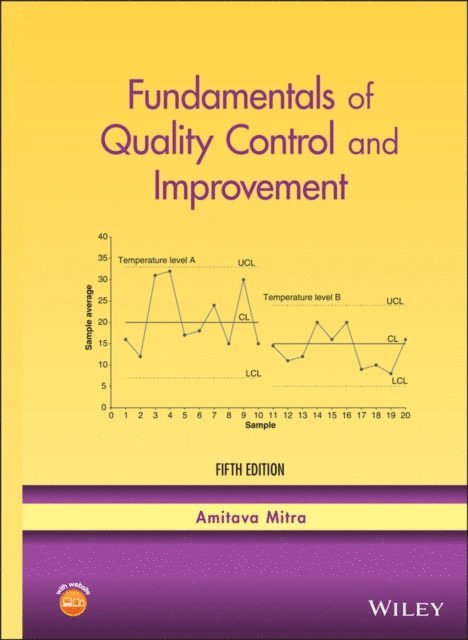
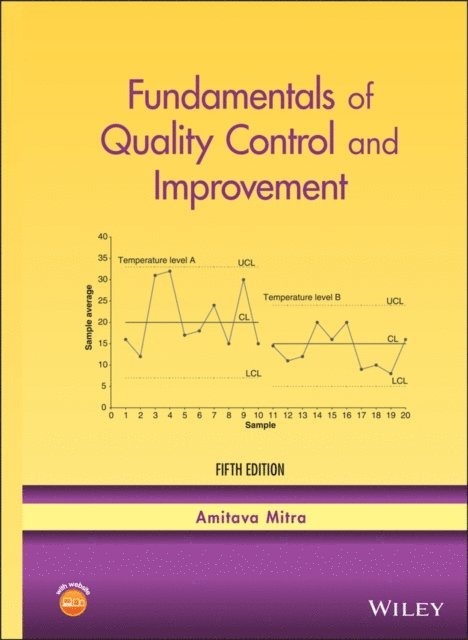
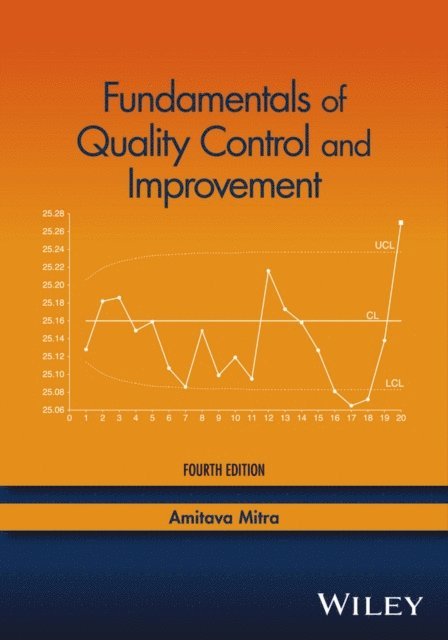
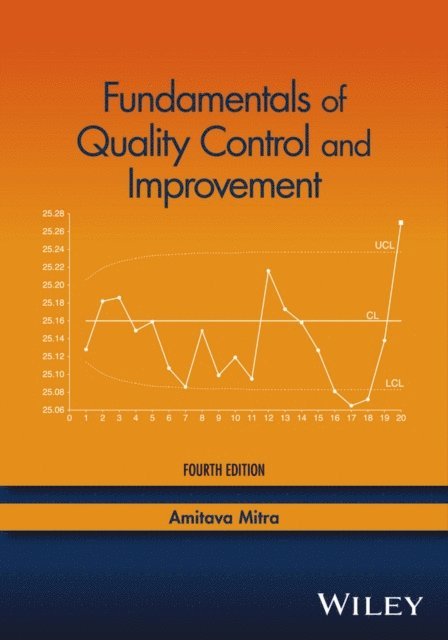
    Fundamentals of Quality Control and Improvement

    AvAmitava Mitra

    Inbunden, Engelska, 2016

    1 810 kr

    Beställningsvara. Skickas inom 5-8 vardagar. Fri frakt över 249 kr.

    Fler format och utgåvor

    E-bok

    2 003 kr

    E-bok

    2 019 kr

    Inbunden

    1 689 kr

    E-bok

    1 940 kr

    E-bok

    1 940 kr

    Beskrivning

    A statistical approach to the principles of quality control and managementIncorporating modern ideas, methods, and philosophies of quality management, Fundamentals of Quality Control and Improvement, Fourth Edition presents a quantitative approach to management-oriented techniques and enforces the integration of statistical concepts into quality assurance methods. Utilizing a sound theoretical foundation and illustrating procedural techniques through real-world examples, the timely new edition bridges the gap between statistical quality control and quality management. Promoting a unique approach, the book focuses on the use of experimental design concepts as well as the Taguchi method for creating product/process designs that successfully incorporate customer needs, improve lead time, and reduce costs. The Fourth Edition of Fundamentals of Quality Control and Improvement also includes: New topical coverage on risk-adjustment, capability indices, model building using regression, and survival analysis Updated examples and exercises that enhance the readers’ understanding of the conceptsDiscussions on the integration of statistical concepts to decision making in the realm of quality assurance Additional concepts, tools, techniques, and issues in the field of health care and health care quality A unique display and analysis of customer satisfaction data through surveys with strategic implications on decision making, based on the degree of satisfaction and the degree of importance of survey itemsFundamentals of Quality Control and Improvement, Fourth Edition is an ideal book for undergraduate and graduate-level courses in management, technology, and engineering. The book also serves as a valuable reference for practitioners and professionals interested in expanding their knowledge of statistical quality control, quality assurance, product/process design, total quality management, and/or Six Sigma training in quality improvement.

    Produktinformation

    • Utgivningsdatum:2016-06-21
    • Mått:185 x 259 x 48 mm
    • Vikt:1 565 g
    • Format:Inbunden
    • Språk:Engelska
    • Antal sidor:816
    • Upplaga:4
    • Förlag:John Wiley & Sons Inc
    • ISBN:9781118705148

    Utforska kategorier

    • Projektledning inom Ekonomi och Ledarskap

    Mer om författaren

    Amitava Mitra, PhD, is Professor in the Department of Systems and Technology and former associate dean in the College of Business at Auburn University, Alabama. He has published over seventy journal articles and currently teaches in the areas of quality assurance and improvement. Dr. Mitra has over thirty years of academic and professional experience, and has conducted courses for professionals in total quality management, quality assurance and statistical process control, design of experiments, and Six Sigma Black Belt training.

    Innehållsförteckning

    • Preface xixAbout the Companion Website xxiiiPart I Philosophy and Fundamentals 11 Introduction to Quality Control and the Total Quality System 31-1 Introduction and Chapter Objectives 31-2 Evolution of Quality Control 41-3 Quality 71-4 Quality Control 121-5 Quality Assurance 131-6 Quality Circles and Quality Improvement Teams 141-7 Customer Needs and Market Share 151-8 Benefits of Quality Control and the Total Quality System 161-9 Quality and Reliability 181-10 Quality Improvement 181-11 Product and Service Costing 191-12 Quality Costs 231-13 Measuring Quality Costs 271-14 Management of Quality 311-15 Quality and Productivity 341-16 Total Quality Environmental Management 37Summary 40Key Terms 41Exercises 41References 462 Some Philosophies and Their Impact on Quality 472-1 Introduction and Chapter Objectives 472-2 Service Industries and Their Characteristics 472-3 Model for Service Quality 532-4 W. Edwards Deming’s Philosophy 562-5 Philip B. Crosby’s Philosophy 752-6 Joseph M. Juran’s Philosophy 782-7 The Three Philosophies Compared 82Summary 85Key Terms 85Exercises 86References 883 Quality Management: Practices, Tools, and Standards 893-1 Introduction and Chapter Objectives 893-2 Management Practices 903-3 Quality Function Deployment 993-4 Benchmarking and Performance Evaluation 1063-5 Health Care Analytics 1153-6 Tools for Continuous Quality Improvement 1243-7 International Standards ISO 9000 and Other Derivatives 137Part II Statistical Foundations and Methods of Quality Improvement 1474 Fundamentals of Statistical Concepts and Techniques in Quality Control and Improvement 1494-1 Introduction and Chapter Objectives 1504-2 Population and Sample 1504-3 Parameter and Statistic 1504-4 Probability 1514-5 Descriptive Statistics: Describing Product or Process Characteristics 1564-6 Probability Distributions 1734-7 Inferential Statistics: Drawing Conclusions on Product and Process Quality 189Summary 212Appendix: Approximations to Some Probability Distributions 212Key Terms 215Exercises 216References 2285 Data Analyses and Sampling 2295-1 Introduction and Chapter Objectives 2295-2 Empirical Distribution Plots 2305-3 Randomness of a Sequence 2355-4 Validating Distributional Assumptions 2375-5 Transformations to Achieve Normality 2405-6 Analysis of Count Data 2445-7 Analysis of Customer Satisfaction Data 2485-8 Concepts in Sampling 257Summary 264Key Terms 265Exercises 266References 272Part III Statistical Process Control 2736 Statistical Process Control Using Control Charts 2756-1 Introduction and Chapter Objectives 2756-2 Causes of Variation 2776-3 Statistical Basis for Control Charts 2776-4 Selection of Rational Samples 2896-5 Analysis of Patterns in Control Charts 2906-6 Maintenance of Control Charts 294Summary 295Key Terms 295Exercises 295References 2987 Control Charts for Variables 2997-1 Introduction and Chapter Objectives 3007-2 Selection of Characteristics for Investigation 3017-3 Preliminary Decisions 3027-4 Control Charts for the Mean and Range 3037-5 Control Charts for the Mean and Standard Deviation 3217-6 Control Charts for Individual Units 3267-7 Control Charts for Short Production Runs 3307-8 Other Control Charts 3327-9 Risk-Adjusted Control Charts 3527-10 Multivariate Control Charts 359Summary 372Key Terms 373Exercises 374References 3878 Control Charts for Attributes 3898-1 Introduction and Chapter Objectives 3908-2 Advantages and Disadvantages of Attribute Charts 3908-3 Preliminary Decisions 3928-4 Chart for Proportion Nonconforming: p-Chart 3928-5 Chart for Number of Nonconforming Items: np-Chart 4098-6 Chart for Number of Nonconformities: c-Chart 4118-7 Chart for Number of Nonconformities Per Unit: u-Chart 4178-8 Chart for Demerits Per Unit: u-Chart 4238-9 Charts for Highly Conforming Processes 4268-10 Operating Characteristic Curves for Attribute Control Charts 431Summary 434Key Terms 435Exercises 435References 4489 Process Capability Analysis 4499-1 Introduction and Chapter Objectives 4499-2 Specification Limits and Control Limits 4509-3 Process Capability Analysis 4519-4 Natural Tolerance Limits 4539-5 Specifications and Process Capability 4549-6 Process Capability Indices 4579-7 Process Capability Analysis Procedures 4769-8 Capability Analysis for Nonnormal Distributions 4789-9 Setting Tolerances on Assemblies and Components 4809-10 Estimating Statistical Tolerance Limits of a Process 487Summary 489Key Terms 490Exercises 490References 499Part IV Acceptance Sampling 50110 Acceptance Sampling Plans for Attributes and Variables 50310-1 Introduction and Chapter Objectives 50410-2 Advantages and Disadvantages of Sampling 50410-3 Producer and Consumer Risks 50510-4 Operating Characteristic Curve 50510-5 Types of Sampling Plans 50910-6 Evaluating Sampling Plans 51110-7 Bayes Rule and Decision Making Based on Samples 51610-8 Lot-by-Lot Attribute Sampling Plans 51910-9 Other Attribute Sampling Plans 53710-10 Deming’s kp Rule 54010-11 Sampling Plans for Variables 54310-12 Variable Sampling Plans for a Process Parameter 54410-13 Variable Sampling Plans for Estimating the Lot Proportion Nonconforming 550Summary 555Key Terms 556Exercises 556References 562Part V Product and Process Design 56311 Reliability 56511-1 Introduction and Chapter Objectives 56511-2 Reliability 56611-3 Life-Cycle Curve and Probability Distributions in Modeling Reliability 56611-4 System Reliability 57011-5 Operating Characteristic Curves 57811-6 Reliability and Life Testing Plans 58011-7 Survival Analysis 588Summary 599Key Terms 599Exercises 600References 60312 Experimental Design and the Taguchi Method 60512-1 Introduction and Chapter Objectives 60612-2 Experimental Design Fundamentals 60612-3 Some Experimental Designs 61112-4 Factorial Experiments 63112-5 The Taguchi Method 65912-6 The Taguchi Philosophy 66012-7 Loss Functions 66312-8 Signal-to-Noise Ratio and Performance Measures 67012-9 Critique of S/N Ratios 67312-10 Experimental Design in the Taguchi Method 67412-11 Parameter Design in the Taguchi Method 69012-12 Critique of Experimental Design and the Taguchi Method 694Summary 696Key Terms 697Exercises 698References 70813 Process Modeling Through Regression Analysis 71113-1 Introduction and Chapter Objectives 71113-2 Deterministic and Probabilistic Models 71213-3 Model Assumptions 71413-4 Least Squares Method for Parameter Estimation 71613-5 Model Validation and Remedial Measures 72213-6 Estimation and Inferences from a Regression Model 72613-7 Qualitative Independent Variables 73213-9 Logistic Regression 742Summary 746Key Terms 747Exercises 748References 752Appendixes 753A-1 Cumulative Binomial Distribution 753A-2 Cumulative Poisson Distribution 758A-3 Cumulative Standard Normal Distribution 760A-4 Values of t for a Specified Right-Tail Area 763A-5 Chi-Squared Values for a Specified Right-Tail Area 765A-6 Values of F for a Specified Right-Tail Area 767A-7 Factors for Computing Centerline and Three-Sigma Control Limits 773A-8 Uniform Random Numbers 774Index 775