• Fri frakt över 249 kr
  • •
  • Snabba leveranser
  • •
  • Billiga böcker
Kundservice

Du är på sajten för privatpersoner.

Företag, bibliotek eller offentlig verksamhet?

Du handlar på classic.bokus.com, där alla dina funktioner finns intakta.
Till classic.bokus.com
Bokus logotyp. Gå till startsidan.
  • Erbjudanden
  • Nyheter
  • Student
  • Topplistor
  • Barn & ungdom
  • Bokus Play
  • E-böcker
  • Pocketböcker
  • Spel & pussel

10% rabatt på allt med kod: NYSTART10 →

Sidfot

Mina sidor

    Hjälp

    • Kundservice
    • Vanliga frågor och svar
    • Frakt och leverans
    • Retur vid ångerrätt
    • Reklamera vara
    • Betalning
    • Köpvillkor
    • Allmänna villkor
    • Information om webbplatsens tillgänglighet

    Om Bokus

    • Om oss
    • Pressrum
    • För studenter
    • För företag
    • För bibliotek och offentlig verksamhet
    • För leverantörer
    • Hållbarhet

    Populärt

    • Aktuella erbjudanden
    • Presentkort
    • Studentlitteratur
    • Nya böcker
    • Topplistor
    • Signerade böcker
    • Engelska böcker

    Inspiration

    • Boktips
    • BookTok
    • Populära bokserier
    • Barnbokskaraktärer
    • Populära författare
    Logotyp för Bokus
    Följ oss på Facebook (extern länk)Följ oss på Instagram (extern länk)Följ oss på YouTube (extern länk)Följ oss på TikTok (extern länk)
    bokus @ CookiesAnpassa cookiesIntegritetspolicyKöpvillkor
    Till Citymail hemsida (extern länk)Till Budbee hemsida (extern länk)Till Postnord hemsida (extern länk)Till Schenker hemsida (extern länk)Till Early Bird hemsida (extern länk)Till Walleys hemsida (extern länk)
    1. Naturvetenskap och teknik
    2. Matematik och naturvetenskap
    3. Fysik

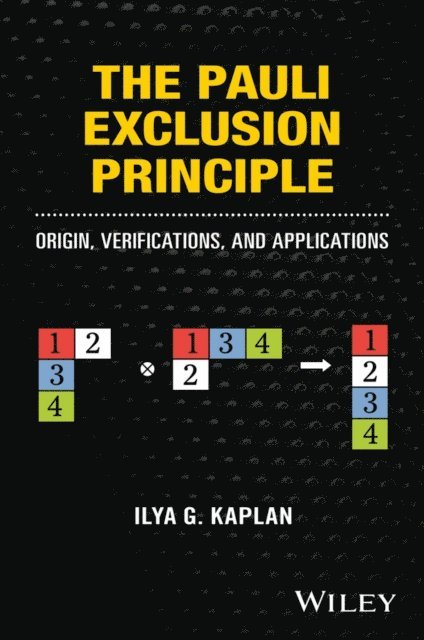
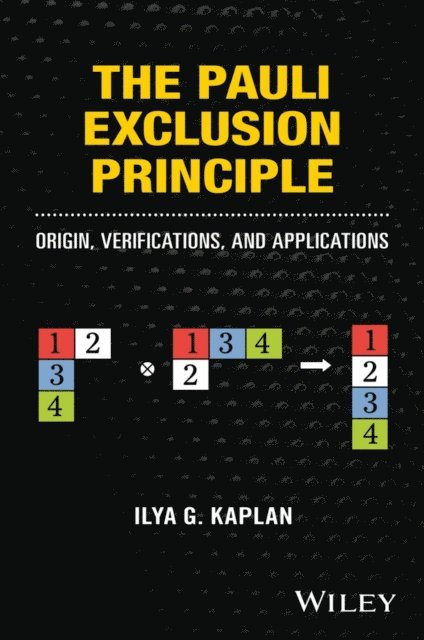
    Pauli Exclusion Principle

    Origin, Verifications, and Applications

    AvIlya G. Kaplan

    Inbunden, Engelska, 2016

    1 517 kr

    Beställningsvara. Skickas inom 5-8 vardagar. Fri frakt över 249 kr.

    Fler format och utgåvor

    E-bok

    1 767 kr

    E-bok

    1 767 kr

    Beskrivning

    This is the first scientic book devoted to the Pauli exclusion principle, which is a fundamental principle of quantum mechanics and is permanently applied in chemistry, physics, and molecular biology. However, while the principle has been studied for more than 90 years, rigorous theoretical foundations still have not been established and many unsolved problems remain.Following a historical survey in Chapter 1, the book discusses the still unresolved questions around this fundamental principle. For instance, why, according to the Pauli exclusion principle, are only symmetric and antisymmetric permutation symmetries for identical particles realized, while the Schrödinger equation is satisfied by functions with any permutation symmetry? Chapter 3 covers possible answers to this question. The construction of function with a given permutation symmetry is described in the previous Chapter 2, while Chapter 4 presents effective and elegant methods for finding the Pauli-allowed states in atomic, molecular, and nuclear spectroscopy. Chapter 5 discusses parastatistics and fractional statistics, demonstrating that the quasiparticles in a periodical lattice, including excitons and magnons, are obeying modified parafermi statistics.With detailed appendices, The Pauli Exclusion Principle: Origin, Verifications, and Applications is intended as a self-sufficient guide for graduate students and academic researchers in the fields of chemistry, physics, molecular biology and applied mathematics. It will be a valuable resource for any reader interested in the foundations of quantum mechanics and its applications, including areas such as atomic and molecular spectroscopy, spintronics, theoretical chemistry, and applied fields of quantum information.
    Produktinformation

    • Utgivningsdatum:2016-12-30
    • Mått:155 x 234 x 18 mm
    • Vikt:454 g
    • Format:Inbunden
    • Språk:Engelska
    • Antal sidor:250
    • Förlag:John Wiley & Sons Inc
    • ISBN:9781118795323

    Utforska kategorier

    • Fysik inom Naturvetenskap och teknik
    • Kvantfysik inom Naturvetenskap och teknik

    Mer om författaren

    Ilya G. Kaplan, Head of Department, Materials Research Institute, National Autonomous University of Mexico, MexicoIlya Kaplan has been studying the Pauli Exclusion Principle for more than 35 years and is a well-known scientist in this field. He has published 4 books in Russian, 4 books in English, including the Wiley title Intermolecular Interactions, and 11 book chapters, one of which was devoted to the Pauli Exclusion Principle. He was also an Associate Editor for Wiley's Handbook of Molecular Physics and Quantum Chemistry, published in 2003.

    Innehållsförteckning

    • Preface xi1 Historical Survey 11.1 Discovery of the Pauli Exclusion Principle and Early Developments 11.2 Further Developments and Still Existing Problems 11References 212 Construction of Functions with a Definite Permutation Symmetry 252.1 Identical Particles in Quantum Mechanics and Indistinguishability Principle 252.2 Construction of Permutation-Symmetric Functions Using the Young Operators 292.3 The Total Wave Functions as a Product of Spatial and Spin Wave Functions 362.3.1 Two-Particle System 362.3.2 General Case of N-Particle System 41References 493 Can the Pauli Exclusion Principle Be Proved? 503.1 Critical Analysis of the Existing Proofs of the Pauli Exclusion Principle 503.2 Some Contradictions with the Concept of Particle Identity and their Independence in the Case of the Multidimensional Permutation Representations 56References 624 Classification of the Pauli-Allowed States in Atoms and Molecules 644.1 Electrons in a Central Field 644.1.1 Equivalent Electrons: L–S Coupling 644.1.2 Additional Quantum Numbers: The Seniority Number 714.1.3 Equivalent Electrons: j–j Coupling 724.2 The Connection between Molecular Terms and Nuclear Spin 744.2.1 Classification of Molecular Terms and the Total Nuclear Spin 744.2.2 The Determination of the Nuclear Statistical Weights of Spatial States 794.3 Determination of Electronic Molecular Multiplets 824.3.1 Valence Bond Method 824.3.2 Degenerate Orbitals and One Valence Electron on Each Atom 874.3.3 Several Electrons Specified on One of the Atoms 914.3.4 Diatomic Molecule with Identical Atoms 934.3.5 General Case I 984.3.6 General Case II 100References 1045 Parastatistics, Fractional Statistics, and Statistics of Quasiparticles of Different Kind 1065.1 Short Account of Parastatistics 1065.2 Statistics of Quasiparticles in a Periodical Lattice 1095.2.1 Holes as Collective States 1095.2.2 Statistics and Some Properties of Holon Gas 1115.2.3 Statistics of Hole Pairs 1175.3 Statistics of Cooper’s Pairs 1215.4 Fractional Statistics 1245.4.1 Eigenvalues of Angular Momentum in the Three- and Two-Dimensional Space 1245.4.2 Anyons and Fractional Statistics 128References 133Appendix A: Necessary Basic Concepts and Theorems of Group Theory 135A.1 Properties of Group Operations 135A.1.1 Group Postulates 135A.1.2 Examples of Groups 137A.1.3 Isomorphism and Homomorphism 138A.1.4 Subgroups and Cosets 139A.1.5 Conjugate Elements. Classes 140A.2 Representation of Groups 141A.2.1 Definition 141A.2.2 Vector Spaces 142A.2.3 Reducibility of Representations 145A.2.4 Properties of Irreducible Representations 147A.2.5 Characters 148A.2.6 The Decomposition of a Reducible Representation 149A.2.7 The Direct Product of Representations 151A.2.8 Clebsch–Gordan Coefficients 154A.2.9 The Regular Representation 156A.2.10 The Construction of Basis Functions for Irreducible Representation 157References 160Appendix B: The Permutation Group 161B.1 General Information 161B.1.1 Operations with Permutation 161B.1.2 Classes 164B.1.3 Young Diagrams and Irreducible Representations 165B.2 The Standard Young–Yamanouchi Orthogonal Representation 167B.2.1 Young Tableaux 167B.2.2 Explicit Determination of the Matrices of the Standard Representation 170B.2.3 The Conjugate Representation 173B.2.4 The Construction of an Antisymmetric Function from the Basis Functions for Two Conjugate Representations 175B.2.5 Young Operators 176B.2.6 The Construction of Basis Functions for the Standard Representation from a Product of N Orthogonal Functions 178References 181Appendix C: The Interconnection between Linear Groups and Permutation Groups 182C.1 Continuous Groups 182C.1.1 Definition 182C.1.2 Examples of Linear Groups 185C.1.3 Infinitesimal Operators 187C.2 The Three-Dimensional Rotation Group 189C.2.1 Rotation Operators and Angular Momentum Operators 189C.2.2 Irreducible Representations 191C.2.3 Reduction of the Direct Product of Two Irreducible Representations 194C.2.4 Reduction of the Direct Product of k Irreducible Representations. 3n − j Symbols 197C.3 Tensor Representations 201C.3.1 Construction of a Tensor Representation 201C.3.2 Reduction of a Tensor Representation into Reducible Components 202C.3.3 Littlewood’s Theorem 207C.3.4 The Reduction of U2j + 1 R3 209C.4 Tables of the Reduction of the Representations U λ 2j+1 to the Group R3 214References 216Appendix D: Irreducible Tensor Operators 217D.1 Definition 217D.2 The Wigner–Eckart Theorem 220References 222Appendix E: Second Quantization 223References 227Index 228