• Fri frakt över 249 kr
  • •
  • Snabba leveranser
  • •
  • Billiga böcker
Kundservice

Du är på sajten för privatpersoner.

Företag, bibliotek eller offentlig verksamhet?

Du handlar på classic.bokus.com, där alla dina funktioner finns intakta.
Till classic.bokus.com
Bokus logotyp. Gå till startsidan.
  • Erbjudanden
  • Nyheter
  • Student
  • Topplistor
  • Barn & ungdom
  • Bokus Play
  • E-böcker
  • Pocketböcker
  • Spel & pussel

Må bättre, för mindre! Upp till 50% rabatt på hälsoböcker

Sidfot

Mina sidor

    Hjälp

    • Kundservice
    • Vanliga frågor och svar
    • Frakt och leverans
    • Retur vid ångerrätt
    • Reklamera vara
    • Betalning
    • Köpvillkor
    • Allmänna villkor
    • Information om webbplatsens tillgänglighet

    Om Bokus

    • Om oss
    • Pressrum
    • För studenter
    • För företag
    • För bibliotek och offentlig verksamhet
    • För leverantörer
    • Hållbarhet

    Populärt

    • Aktuella erbjudanden
    • Presentkort
    • Studentlitteratur
    • Nya böcker
    • Topplistor
    • Signerade böcker
    • Engelska böcker

    Inspiration

    • Boktips
    • BookTok
    • Populära bokserier
    • Barnbokskaraktärer
    • Populära författare
    Logotyp för Bokus
    Följ oss på Facebook (extern länk)Följ oss på Instagram (extern länk)Följ oss på YouTube (extern länk)Följ oss på TikTok (extern länk)
    bokus @ CookiesAnpassa cookiesIntegritetspolicyKöpvillkor
    Till Citymail hemsida (extern länk)Till Budbee hemsida (extern länk)Till Postnord hemsida (extern länk)Till Schenker hemsida (extern länk)Till Early Bird hemsida (extern länk)Till Walleys hemsida (extern länk)
    1. Ekonomi och Ledarskap
    2. Ledarskapsböcker
    3. Projektledning

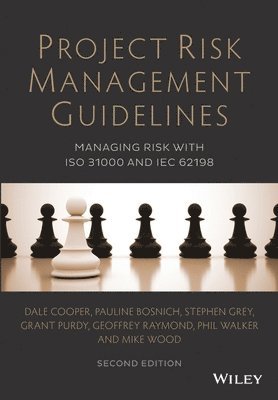
    Project Risk Management Guidelines

    Managing Risk with ISO 31000 and IEC 62198

    AvDale Cooper,Pauline Bosnich

    Häftad, Engelska, 2014

    881 kr

    Beställningsvara. Skickas inom 5-8 vardagar. Fri frakt över 249 kr.

    Beskrivning

    Risk runs through the fabric of any project.  It is so intimately bound up in forecasting and decision making that it cannot be isolated or handled separately from other project management activities.  Success can only be achieved if risk management is integrated closely with project management.Over the past decade, developments in risk management methods and standards have addressed the need to manage risk in a project in an integrated manner.  This is a more natural way of working than past practices have been.  It has beneficial effects on the practice of risk management and the way it is implemented in projects.This new edition of Project Risk Management Guidelines has been fully updated to include the new international standards that embody this principle, ISO 31000 Risk management and IEC 62198 Managing risk in projects.  The book explains the standards and how they can be applied.  It provides a clear introduction to basic project risk management, introduces the reader to specialized areas of projects and procurement, and shows how quantitative risk analysis methods can be used in large projects.Chapter by chapter, the authors present simple, practical steps and illustrate them with examples drawn from their extensive experience from around the world, in many different industry sectors and cultures and at all stages of projects from conception through development and into execution. Qualitative and quantitative approaches are covered. Traditional structures and processes are discussed as well as developments in the way projects are conducted, such as outsourcing arrangements and risk-sharing structures like public–private partnerships.Improved outcomes can be achieved when sound risk management is used to capture opportunities and reduce threats. Its unique focus and wealth of checklists, tables and other resources make this book an essential and enduring tool for anyone involved with project work.

    Produktinformation

    • Utgivningsdatum:2014-03-07
    • Mått:170 x 244 x 25 mm
    • Vikt:726 g
    • Format:Häftad
    • Språk:Engelska
    • Antal sidor:432
    • Upplaga:2
    • Förlag:John Wiley & Sons Inc
    • ISBN:9781118820315

    Utforska kategorier

    • Projektledning inom Ekonomi och Ledarskap

    Mer om författaren

    Dale Cooper has over twenty-five years of international experience with risk management for large and complex projects. He is a Fellow of the Australian Institute of Company Directors, an Affiliate of the Securities Institute of Australia, a member of the Risk Engineering Society and the Society for Risk Analysis, and an accredited provider of risk management consulting services to government agencies in Australia and New Zealand. Since late 1991, Dale Cooper has run Broadleaf Capital International, a consulting company that specialises in high-level strategic, organisational and project risk analysis, for both public and private sector clients. His risk consulting activities have included assignments in North America, Europe, Australasia, Asia and the Middle East. He is a member of the Standards Australia Technical Committee that developed the risk management standard AS/NZS 4360 and associated handbooks.Pauline Brosnich worked in engineering companies, providing risk management support with an emphasis on maximizing safety and optimizing reliability and operation of projects. She has worked extensively in the minerals, resources and transport industries. providing advice on risk management and facilitating risk workshops for projects and for operations. At Broadleaf, she has continued providing risk advice for customers in these areas as well as for Defence, government and not-for-profit organisations. She has developed in the area of providing and implementing risk management frameworks that are tailored to the individual requirements of specific organisations.Stephen Grey is an experienced risk management practitioner specialising in project, organisational and strategic risk applications. He has worked with many private and public sector organisations in the UK, Europe, Australia and New Zealand for over fifteen years. Stephen is actively involved in the development of risk management practices around the world. He is a member of the Risk Engineering Society within the Institution of Engineers (Australia), a member of the Special Interest Group on Project Risk Management of the UK Association for Project Management and Director of Region IV, Asia and Pacific, of the Risk Special Interest Group of the US based Project Management Institute. He is an Associate Director of Broadleaf Capital International.Geoff Raymond is a highly experienced risk management consultant, facilitator and trainer. He has significant recent experience in the conduct of qualitative and quantitative risk assessments, hazard analyses and value management studies in a variety of contexts. Prior to joining Broadleaf Capital International as an Associate Director in 1996, he established the Risk Engineering Services business unit at BHP Engineering. His main activities are in strategic planning, corporate and project risk analysis and risk management training, for both public and private sector clients.Phil Walker had a long career in the Australian Department of Defence, culminating in responsibility for very large defence projects, prior to joining Broadleaf as an Associate Director in 1999. While in Defence, Phil managed very large and complex projects with large multi-skilled teams scattered in many locations worldwide. His skills and expertise in projects centre on business, finance and contractual matters, although he has a strong technical knowledge. Phil has worked with the US Navy for three year in Philadelphia on a number of large scale maritime projects and initiatives.

    Innehållsförteckning

    • About the Authors viiForeword to the Second Edition xiPreface xiiiAcknowledgements xvIntroduction to Project Risk Management xviiPart I Project Risk Management: Principles and Framework 1Chapter 1 Principles of Effective Project Risk Management 3Chapter 2 Project Phases and Approval Decisions 9Chapter 3 Framework for Managing Risk in Projects 23Part II The Project Risk Management Process 33Chapter 4 The Approach to Managing Risk in Projects 35Chapter 5 Communication and Consultation 41Chapter 6 Establish the Context 49Chapter 7 Risk Identification 69Chapter 8 Qualitative Risk Analysis and Risk Evaluation 77Chapter 9 Semi-Quantitative Risk Assessment for Systems and Sub-Systems 95Chapter 10 Risk Treatment 105Chapter 11 Monitoring and Review 117Chapter 12 Recording and Reporting 123Chapter 13 Managing Opportunities 129Chapter 14 Simplifying the Process 141Part III Quantitative Risk Analysis for Projects 151Chapter 15 Introduction to Quantification for Project Risks 153Chapter 16 Cost Risk Assessment 173Chapter 17 Schedule Risk Analysis 197Chapter 18 Investment Evaluation for Large Projects 219Chapter 19 Risk Analysis and Economic Appraisal 241Part IV Extending the Process 251Chapter 20 Contracts and Risk Allocation 253Chapter 21 Case Study: Tender Evaluation 265Chapter 22 Market Testing and Outsourcing 271Chapter 23 Public–Private Partnerships and Private Financing 283Chapter 24 Technical Tools and Techniques 303Chapter 25 Managing Environment-Related Risks 323Chapter 26 Climate Change 345Part V Additional Information and Supporting Material 351Chapter 27 Other Approaches to Project Risk Management 353Chapter 28 Risk Management Process Checklist 361Chapter 29 Worksheets and Evaluation Tables 365Chapter 30 Examples of Risks and Treatments 381Glossary 393References 397Index 401