• Fri frakt över 249 kr
  • •
  • Snabba leveranser
  • •
  • Billiga böcker
Kundservice

Du är på sajten för privatpersoner.

Företag, bibliotek eller offentlig verksamhet?

Du handlar på classic.bokus.com, där alla dina funktioner finns intakta.
Till classic.bokus.com
Bokus logotyp. Gå till startsidan.
  • Erbjudanden
  • Nyheter
  • Student
  • Topplistor
  • Barn & ungdom
  • Bokus Play
  • E-böcker
  • Pocketböcker
  • Spel & pussel

10% rabatt på allt med kod: NYSTART10 →

Sidfot

Mina sidor

    Hjälp

    • Kundservice
    • Vanliga frågor och svar
    • Frakt och leverans
    • Retur vid ångerrätt
    • Reklamera vara
    • Betalning
    • Köpvillkor
    • Allmänna villkor
    • Information om webbplatsens tillgänglighet

    Om Bokus

    • Om oss
    • Pressrum
    • För studenter
    • För företag
    • För bibliotek och offentlig verksamhet
    • För leverantörer
    • Hållbarhet

    Populärt

    • Aktuella erbjudanden
    • Presentkort
    • Studentlitteratur
    • Nya böcker
    • Topplistor
    • Signerade böcker
    • Engelska böcker

    Inspiration

    • Boktips
    • BookTok
    • Populära bokserier
    • Barnbokskaraktärer
    • Populära författare
    Logotyp för Bokus
    Följ oss på Facebook (extern länk)Följ oss på Instagram (extern länk)Följ oss på YouTube (extern länk)Följ oss på TikTok (extern länk)
    bokus @ CookiesAnpassa cookiesIntegritetspolicyKöpvillkor
    Till Citymail hemsida (extern länk)Till Budbee hemsida (extern länk)Till Postnord hemsida (extern länk)Till Schenker hemsida (extern länk)Till Early Bird hemsida (extern länk)Till Walleys hemsida (extern länk)
    1. Naturvetenskap och teknik
    2. Matematik och naturvetenskap
    3. Fysik

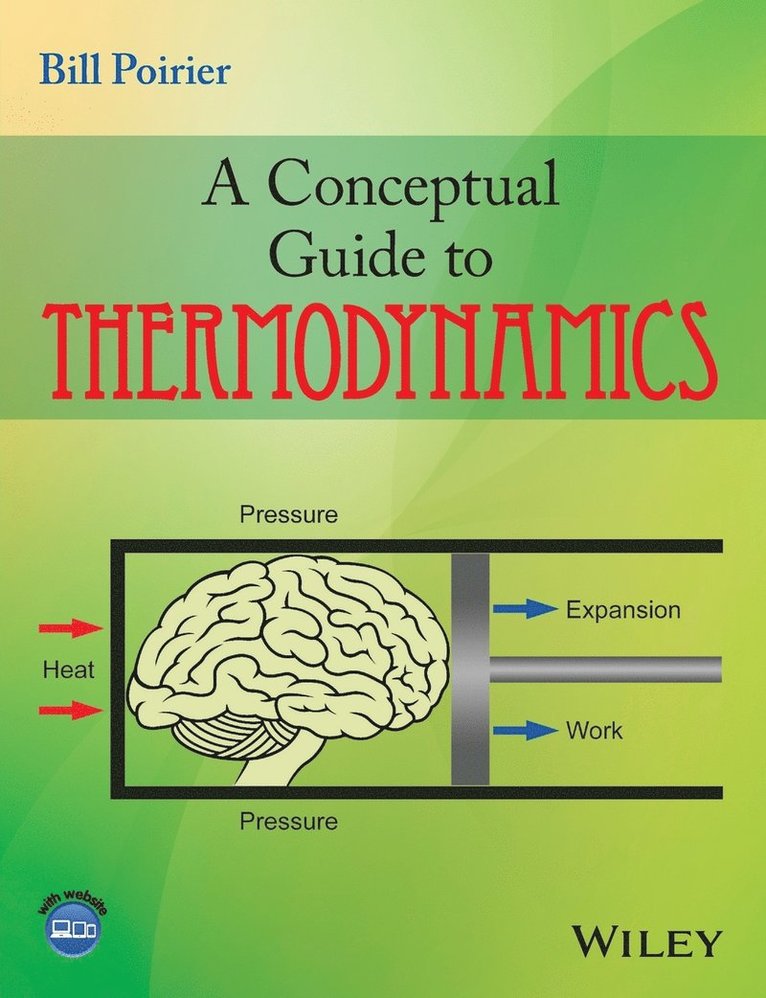
    Conceptual Guide to Thermodynamics

    AvBill Poirier

    Häftad, Engelska, 2014

    526 kr

    Beställningsvara. Skickas inom 5-8 vardagar. Fri frakt över 249 kr.

    Fler format och utgåvor

    E-bok

    599 kr

    E-bok

    601 kr

    Beskrivning

    Thermodynamics is the science that describes the behavior of matter at the macroscopic scale, and how this arises from individual molecules. As such, it is a subject of profound practical and fundamental importance to many science and engineering fields. Despite extremely varied applications ranging from nanomotors to cosmology, the core concepts of thermodynamics such as equilibrium and entropy are the same across all disciplines. A Conceptual Guide to Thermodynamics serves as a concise, conceptual and practical supplement to the major thermodynamics textbooks used in various fields. Presenting clear explanations of the core concepts,  the book aims to improve fundamental understanding of the material, as well as homework and exam performance. Distinctive features include: Terminology and Notation Key:  A universal translator that addresses the myriad of conventions, terminologies, and notations found across the major thermodynamics texts.Content Maps:  Specific references to each major thermodynamic text by section and page number for each new concept that is introduced.Helpful Hints and Don’t Try Its:  Numerous useful tips for solving problems, as well as warnings of common student pitfalls.Unique Explanations: Conceptually clear, mathematically fairly simple, yet also sufficiently precise and rigorous. A more extensive set of reference materials,  including older and newer editions of the major textbooks, as well as a number of less commonly used titles, is available online at http://www.conceptualthermo.com. Undergraduate and graduate students of chemistry, physics, engineering, geosciences and biological sciences will benefit from this book, as will students preparing for graduate school entrance exams and MCATs.

    Produktinformation

    • Utgivningsdatum:2014-09-05
    • Mått:191 x 245 x 9 mm
    • Vikt:363 g
    • Format:Häftad
    • Språk:Engelska
    • Antal sidor:192
    • Förlag:John Wiley & Sons Inc
    • ISBN:9781118840535

    Utforska kategorier

    • Fysik inom Naturvetenskap och teknik

    Mer om författaren

    Professor Bill Poirier, Department of Chemistry & Biochemistry, Texas Tech University, USAProfessor Poirier is Professor of Chemistry and Biochemistry and Joint Professor of Physics at Texas Tech University, where he has held research positions since 2001. His research is concerned with the development and application of new methods for performing accurate quantum dynamics calculations with unprecedented computational efficiency, to allow calculations for larger systems than ever before. This has wide ranging applications in areas including astrophysics, environmental, atmospheric and combustion chemistry, materials, and hydrogen storage.Professor Poirier has extensive teaching experience at undergraduate and graduate level, teaching undergraduate courses in general chemistry and physical chemistry, and graduate courses in chemical kinetics, molecular spectroscopy and statistical mechanics.

    Recensioner i media

    “Useful for students and professionals in numerous areas, including biology, chemistry, physics, and engineering. . . Summing Up: Recommended. Upper-division undergraduates and above.”  (Choice, 1 April 2015)

    Innehållsförteckning

    • Preface xiAcknowledgments xiiiTextbook Guide xv0.1 List of Thermodynamics Textbooks by Discipline xv0.2 Terminology and Notation Used in This Book xvi0.3 Terminology and Notation Used in Textbooks xviii1 About This Book 11.1 Who Should Use This Book? 21.2 Philosophy of This Book 31.3 Four Core Concepts of Thermodynamics 31.4 How to Use This Book 5I Equilibrium2 Philosophy of Thermodynamics 112.1 Thermodynamics 112.2 Scientific Models & Laws 122.3 Statistical Mechanics 143 Thermodynamic States, Variables & Quantities 173.1 Thermodynamic Variables & Quantities 173.2 More on Thermodynamic Quantities 193.3 Thermodynamic & Molecular States 204 Zeroth Law & Thermodynamic Equilibrium 234.1 Equation of State 234.2 Thermodynamic Equilibrium 264.3 Zeroth Law 274.4 Ideal Gases & Non-ideal Systems 29II Energy5 Molecular Energy, Internal Energy, & Temperature 335.1 Energy at the Molecular Scale 335.2 Internal Energy 355.3 Intermolecular Interactions & the Kinetic Model 375.4 Equipartition Theorem & Temperature 386 Boltzmann Distribution & the Kinetic Model 416.1 Boltzmann Distribution 416.2 Maxwell-Boltzmann Distribution 426.3 Maxwell Distribution of Speeds 44III Thermodynamic Change7 First Law & Thermodynamic Change 497.1 System & Surroundings 497.2 Thermodynamic Change 507.3 First Law 528 Work, Heat, & Reversible Change 558.1 State Functions & Path Functions 558.2 Definition of Work 578.3 Definition of Heat 598.4 Reversible & Irreversible Change 608.5 A Gas Expansion Example 629 Partial Derivative Quantities 659.1 Internal Energy & Heat Capacity at Constant Volume 669.2 Enthalpy & Heat Capacity at Constant Pressure 679.3 Other Partial Derivative Quantities 709.4 Partial Derivatives & Differentials 71IV Entropy10 Entropy & Information Theory 7710.1 Why Does Entropy Seem So Complicated? 7710.2 Entropy as Unknown Molecular Information 7910.3 Amount of Information 8010.4 Application to Thermodynamics 8411 Entropy & Ideal Gas 8711.1 Measuring Our Molecular Ignorance 8711.2 Volume Contribution to Entropy 8811.3 Temperature Contribution to Entropy 9111.4 Combined Entropy Expression 9211.5 Entropy, Heat, & Reversible Adiabatic Expansion 9412 Second Law & Spontaneous Irreversible Change 9712.1 Heat Engines & Thermodynamic Cycles 9712.2 Traditional Statements of the Second Law 9812.3 Entropy Statement of the Second Law 9912.4 Information Statement of the Second Law 10012.5 Maximum Entropy & the Clausius Inequality 10313 Third Law, Carnot Cycle, & Absolute Entropy 10713.1 Entropy & Reversible Change 10713.2 Carnot Cycle & Absolute Zero Temperature 10913.3 Third Law & Absolute Entropy 111V Free Energy14 Free Energy & Exergy 11514.1 What Would Happen If Entropy Were a Variable? 11614.2 Helmholtz and Gibbs Free Energies 11714.3 Second Law & Maximum Work 11914.4 Exergy 12115 Chemical Potential, Fugacity, & Open Systems 12315.1 What Would Happen If n Were a Variable? 12315.2 Chemical Potential 12515.3 Ideal Gas & Fugacity 126VI Applications16 Crazy Gay-Lussac’s Gas Expansion Emporium 13116.1 Sales Pitch 13116.2 How to Solve Gas Expansion Problems 13216.3 Comprehensive Compendium 13517 Electronic Emporium: Free Online Shopping! 139VII AppendicesAppendix A: Beards Gone Wild! Facial Hair & the Founding Fathers of Thermodynamics 143Appendix B: Thermodynamics, Abolitionism, & Sha Na Na 147Appendix C: Thermodynamics & the Science of Steampunk 149Steampunk Gallery 151Travel Try Its 153Photo Credits 155Index 159