• Fri frakt över 249 kr
  • •
  • Snabba leveranser
  • •
  • Billiga böcker
Kundservice

Du är på sajten för privatpersoner.

Företag, bibliotek eller offentlig verksamhet?

Du handlar på classic.bokus.com, där alla dina funktioner finns intakta.
Till classic.bokus.com
Bokus logotyp. Gå till startsidan.
  • Erbjudanden
  • Nyheter
  • Student
  • Topplistor
  • Barn & ungdom
  • Bokus Play
  • E-böcker
  • Pocketböcker
  • Spel & pussel

10% rabatt på allt med kod NYSTART10 →

Sidfot

Mina sidor

    Hjälp

    • Kundservice
    • Vanliga frågor och svar
    • Frakt och leverans
    • Retur vid ångerrätt
    • Reklamera vara
    • Betalning
    • Köpvillkor
    • Allmänna villkor
    • Information om webbplatsens tillgänglighet

    Om Bokus

    • Om oss
    • Pressrum
    • För studenter
    • För företag
    • För bibliotek och offentlig verksamhet
    • För leverantörer
    • Hållbarhet

    Populärt

    • Aktuella erbjudanden
    • Presentkort
    • Studentlitteratur
    • Nya böcker
    • Topplistor
    • Signerade böcker
    • Engelska böcker

    Inspiration

    • Boktips
    • BookTok
    • Populära bokserier
    • Barnbokskaraktärer
    • Populära författare
    Logotyp för Bokus
    Följ oss på Facebook (extern länk)Följ oss på Instagram (extern länk)Följ oss på YouTube (extern länk)Följ oss på TikTok (extern länk)
    bokus @ CookiesAnpassa cookiesIntegritetspolicyKöpvillkor
    Till Citymail hemsida (extern länk)Till Budbee hemsida (extern länk)Till Postnord hemsida (extern länk)Till Schenker hemsida (extern länk)Till Early Bird hemsida (extern länk)Till Walleys hemsida (extern länk)
    1. Data och IT
    2. Systemvetenskap och AI

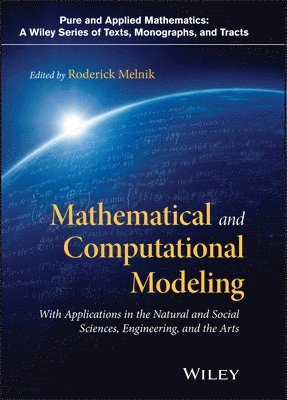
    Mathematical and Computational Modeling

    With Applications in Natural and Social Sciences, Engineering, and the Arts

    AvRoderick Melnik,Roderick Melnik

    Inbunden, Engelska, 2015

    Del i serien Pure and Applied Mathematics: A Wiley Series of Texts, Monographs and Tracts

    1 170 kr

    Beställningsvara. Skickas inom 5-8 vardagar. Fri frakt över 249 kr.

    Beskrivning

    Mathematical and Computational Modeling Illustrates the application of mathematical and computational modeling in a variety of disciplines With an emphasis on the interdisciplinary nature of mathematical and computational modeling, Mathematical and Computational Modeling: With Applications in the Natural and Social Sciences, Engineering, and the Arts features chapters written by well-known, international experts in these fields and presents readers with a host of state-of-theart achievements in the development of mathematical modeling and computational experiment methodology. The book is a valuable guide to the methods, ideas, and tools of applied and computational mathematics as they apply to other disciplines such as the natural and social sciences, engineering, and technology. The book also features: Rigorous mathematical procedures and applications as the driving force behind mathematical innovation and discoveryNumerous examples from a wide range of disciplines to emphasize the multidisciplinary application and universality of applied mathematics and mathematical modelingOriginal results on both fundamental theoretical and applied developments in diverse areas of human knowledgeDiscussions that promote interdisciplinary interactions between mathematicians, scientists, and engineersMathematical and Computational Modeling: With Applications in the Natural and Social Sciences, Engineering, and the Arts is an ideal resource for professionals in various areas of mathematical and statistical sciences, modeling and simulation, physics, computer science, engineering, biology and chemistry, and industrial and computational engineering. The book also serves as an excellent textbook for graduate courses in mathematical modeling, applied mathematics, numerical methods, operations research, and optimization.

    Produktinformation

    • Utgivningsdatum:2015-06-23
    • Mått:163 x 243 x 23 mm
    • Vikt:590 g
    • Format:Inbunden
    • Språk:Engelska
    • Serie:Pure and Applied Mathematics: A Wiley Series of Texts, Monographs and Tracts
    • Antal sidor:336
    • Förlag:John Wiley & Sons Inc
    • ISBN:9781118853986

    Utforska kategorier

    • Systemvetenskap och AI inom Data och IT
    • Tillämpad matematik inom Naturvetenskap och teknik

    Mer om författaren

    RODERICK MELNIK, PhD, is Professor in the Department of Mathematics at Wilfrid Laurier University, Canada, where he is also Tier I Canada Research Chair in Mathematical Modeling. He is internationally known for his research in computational and applied mathematics, numerical analysis, and mathematical modeling for scientific and engineering applications. Dr. Melnik is the recipient of many awards, including a number of prestigious fellowships in Italy, Denmark, England and Spain. He has published over 300 refereed research papers and has served on editorial boards of numerous international journals and book series. Currently, Dr. Melnik is Director of the MS2Discovery Interdisciplinary Research Institute in Waterloo, Canada.

    Innehållsförteckning

    • List of Contributors xiiiPreface xvSection 1 Introduction 11 Universality of Mathematical Models in Understanding Nature Society and Man-Made World 3Roderick Melnik1.1 Human Knowledge Models and Algorithms 31.2 Looking into the Future from a Modeling Perspective 71.3 What This Book Is About 101.4 Concluding Remarks 15References 16Section 2 Advanced Mathematical and Computational Models in Physics and Chemistry 172 Magnetic Vortices Abrikosov Lattices and Automorphic Functions 19Israel Michael Sigal2.1 Introduction 192.2 The Ginzburg–Landau Equations 202.2.1 Ginzburg–Landau energy 212.2.2 Symmetries of the equations 212.2.3 Quantization of flux 222.2.4 Homogeneous solutions 222.2.5 Type I and Type II superconductors 232.2.6 Self-dual case κ=1/ √ 2 242.2.7 Critical magnetic fields 242.2.8 Time-dependent equations 252.3 Vortices 252.3.1 n-vortex solutions 252.3.2 Stability 262.4 Vortex Lattices 302.4.1 Abrikosov lattices 312.4.2 Existence of Abrikosov lattices 312.4.3 Abrikosov lattices as gauge-equivariant states 342.4.4 Abrikosov function 342.4.5 Comments on the proofs of existence results 352.4.6 Stability of Abrikosov lattices 402.4.7 Functions γ δ (τ),δ >0 422.4.8 Key ideas of approach to stability 452.5 Multi-Vortex Dynamics 482.6 Conclusions 51Appendix 2.A Parameterization of the equivalence classes [L] 51Appendix 2.B Automorphy factors 52References 543 Numerical Challenges in a Cholesky-Decomposed Local Correlation Quantum Chemistry Framework 59David B. Krisiloff, Johannes M. Dieterich, Florian Libisch and Emily A. Carter3.1 Introduction 593.2 Local MRSDCI 613.2.1 Mrsdci 613.2.2 Symmetric group graphical approach 623.2.3 Local electron correlation approximation 643.2.4 Algorithm summary 663.3 Numerical Importance of Individual Steps 673.4 Cholesky Decomposition 683.5 Transformation of the Cholesky Vectors 713.6 Two-Electron Integral Reassembly 723.7 Integral and Execution Buffer 763.8 Symmetric Group Graphical Approach 773.9 Summary and Outlook 87References 874 Generalized Variational Theorem in Quantum Mechanics 92Mel Levy and Antonios Gonis4.1 Introduction 924.2 First Proof 934.3 Second Proof 954.4 Conclusions 96References 97Section 3 Mathematical and Statistical Models in Life And Climate Science Applications 995 A Model for the Spread of Tuberculosis with Drug-Sensitive and Emerging Multidrug-Resistant and Extensively Drug-Resistant Strains 101Julien Arino and Iman A. Soliman5.1 Introduction 1015.1.1 Model formulation 1025.1.2 Mathematical Analysis 1075.1.2.1 Basic properties of solutions 1075.1.2.2 Nature of the disease-free equilibrium 1085.1.2.3 Local asymptotic stability of the DFE 1085.1.2.4 Existence of subthreshold endemic equilibria 1105.1.2.5 Global stability of the DFE when the bifurcation is “forward” 1135.1.2.6 Strain-specific global stability in “forward” bifurcation cases 1155.2 Discussion 117References 1196 The Need for More Integrated Epidemic Modeling with Emphasis on Antibiotic Resistance 121Eili Y. Klein, Julia Chelen, Michael D. Makowsky and Paul E. Smaldino6.1 Introduction 1216.2 Mathematical Modeling of Infectious Diseases 1226.3 Antibiotic Resistance Behavior and Mathematical Modeling 1256.3.1 Why an integrated approach? 1256.3.2 The role of symptomology 1276.4 Conclusion 128References 129Section 4 Mathematical Models and Analysis for Science and Engineering 1357 Data-Driven Methods for Dynamical Systems: Quantifying Predictability and Extracting Spatiotemporal Patterns 137Dimitrios Giannakis and Andrew J. Majda7.1 Quantifying Long-Range Predictability and Model Error through Data Clustering and Information Theory 1387.1.1 Background 1387.1.2 Information theory predictability and model error 1407.1.2.1 Predictability in a perfect-model environment 1407.1.2.2 Quantifying the error of imperfect models 1437.1.3 Coarse-graining phase space to reveal long-range predictability 1447.1.3.1 Perfect-model scenario 1447.1.3.2 Quantifying the model error in long-range forecasts 1477.1.4 K-means clustering with persistence 1497.1.5 Demonstration in a double-gyre ocean model 1527.1.5.1 Predictability bounds for coarse-grained observables 1547.1.5.2 The physical properties of the regimes 1577.1.5.3 Markov models of regime behavior in the 1.5-layer ocean model 1597.1.5.4 The model error in long-range predictions with coarse-grained Markov models 1627.2 NLSA Algorithms for Decomposition of Spatiotemporal Data 1637.2.1 Background 1637.2.2 Mathematical framework 1657.2.2.1 Time-lagged embedding 1667.2.2.2 Overview of singular spectrum analysis 1677.2.2.3 Spaces of temporal patterns 1677.2.2.4 Discrete formulation 1697.2.2.5 Dynamics-adapted kernels 1717.2.2.6 Singular value decomposition 1737.2.2.7 Setting the truncation level 1747.2.2.8 Projection to data space 1757.2.3 Analysis of infrared brightness temperature satellite data for tropical dynamics 1757.2.3.1 Dataset description 1767.2.3.2 Modes recovered by NLSA 1767.2.3.3 Reconstruction of the TOGA COARE MJOs 1837.3 Conclusions 184References 1858 On Smoothness Concepts in Regularization for Nonlinear Inverse Problems in Banach Spaces 192Bernd Hofmann8.1 Introduction 1928.2 Model Assumptions Existence and Stability 1958.3 Convergence of Regularized Solutions 1978.4 A Powerful Tool for Obtaining Convergence Rates 2008.5 How to Obtain Variational Inequalities? 2068.5.1 Bregman distance as error measure: the benchmark case 2068.5.2 Bregman distance as error measure: violating the benchmark 2108.5.3 Norm distance as error measure: l 1 -regularization 2138.6 Summary 215References 2159 Initial and Initial-Boundary Value Problems for First-Order Symmetric Hyperbolic Systems with Constraints 222Nicolae Tarfulea9.1 Introduction 2229.2 FOSH Initial Value Problems with Constraints 2239.2.1 FOSH initial value problems 2249.2.2 Abstract formulation 2259.2.3 FOSH initial value problems with constraints 2289.3 FOSH Initial-Boundary Value Problems with Constraints 2309.3.1 FOSH initial-boundary value problems 2329.3.2 FOSH initial-boundary value problems with constraints 2349.4 Applications 2369.4.1 System of wave equations with constraints 2379.4.2 Applications to Einstein’s equations 2409.4.2.1 Einstein–Christoffel formulation 2439.4.2.2 Alekseenko–Arnold formulation 246References 25010 Information Integration Organization and Numerical Harmonic Analysis 254Ronald R. Coifman, Ronen Talmon, Matan Gavish and Ali Haddad10.1 Introduction 25410.2 Empirical Intrinsic Geometry 25710.2.1 Manifold formulation 25910.2.2 Mahalanobis distance 26110.3 Organization and Harmonic Analysis of Databases/Matrices 26310.3.1 Haar bases 26410.3.2 Coupled partition trees 26510.4 Summary 269References 270Section 5 Mathematical Methods in Social Sciences And Arts 27311 Satisfaction Approval Voting 275Steven J. Brams and D. Marc Kilgour11.1 Introduction 27511.2 Satisfaction Approval Voting for Individual Candidates 27711.3 The Game Theory Society Election 28511.4 Voting for Multiple Candidates under SAV: A Decision-Theoretic Analysis 28711.5 Voting for Political Parties 29111.5.1 Bullet voting 29111.5.2 Formalization 29211.5.3 Multiple-party voting 29411.6 Conclusions 29511.7 Summary 296References 29712 Modeling Musical Rhythm Mutations with Geometric Quantization 299Godfried T. Toussaint12.1 Introduction 29912.2 Rhythm Mutations 30112.2.1 Musicological rhythm mutations 30112.2.2 Geometric rhythm mutations 30212.3 Similarity-Based Rhythm Mutations 30312.3.1 Global rhythm similarity measures 30412.4 Conclusion 306References 307Index 309