• Fri frakt över 249 kr
  • •
  • Snabba leveranser
  • •
  • Billiga böcker
Kundservice

Du är på sajten för privatpersoner.

Företag, bibliotek eller offentlig verksamhet?

Du handlar på classic.bokus.com, där alla dina funktioner finns intakta.
Till classic.bokus.com
Bokus logotyp. Gå till startsidan.
  • Erbjudanden
  • Student
  • Topplistor
  • Barn & ungdom
  • Bokus Play
  • E-böcker
  • Ljudböcker
  • Pocketböcker
  • Spel och pussel

Pocketfynda! Hundratals böcker för 49 kr/st →

Sidfot

Mina sidor

    Hjälp

    • Kundservice
    • Vanliga frågor och svar
    • Frakt och leverans
    • Retur vid ångerrätt
    • Reklamera vara
    • Betalning
    • Köpvillkor
    • Allmänna villkor
    • Information om webbplatsens tillgänglighet

    Om Bokus

    • Om oss
    • Pressrum
    • För studenter
    • För företag
    • För bibliotek och offentlig verksamhet
    • För leverantörer
    • Hållbarhet

    Populärt

    • Aktuella erbjudanden
    • Presentkort
    • Studentlitteratur
    • Nya böcker
    • Topplistor
    • Signerade böcker
    • Engelska böcker

    Inspiration

    • Boktips
    • BookTok
    • Barnbokskaraktärer
    • Populära författare
    Logotyp för Bokus
    Följ oss på Facebook (extern länk)Följ oss på Instagram (extern länk)Följ oss på YouTube (extern länk)Följ oss på TikTok (extern länk)
    bokus @ CookiesAnpassa cookiesIntegritetspolicyKöpvillkor
    Till Citymail hemsida (extern länk)Till Budbee hemsida (extern länk)Till Postnord hemsida (extern länk)Till Schenker hemsida (extern länk)Till Early Bird hemsida (extern länk)Till Walleys hemsida (extern länk)
    1. Data och IT
    2. Systemvetenskap och AI

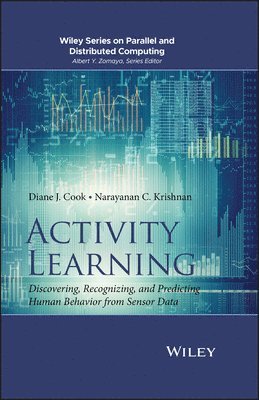
    Activity Learning

    Discovering, Recognizing, and Predicting Human Behavior from Sensor Data

    AvDiane J. Cook,Narayanan C. Krishnan

    Inbunden, Engelska, 2015

    Del i serien Wiley Series on Parallel and Distributed Computing

    1 422 kr

    Beställningsvara. Skickas inom 5-8 vardagar. Fri frakt över 249 kr.

    Beskrivning

    Defines the notion of an activity model learned from sensor data and presents key algorithms that form the core of the fieldActivity Learning: Discovering, Recognizing and Predicting Human Behavior from Sensor Data provides an in-depth look at computational approaches to activity learning from sensor data. Each chapter is constructed to provide practical, step-by-step information on how to analyze and process sensor data. The book discusses techniques for activity learning that include the following: Discovering activity patterns that emerge from behavior-based sensor dataRecognizing occurrences of predefined or discovered activities in real timePredicting the occurrences of activitiesThe techniques covered can be applied to numerous fields, including security, telecommunications, healthcare, smart grids, and home automation. An online companion site enables readers to experiment with the techniques described in the book, and to adapt or enhance the techniques for their own use.With an emphasis on computational approaches, Activity Learning: Discovering, Recognizing, and Predicting Human Behavior from Sensor Data provides graduate students and researchers with an algorithmic perspective to activity learning.

    Produktinformation

    • Utgivningsdatum:2015-04-21
    • Mått:163 x 244 x 24 mm
    • Vikt:590 g
    • Format:Inbunden
    • Språk:Engelska
    • Serie:Wiley Series on Parallel and Distributed Computing
    • Antal sidor:288
    • Förlag:John Wiley & Sons Inc
    • ISBN:9781118893760

    Utforska kategorier

    • Systemvetenskap och AI inom Data och IT

    Mer om författaren

    DIANE J. COOK, PhD, is a professor in the School of Electrical Engineering and Computer Science at Washington State University, USA. Her research relating to artificial intelligence and data mining have been supported by grants from the National Science Foundation, the National Institutes of Health, NASA, DARPA, USAF, NRL, and DHS. She is the co-author of Mining Graph Data and Smart Environments, both published by Wiley. Dr. Cook is an IEEE fellow and a member of AAAI. NARAYANAN C. KRISHNAN, PhD, is a faculty member of the Department of Computer Science and Engineering at the Indian Institute of Technology Ropar, India. His research focuses on activity recognition, pervasive computing, and applied machine learning. Dr. Krishnan received the gold medal for academic excellence in Masters of Technology in Computer Science in 2004 and was nominated for the Best PhD Thesis Award at Arizona State University in 2010.

    Innehållsförteckning

    • Preface ixList of Figures xi1. Introduction 12. Activities 52.1 Definitions 52.2 Classes of Activities 72.3 Additional Reading 83. Sensing 113.1 Sensors Used for Activity Learning 113.1.1 Sensors in the Environment 123.1.2 Sensors on the Body 153.2 Sample Sensor Datasets 173.3 Features 173.3.1 Sequence Features 213.3.2 Discrete Event Features 233.3.3 Statistical Features 253.3.4 Spectral Features 313.3.5 Activity Context Features 343.4 Multisensor Fusion 343.5 Additional Reading 384. Machine Learning 414.1 Supervised Learning Framework 414.2 Naïve Bayes Classifier 444.3 Gaussian Mixture Model 484.4 Hidden Markov Model 504.5 Decision Tree 544.6 Support Vector Machine 564.7 Conditional Random Field 624.8 Combining Classifier Models 634.8.1 Boosting 644.8.2 Bagging 654.9 Dimensionality Reduction 664.10 Additional Reading 725. Activity Recognition 755.1 Activity Segmentation 765.2 Sliding Windows 815.2.1 Time Based Windowing 815.2.2 Size Based Windowing 825.2.3 Weighting Events within a Window 835.2.4 Dynamic Window Sizes 875.3 Unsupervised Segmentation 885.4 Measuring Performance 925.4.1 Classifier-Based Activity Recognition Performance Metrics 955.4.2 Event-Based Activity Recognition Performance Metrics 995.4.3 Experimental Frameworks for Evaluating Activity Recognition 1025.5 Additional Reading 1036. Activity Discovery 1076.1 Zero-Shot Learning 1086.2 Sequence Mining 1106.2.1 Frequency-Based Sequence Mining 1116.2.2 Compression-Based Sequence Mining 1126.3 Clustering 1176.4 Topic Models 1196.5 Measuring Performance 1216.5.1 Expert Evaluation 1216.6 Additional Reading 1247. Activity Prediction 1277.1 Activity Sequence Prediction 1287.2 Activity Forecasting 1337.3 Probabilistic Graph-Based Activity Prediction 1377.4 Rule-Based Activity Timing Prediction 1397.5 Measuring Performance 1427.6 Additional Reading 1468. Activity Learning in the Wild 1498.1 Collecting Annotated Sensor Data 1498.2 Transfer Learning 1588.2.1 Instance and Label Transfer 1628.2.2 Feature Transfer with No Co-occurrence Data 1668.2.3 Informed Feature Transfer with Co-occurrence Data 1678.2.4 Uninformed Feature Transfer with Co-occurrence Data Using a Teacher–Learner Model 1688.2.5 Uninformed Feature Transfer with Co-occurrence Data Using Feature Space Alignment 1708.3 Multi-Label Learning 1708.3.1 Problem Transformation 1738.3.2 Label Dependency Exploitation 1748.3.3 Evaluating the Performance of Multi-Label Learning Algorithms 1798.4 Activity Learning for Multiple Individuals 1808.4.1 Learning Group Activities 1808.4.2 Train on One/Test on Multiple 1838.4.3 Separating Event Streams 1858.4.4 Tracking Multiple Users 1888.5 Additional Reading 1909. Applications of Activity Learning 1959.1 Health 1959.2 Activity-Aware Services 1989.3 Security and Emergency Management 1999.4 Activity Reconstruction, Expression and Visualization 2019.5 Analyzing Human Dynamics 2079.6 Additional Reading 21010. The Future of Activity Learning 213Appendix: Sample Activity Data 217Bibliography 237Index 253