• Fri frakt över 249 kr
  • •
  • Snabba leveranser
  • •
  • Billiga böcker
Kundservice

Du är på sajten för privatpersoner.

Företag, bibliotek eller offentlig verksamhet?

Du handlar på classic.bokus.com, där alla dina funktioner finns intakta.
Till classic.bokus.com
Bokus logotyp. Gå till startsidan.
  • Erbjudanden
  • Nyheter
  • Student
  • Topplistor
  • Barn & ungdom
  • Bokus Play
  • E-böcker
  • Pocketböcker
  • Spel & pussel

10% rabatt på allt med kod NYSTART10 →

Sidfot

Mina sidor

    Hjälp

    • Kundservice
    • Vanliga frågor och svar
    • Frakt och leverans
    • Retur vid ångerrätt
    • Reklamera vara
    • Betalning
    • Köpvillkor
    • Allmänna villkor
    • Information om webbplatsens tillgänglighet

    Om Bokus

    • Om oss
    • Pressrum
    • För studenter
    • För företag
    • För bibliotek och offentlig verksamhet
    • För leverantörer
    • Hållbarhet

    Populärt

    • Aktuella erbjudanden
    • Presentkort
    • Studentlitteratur
    • Nya böcker
    • Topplistor
    • Signerade böcker
    • Engelska böcker

    Inspiration

    • Boktips
    • BookTok
    • Populära bokserier
    • Barnbokskaraktärer
    • Populära författare
    Logotyp för Bokus
    Följ oss på Facebook (extern länk)Följ oss på Instagram (extern länk)Följ oss på YouTube (extern länk)Följ oss på TikTok (extern länk)
    bokus @ CookiesAnpassa cookiesIntegritetspolicyKöpvillkor
    Till Citymail hemsida (extern länk)Till Budbee hemsida (extern länk)Till Postnord hemsida (extern länk)Till Schenker hemsida (extern länk)Till Early Bird hemsida (extern länk)Till Walleys hemsida (extern länk)
    1. Naturvetenskap och teknik
    2. Teknik och industri
    3. Byggnadsteknik

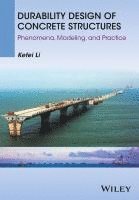
    Durability Design of Concrete Structures

    Phenomena, Modeling, and Practice

    AvKefei Li

    Inbunden, Engelska, 2016

    1 271 kr

    Tillfälligt slut

    Fler format och utgåvor

    E-bok

    1 830 kr

    E-bok

    1 772 kr

    Beskrivning

    Comprehensive coverage of durability of concrete at both material and structural levels, with design related issues Links two active fields in materials science and structural engineering: the durability processes of concrete materials and design methods of concrete structuresFacilitates communication between the two communities, helping to implement life-cycle concepts into future design methods of concrete structuresPresents state-of-the-art information on the deterioration mechanism and performance evolution of structural concrete under environmental actions and the design methods for durability of concrete structuresProvides efficient support and practical tools for life-cycle oriented structural design which has been widely recognized as a new generation of design philosophy for engineering structuresThe author has long experience working with the topic and the materials presented have been part of the author's current teaching course of Durability and Assessment of Engineering Structures for graduate students at Tsinghua UniversityThe design methods and approaches for durability of concrete structures are developed from newly finished high level research projects and have been employed as recommended provisions in design code including Chinese Code and Eurocode 2

    Produktinformation

    • Utgivningsdatum:2016-11-25
    • Mått:163 x 244 x 20 mm
    • Vikt:612 g
    • Format:Inbunden
    • Språk:Engelska
    • Antal sidor:288
    • Förlag:John Wiley & Sons Inc
    • ISBN:9781118910092

    Utforska kategorier

    • Byggnadsteknik inom Naturvetenskap och teknik

    Mer om författaren

    Kefei Li, Professor, Civil Engineering Department, Tsinghua University, Beijing, China. Li obtained his first Ph.D in Bridge Engineering in 2000 from Tongji University (China), and the second in Material Science from Ecole des Ponts, ParisTech (France) in 2002. He began his professional life as a civil engineering consultant in OXAND S.A. (France) and transferred to Tsinghua University taking a teaching-research position in 2004.  His research interests include durability mechanisms of structural concretes, durability design of concrete structures, and assessment of structural behaviors. He also participated in or led the following projects:- the design of Hong Kong-Zhuhai-Macao sea link project (design life of 120 years); the durability design and assessment of High Integrity Container for radioactive disposal (design life of 300 years, 2010-now); the Chinese design code GB/T 50476-2008 "Code for Durability Design of Concrete Structures". He has published more than 50 journal papers and this is his first book.

    Recensioner i media

    "The book follows a basic logic line from concrete materials to structural design, and the content is accordingly divided into three parts...Overall, the book provides good coverage of the topic and valuable information for the understanding of deterioration processes of concrete structures. The book can serve as a reference for civil and structural engineering students, as well as practising engineers". (The Structural Engineer/The Institution of Structural Engineers, May 2017)

    Innehållsförteckning

    • Preface ixAcknowledgments xvPart I DETERIORATION OF CONCRETE MATERIALS 11 Carbonation and Induced Steel Corrosion 31.1 Phenomena and Observations 31.2 Carbonation of Concrete 71.2.1 Mechanisms 71.2.2 Influential Factors 91.2.3 Models 121.3 Steel Corrosion by Carbonation 181.3.1 Mechanism 181.3.2 Influential Factors 211.3.3 Models 221.4 Basis for Design 251.4.1 Structural Consequence 251.4.2 Design Considerations 272 Chloride Ingress and Induced Steel Corrosion 292.1 Phenomena and Observations 292.2 Chloride Ingress 322.2.1 Mechanism 322.2.2 Influential Factors 342.2.3 Models 422.3 Steel Corrosion by Chloride Ingress 462.3.1 Mechanisms 462.3.2 Influential Factors 492.3.3 Models 512.4 Basis for Design 532.4.1 Structural Consequence 532.4.2 Design Considerations 543 Freeze–Thaw Damage 563.1 Phenomena and Observations 563.2 Mechanisms and Influential Factors 573.2.1 Mechanisms 573.2.2 Influential Factors 643.3 Modeling for Engineering Use 713.3.1 Model FT-1: Critical Saturation Model 713.3.2 Model FT-2: Crystallization Stress Model 723.4 Basis for Design 763.4.1 Structural Consequence 763.4.2 Design Considerations 764 Leaching 784.1 Phenomena and Observations 784.2 Mechanisms and Influential Factors 804.2.1 Mechanisms 804.2.2 Influential Factors 834.3 Modeling for Engineering Use 854.3.1 Model L-1: CH Dissolution Model 854.3.2 Model L-2: CH + C]S]H Leaching Model 874.3.3 Further Analysis of Surface Conditions 924.4 Basis for Design 944.4.1 Structural Consequence 944.4.2 Design Considerations 945 Salt Crystallization 965.1 Phenomena and Observations 965.2 Mechanisms and Influential Factors 995.2.1 Mechanisms 995.2.2 Influential Factors 1025.3 Modeling for Engineering Use 1065.3.1 Model CT-1: Critical Supersaturation Model 1065.3.2 Model CT-2: Crystallization Stress Model 1075.4 Basis for Design 110Part II FROM MATERIALS TO STRUCTURES 1136 Deterioration in Structural Contexts 1156.1 Loading and Cracking 1156.1.1 Mechanical Loading 1166.1.2 Effect of Cracks: Single Crack 1186.1.3 Effect of Cracks: Multi]cracks 1286.2 Multi]fields Problems 1306.2.1 Thermal Field 1326.2.2 Moisture Field 1356.2.3 Multi]field Problems 1416.3 Drying–Wetting Actions 1446.3.1 Basis for Drying–Wetting Actions 1446.3.2 Drying–Wetting Depth 1476.3.3 Moisture Transport under Drying–Wetting Actions 151Part III DURABILITY DESIGN OF CONCRETE STRUCTURES 1557 Durability Design: Approaches and Methods 1577.1 Fundamentals 1577.1.1 Performance Deterioration 1587.1.2 Durability Limit States 1587.1.3 Service Life 1617.2 Approaches and Methods 1647.2.1 Objectives 1647.2.2 Global Approaches 1667.2.3 Model]based Methods 1687.3 Life Cycle Consideration 1707.3.1 Fundamentals for Life]cycle Engineering 1717.3.2 Life]cycle Cost Analysis 1717.3.3 Maintenance Design 1738 Durability Design: Properties and Indicators 1838.1 Basic Properties for Durability 1838.1.1 Chemical Properties 1848.1.2 Microstructure and Related Properties 1858.1.3 Transport Properties 1878.1.4 Mechanical Properties 1948.1.5 Fundamental Relationships 1958.2 Characterization of Durability]related Properties 1988.2.1 Characterization of Chemical and Microstructural Properties 1988.2.2 Characterization of Transport and Mechanical Properties 2008.2.3 Durability Performance Tests 2018.3 Durability Indicators for Design 2058.3.1 Nature of Durability Indicators 2058.3.2 Durability Indicators for Deterioration 2068.3.3 Durability Indicators: State of the Art 2089 Durability Design: Applications 2109.1 Sea Link Project for 120 Years 2109.1.1 Project Introduction 2109.1.2 Durability Design: The Philosophy 2139.1.3 Model]based Design for Chloride Ingress 2149.1.4 Quality Control for Design 2199.2 High]Integrity Container for 300 Years 2209.2.1 High]Integrity Container and Near]Surface Disposal 2209.2.2 Design Context 2239.2.3 Design Models for Control Processes 2269.2.4 Model]based Design for 300 Years 2279.3 Further Considerations for Long Service Life Design 23210 Codes for Durability Design 23410.1 Codes and Standards: State of the Art 23410.1.1 Eurocode 23410.1.2 ACI Code 23510.1.3 JSCE Code 23710.1.4 China Codes 23910.2 GB/T 50476: Design Basis 24010.2.1 Environmental Classification 24110.2.2 Design Lives and Durability Limit States 24210.2.3 Durability Prescriptions 24310.3 GB/T 50476: Requirements for Durability 24410.3.1 Atmospheric Environment 24510.3.2 Freeze–Thaw Environment 24610.3.3 Marine and Deicing Salts Environments 24910.3.4 Sulfate Environment 25310.3.5 Post]tensioned Prestressed Structures 255References 259Index 270