• Fri frakt över 249 kr
  • •
  • Snabba leveranser
  • •
  • Billiga böcker
Kundservice

Du är på sajten för privatpersoner.

Företag, bibliotek eller offentlig verksamhet?

Du handlar på classic.bokus.com, där alla dina funktioner finns intakta.
Till classic.bokus.com
Bokus logotyp. Gå till startsidan.
  • Erbjudanden
  • Nyheter
  • Student
  • Topplistor
  • Barn & ungdom
  • Bokus Play
  • E-böcker
  • Pocketböcker
  • Spel & pussel

10% studentrabatt med kod TERM26

Sidfot

Mina sidor

    Hjälp

    • Kundservice
    • Vanliga frågor och svar
    • Frakt och leverans
    • Retur vid ångerrätt
    • Reklamera vara
    • Betalning
    • Köpvillkor
    • Allmänna villkor
    • Information om webbplatsens tillgänglighet

    Om Bokus

    • Om oss
    • Pressrum
    • För studenter
    • För företag
    • För bibliotek och offentlig verksamhet
    • För leverantörer
    • Hållbarhet

    Populärt

    • Aktuella erbjudanden
    • Presentkort
    • Studentlitteratur
    • Nya böcker
    • Topplistor
    • Signerade böcker
    • Engelska böcker

    Inspiration

    • Boktips
    • BookTok
    • Populära bokserier
    • Barnbokskaraktärer
    • Populära författare
    Logotyp för Bokus
    Följ oss på Facebook (extern länk)Följ oss på Instagram (extern länk)Följ oss på YouTube (extern länk)Följ oss på TikTok (extern länk)
    bokus @ CookiesAnpassa cookiesIntegritetspolicyKöpvillkor
    Till Citymail hemsida (extern länk)Till Budbee hemsida (extern länk)Till Postnord hemsida (extern länk)Till Schenker hemsida (extern länk)Till Early Bird hemsida (extern länk)Till Walleys hemsida (extern länk)
    1. Ekonomi och Ledarskap
    2. Nationalekonomi

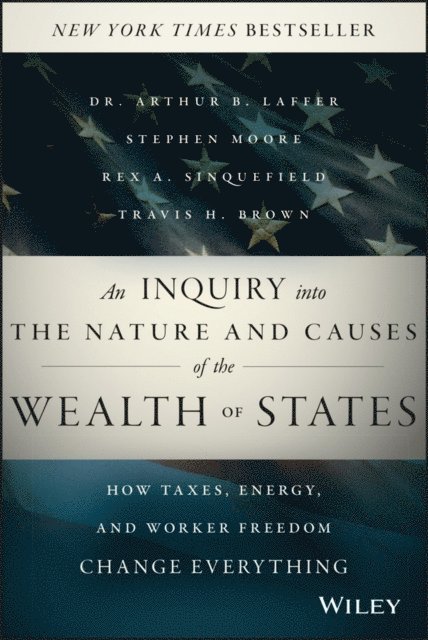
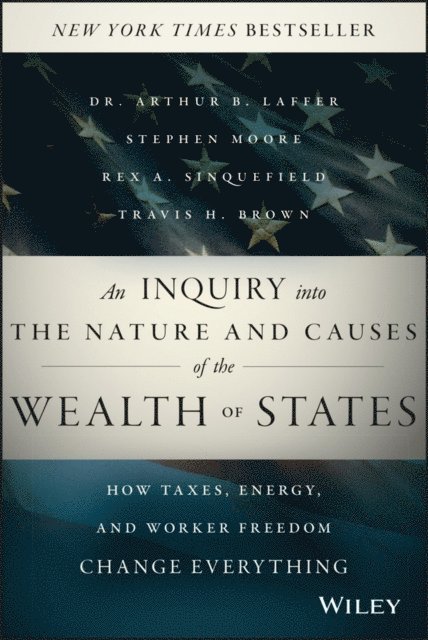
    Inquiry into the Nature and Causes of the Wealth of States

    How Taxes, Energy, and Worker Freedom Change Everything

    AvArthur Laffer,Stephen Moore

    Inbunden, Engelska, 2014

    242 kr

    Beställningsvara. Skickas inom 5-8 vardagar. Fri frakt över 249 kr.

    Beskrivning

    A passionate, detailed, quantified argument for state-level tax reformAn Inquiry into the Nature and Causes of the Wealth of States explains why eliminating or lowering tax burdens at the state level leads to economic growth and wealth creation. A passionate argument for tax reform, the book shows that even states with small populations can benefit enormously with the right policies. The authors’ detailed exposition evaluates the impact state and local government policies have on a state’s relative performance and economic growth overall, backed up with economic data and analysis.Facts don’t lie. But they do point clearly to the failure of so-called progressive tax schemes designed more to curry favor with selected constituencies than to create an economic system that leads to individual wealth as the reward for hard work and entrepreneurial risk taking. An Inquiry into the Nature and Causes of the Wealth of States is a detailed and critical look at income taxation across the nation, and drills down into an analysis of the economic growth or malaise that results from tax policy. Arguing eloquently that a state cannot tax itself into prosperity, just as the impoverished cannot spend themselves into wealth, the authors point out what many inherently know but often fear to say out loud. The book provides detailed quantitative analysis, and discusses the policy variables that can have enormous effects on the financial well-being of states and individual residents, such as: Personal and corporate income tax ratesTotal tax burden as a percentage of personal incomeEstate and inheritance taxesRight-to-work lawsAn Inquiry into the Nature and Causes of the Wealth of States shows everyone how to evaluate state-level fiscal and economic policies to become more competitive.

    Produktinformation

    • Utgivningsdatum:2014-05-23
    • Mått:156 x 228 x 34 mm
    • Vikt:567 g
    • Format:Inbunden
    • Språk:Engelska
    • Antal sidor:368
    • Förlag:John Wiley & Sons Inc
    • ISBN:9781118921227

    Utforska kategorier

    • Nationalekonomi inom Ekonomi och Ledarskap

    Mer om författaren

    ARTHUR B. LAFFER, PhD, is the founder and chairman of Laffer Associates, an economic research firm focusing on interconnecting macroeconomic, political, and demographic changes. STEPHEN MOORE is chief economist at The Heritage Foundation. He focuses on budget, tax, and monetary policy. REX A. SINQUEFIELD was a co-founder and director of Dimensional Fund Advisors LP. Since retirement, he has become one of Missouri’s leading philanthropists and a dedicated supporter of public policy change. TRAVIS H. BROWN is the CEO and co-founder of Pelopidas, LLC, a public affairs and issue-advocacy firm. He frequently contributes to Fox & Friends and Forbes.com and is the author of How Money Walks.

    Innehållsförteckning

    • Prologue xiiiChapter 1 The Fall from Grace: The Story of States 11 and the Income Tax Adopted 1The Implementation of an Income Tax—A Terrible Mistake 1That Giant Sucking Sound Is People, Output, and Tax Revenue Fleeing Income Taxes 4Economic Malaise 4Misleading Measures 5Ohio 7The Story of New Jersey—A Colorful Example of Opportunity Wasted 10Lower Tax Revenue 10The Rhetoric Surrounding Tax Revenue and the Decline in Public Services 11The Case of the Disappearing Tax Revenue 12Connecticut 13No Bang for the Buck—How Costly Tax Increases Fail to Result in Better Provision of Public Services 16Chapter 2 Economic Metrics 23Primary Economic Metrics 24Tax Revenue Performance of All States over the Past Decade 32The ALEC-Laffer State Rankings 37Internal Revenue Service Tax Migration Data 39Chapter 3 The Nine Members of the Fellowship of the Ring to Balance Out the Nine Nazgûl 53An Analysis of the Top Personal Income Tax (PIT) Rates 56Public Services and the Personal Income Tax 61The Effects of Oil and Severance Taxes 63A Longer-Term View of the Data 67An Analysis of Corporate Income Taxes 69An Analysis of the Overall Tax Burden 73An Analysis of the ALEC-Laffer State Economic Competitiveness Index 76Chapter 4 Piling On 81An Analysis of the Property Tax Burden 82An Analysis of the Sales Tax Burden 82Estate and Inheritance Taxes 88Right-to-Work Laws 90Labor Force Unionization 93State Minimum Wages 96Chapter 5 Give unto Caesar 99New Hampshire—Case in Point 104Top Traders 121Real-Time Mobility Index 127Chapter 6 Why Growth Rates Differ: An Econometric Analysis of the Data 133List of Variables 137Gross State Product Growth: Single-Variable Analysis 141Gross State Product Growth: Two-Variable Analysis 146Gross State Product Growth: Three-Variable Analysis 149Population Growth: Single-Variable Analysis 150Population Growth: Two-Variable Analysis 153Population Growth: Three-Variable Analysis 156Population Growth: Four-Variable Analysis 157Conclusions 158Annotated Econometric Bibliography 159Key Quotes from Econometric Bibliography 186Chapter 7 Fiscal Parasitic Leakages: Texas versus California 193A Tale of Two States—A 55-Point Summary 194The November 2012 Elections in California and Texas 199Economic Performance: California, Texas, and the United States 201A Brief Note on Poverty Metrics 207The Texas Oil Boom and California’s Oil Bust: A Clash of Economic Cultures 208An Overview of Total State and Local Government Revenues—Texas and California 212Texas, California, and the United States: A Comparison of Tax Revenue and Debt Financing 213Policy Variables Affecting Growth 218The Relationship among Taxation, Spending, and the Achievement of Policy Objectives—A Story of Parasitic Leakages 224Intergovernmental Revenues, Federally Mandated Social Services, and State Welfare, Medicaid, and Food Stamp Programs 225The Provision of Public Services by State and Local Governments 229The Performance of State and Local Public Education 235Highways: California versus Texas 239Prisons: California and Texas 241Conclusion 242Chapter 8 Au Contraire, Mon Frère: Criticisms of Our Work— Our Responses 245Conflicts of Interest and Policies 245Taxes and Other Supply-Side Policy Variables Don’t Affect Population and Gross State Product Growth 247Growth Is a Move from North to South, from Clouds to Sunshine, from Cold to Warm 251Growth Is Predominantly a Matter of Education and Not Taxes and Other Economic Policy Measures 252Personal Income per Capita and Median Income Growth as Measures of Success Show Taxes Don’t Matter 253Tax Rate Cuts Are Public Service Cuts 257Other Factors Affect Population Growth (Oil, Sunshine, Accessible Suburbs, Etc.), and Therefore Taxes, Right-to-Work Laws, and Other Supply-Side Variables Don’t 259Correlations between Tax Rates and Growth Reflect a Simultaneous Equation Bias (Reverse Causation); That Is, Growth Causes Tax Cuts, Not the Reverse 261There Are High-Tax States That Outperform Low-Tax States; Therefore the Supply-Side Theory Is Wrong 264The Oklahoma Argument against Tax Cuts 267Income Distribution Becomes More Even with Progressive High-Rate Tax Codes 270The Probity of the ALEC-Laffer Measures Is Nonexistent; Therefore Their Policy Prescriptions Are Wrong 273Federal Tax Rates Are More Important Than State Tax Rates, and Therefore State Tax Rates Don’t Matter 275The Wealthy Used Public Resources, and They—Not Others—Should Pay for Those Public Resources; We Need More Progressive Taxes, Not Less 276When Is Enough Evidence Enough? If the Facts Were Reversed, We Would Concede 277Notes 281Bibliography 295Acknowledgments 317About the Authors 319Index 321