• Fri frakt över 249 kr
  • •
  • Snabba leveranser
  • •
  • Billiga böcker
Kundservice

Du är på sajten för privatpersoner.

Företag, bibliotek eller offentlig verksamhet?

Du handlar på classic.bokus.com, där alla dina funktioner finns intakta.
Till classic.bokus.com
Bokus logotyp. Gå till startsidan.
  • Erbjudanden
  • Nyheter
  • Student
  • Topplistor
  • Barn & ungdom
  • Bokus Play
  • E-böcker
  • Pocketböcker
  • Spel & pussel

10% rabatt på allt med kod NYSTART10 →

Sidfot

Mina sidor

    Hjälp

    • Kundservice
    • Vanliga frågor och svar
    • Frakt och leverans
    • Retur vid ångerrätt
    • Reklamera vara
    • Betalning
    • Köpvillkor
    • Allmänna villkor
    • Information om webbplatsens tillgänglighet

    Om Bokus

    • Om oss
    • Pressrum
    • För studenter
    • För företag
    • För bibliotek och offentlig verksamhet
    • För leverantörer
    • Hållbarhet

    Populärt

    • Aktuella erbjudanden
    • Presentkort
    • Studentlitteratur
    • Nya böcker
    • Topplistor
    • Signerade böcker
    • Engelska böcker

    Inspiration

    • Boktips
    • BookTok
    • Populära bokserier
    • Barnbokskaraktärer
    • Populära författare
    Logotyp för Bokus
    Följ oss på Facebook (extern länk)Följ oss på Instagram (extern länk)Följ oss på YouTube (extern länk)Följ oss på TikTok (extern länk)
    bokus @ CookiesAnpassa cookiesIntegritetspolicyKöpvillkor
    Till Citymail hemsida (extern länk)Till Budbee hemsida (extern länk)Till Postnord hemsida (extern länk)Till Schenker hemsida (extern länk)Till Early Bird hemsida (extern länk)Till Walleys hemsida (extern länk)
    1. Naturvetenskap och teknik
    2. Teknik och industri
    3. Energiteknik

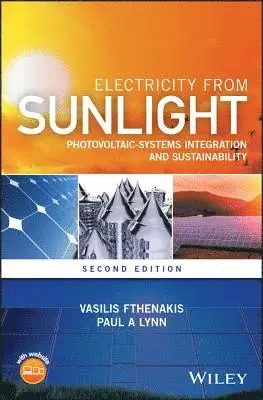
    Electricity from Sunlight

    Photovoltaic-Systems Integration and Sustainability

    AvVasilis M. Fthenakis,Paul A. Lynn

    Inbunden, Engelska, 2018

    1 004 kr

    Beställningsvara. Skickas inom 5-8 vardagar. Fri frakt över 249 kr.

    Beskrivning

    Praised for its visual appeal, conversational style and clear explanation of complex ideas with minimal mathematics, Electricity from Sunlight has been thoroughly revised and updated to reflect advances in the global PV market, economics and installed capacity. Key features of the 2nd edition include: A timely update of the advances of photovoltaics (PV), with major new material on grid-connected systems. More in-depth treatment of PV scientific principles, solar cells, modules, and systems. Up-to-date coverage of the PV market including conversion efficiencies and the expansion of grid-friendly power plants. End-of-chapter problems with solutions manual available to instructors via companion website. Additional end-of-chapter questions and answers to support students through guided self-study. New chapters on manufacturing processes and on materials and other resources availability. New large-scale PV section covering the growth of global capacity, utility-scale PV and affordable solutions for intermittency. Systems analysis of new applications empowered by low-cost PV, such as energy storage and water desalination. Significantly expanded economics and environmental section explaining leveled cost of electricity versus upfront costs, energy return on investments, and lifecycle analysis. Electricity from Sunlight: Photovoltaics Systems Integration and Sustainability, Second Edition is an essential primer for new entrants to the PV industry, needing a basic appreciation of complete PV systems, and to students on undergraduate and graduate courses on renewable energy and photovoltaics. It also offers a unique treatise of the sustainability of emerging transformative technologies, which makes it useful to both system analysts and energy policy strategists. Co-author, Vasilis Fthenakis, is Recipient of the 2018 William R. Cherry Award The Cherry Award recognizes an individual engineer or scientist who has made a significant contribution to the advancement of the science and technology of photovoltaic energy conversion, with dissemination by substantial publications and presentations. Fthenakis was honored for his pioneering research at the interface of energy and the environment that catalyzed photovoltaic technology advancement and deployment world-wide.

    Produktinformation

    • Utgivningsdatum:2018-03-19
    • Mått:178 x 246 x 23 mm
    • Vikt:862 g
    • Format:Inbunden
    • Språk:Engelska
    • Antal sidor:368
    • Upplaga:2
    • Förlag:John Wiley & Sons Inc
    • ISBN:9781118963807

    Utforska kategorier

    • Energiteknik inom Naturvetenskap och teknik

    Mer om författaren

    VASILIS M. FTHENAKIS is the founder and director of the Center for Life Cycle Analysis (CLCA), Department of Earth and Environmental Engineering, Columbia University, New York, USA. He is also a senior scientist emeritus at Brookhaven National Laboratory (BNL) where he conducted research for 36 years and directed the National Photovoltaics (PV) Environmental Research Center and several international networks. Dr. Fthenakis is the coauthor and editor of four books and about 400 scientific publications on topics at the interface of energy life cycles and the environment. Currently, he is leading research on solar desalination, energy systems modeling, life-cycle analysis, chemical process safety, and PV recycling. Vasilis Fthenakis is the recipient of the William R. Cherry Award 2018. The Cherry Award recognizes an individual engineer or scientist who has made a significant contribution to the advancement of the science and technology of photovoltaic energy conversion, with dissemination by substantial publications and presentations. PAUL A. LYNN obtained his B.Sc.(Eng) and Ph.D. degrees from Imperial College London, UK. After several years in the electrical/electronics industry, he lectured at Imperial College and the University of Bristol. As a retired academic, Dr. Lynn's long-term interest in renewable energy has led to a trilogy of Wiley books (including this one), and three solar-powered boats. He is the author of ten other books and numerous technical papers and articles.

    Innehållsförteckning

    • About the Authors xiForeword xiiiPreface to the First Edition xvPreface to the Second Edition xviiAcknowledgment to the First Edition xixAcknowledgment to the Second Edition xxiiiAbout the Companion Website xxv1 Introduction 11.1 Energy and Sustainable Development 11.2 The Sun, Earth, and Renewable Energy 21.3 The Solar Resource 61.4 The Magic of Photovoltaics 111.5 A Piece of History 131.6 Coming Up to Date 17Appendix 1.A Energy Units and Conversions 22CO2 Emissions per Fuel Type 22CO2 Emissions in Transportation 23Self‐Assessment Questions 23Problems 24Answers to Questions 25References 252 Solar Cells 272.1 Setting the Scene 272.2 Crystalline Silicon 302.2.1 The Ideal Crystal 302.2.2 The p–n Junction 322.2.3 Monocrystalline Silicon 352.2.3.1 Photons in Action 352.2.3.2 Generating Power 372.2.3.3 Sunlight, Silicon, and Quantum Mechanics 412.2.3.4 Refining the Design 452.2.4 Multicrystalline Silicon 512.3 Second‐Generation Photovoltaics 522.3.1 Amorphous and Thin‐Film Silicon 532.3.2 Copper Indium Gallium Diselenide (CIGS) 572.3.3 Cadmium Telluride (CdTe) 602.4 Cell Efficiency and Module Cost 612.5 Third‐Generation Solar Cells 642.5.1 Gallium Arsenide (GaAs) Multi‐Junctions 652.5.2 Dye‐Sensitized Cells 672.5.3 Organic Solar Cells 692.5.4 Perovskites 72Self‐Assessment Questions 73Problems 75Answers to Questions 76References 773 PV Modules and Arrays 793.1 Introduction 793.2 Electrical Performance 823.2.1 Connecting Cells and Modules 823.2.2 Module Parameters 853.3 Capturing Sunlight 883.3.1 Aligning the Array 923.3.2 Sunshine and Shadow 983.4 One‐Axis Tracking 1013.5 Concentration and Two‐Axis Tracking 102Appendix 3.A 1073.A.1 Converting Global Horizontal Irradiation Data to Tilted and Sun‐Tracking Surfaces 1073.A.1.1 Solar Data Collection 1083.A.1.2 Calculation of Extraterrestrial Radiation 1083.A.1.3 Determining the Diffuse and the Direct Components of the Global Horizontal Irradiation 1103.A.1.4 Using a Model to Calculate the Energy Incident on the Inclined Surface per Time Increment 1113.A.1.5 Comparisons of Different Configurations 114Self‐Assessment Questions 114Problems 115Answers to Questions 119References 1204 Grid‐Connected PV Systems 1214.1 Introduction 1214.2 From DC to AC 1224.3 Completing the System 1284.4 Building‐Integrated Photovoltaics (BIPV) 1304.4.1 Engineering and Architecture 1304.4.2 PV Outside, PV Inside 1324.5 The Growth of Global PV Markets 1404.6 Current Status of the PV Industry 1444.7 Large PV Power Plants 1454.7.1 Commercial and Industrial Installations 1474.7.2 Utility‐Scale PV 1474.8 PV Grid Connection and Integration 1554.8.1 The Electricity Grid 1554.8.2 Grid‐Friendly PV Power Plants 1574.9 Electricity Markets and Types of Power Generators 1604.10 The Variability Challenge and Solutions 1644.10.1 Long‐Distance Transmission Lines 1674.10.2 Grid Flexibility 1684.11 Energy Storage 1704.11.1 Power‐Quality Storage Technologies 1714.11.1.1 Superconducting Magnetic Energy Storage 1714.11.1.2 Electric Double‐Layer Capacitors 1724.11.1.3 Flywheels 1734.11.2 Bridging Power 1734.11.2.1 Lead‐Acid Batteries 1734.11.2.2 Lithium‐Ion Batteries 1754.11.2.3 Flow Batteries 1764.11.3. Energy Management Storage Technologies 1784.11.3.1 Pumped Hydro Energy Storage 1784.11.3.2 Compressed Air Energy Storage 179Self‐Assessment Questions 182Problems 183Answers to Questions 184References 1855 Stand‐Alone PV Systems 1875.1 Remote and Independent 1875.2 System Components 1895.2.1 Batteries 1895.2.2 Charge Controllers 1935.2.3 Inverters 1985.3 Hybrid Systems 2025.4 System Sizing 2045.4.1 Assessing the Problem 2045.4.2 PV Arrays and Battery Banks 2075.5 Applications 2115.5.1 PV in Space 2125.5.2 Island Electricity 2155.5.3 PV Water Pumping 2195.5.4 Solar‐Enabled Water Desalination 2235.5.5 Solar‐Powered Boats 2255.5.6 Far and Wide 230Self‐Assessment Questions 233Problems 234Answers to Questions 235References 2356 Photovoltaic Manufacturing 2376.1 Production of Crystalline Si Solar Cells 2376.1.1 Production of Metallurgical Silicon 2376.1.2 Production of Polysilicon (Silicon Purification) 2386.1.3 Production of Crystalline Silicon 2436.1.3.1 Single‐Crystal Silicon 2446.1.3.2 Multicrystalline Silicon 2456.1.4 Ingot Wafering 2466.1.5 Doping/Forming the p–n Junction 2486.1.6 Cleaning Etch 2496.1.7 Surface Texturing to Reduce Reflection 2496.1.8 Antireflection Coatings and Fire‐Through Contacts 2496.1.9 Edge Isolation 2496.1.10 Rear Contact 2496.1.11 Encapsulation 2496.2 Opportunities and Challenges in Si PV Manufacturing 2506.3 Thin‐Film PV Manufacturing 2536.3.1 CIGS Thin‐Film Manufacturing 2546.3.1.1 Co‐evaporation 2576.3.1.2 Metal Selenization/Sulfurization 2576.3.1.3 Non‐Vacuum Particle or Solution Processing 2586.3.2 CdTe PV Manufacturing 258Self‐Assessment Questions 261Problems 262Answers to Questions 263References 2637 PV Growth and Sustainability 2657.1 Affordability 2667.1.1 Costs and Markets 2667.1.2 Financial Incentives 2727.1.2.1 Capital Grants 2727.1.2.2 Special Tariffs 2747.1.2.3 Financing Options 2757.1.2.4 Renewable Portfolio Standards 2767.1.2.5 Carbon Fees/Programs 2767.1.3 Rural Electrification 2797.1.4 External Costs and Benefits 2837.1.5 Policy Recommendations for Further Growing Solar Energy 2847.1.5.1 R&D Funding 2847.1.5.2 Solar Financing Flexibility 2847.2 Resource Availability 2857.2.1 Raw Materials 2857.2.2 Land Use 2907.2.3 Water Use 2937.3 Life‐Cycle Environmental Impacts 2957.3.1 Life‐Cycle Analysis 2957.3.2 Environmental Health and Safety (EHS) in PV Manufacturing 3067.3.3 Recycling Programs 3117.4 The Growth of PV is Sustainable and Greatly Needed 315Self‐Assessment Questions 316Problems 316Answers to Questions 317References 318Index 321