• Fri frakt över 249 kr
  • •
  • Snabba leveranser
  • •
  • Billiga böcker
Kundservice

Du är på sajten för privatpersoner.

Företag, bibliotek eller offentlig verksamhet?

Du handlar på classic.bokus.com, där alla dina funktioner finns intakta.
Till classic.bokus.com
Bokus logotyp. Gå till startsidan.
  • Erbjudanden
  • Student
  • Topplistor
  • Barn & ungdom
  • Bokus Play
  • E-böcker
  • Ljudböcker
  • Pocketböcker
  • Spel & pussel

10% rabatt på allt med kod NYSTART10 →

Sidfot

Mina sidor

    Hjälp

    • Kundservice
    • Vanliga frågor och svar
    • Frakt och leverans
    • Retur vid ångerrätt
    • Reklamera vara
    • Betalning
    • Köpvillkor
    • Allmänna villkor
    • Information om webbplatsens tillgänglighet

    Om Bokus

    • Om oss
    • Pressrum
    • För studenter
    • För företag
    • För bibliotek och offentlig verksamhet
    • För leverantörer
    • Hållbarhet

    Populärt

    • Aktuella erbjudanden
    • Presentkort
    • Studentlitteratur
    • Nya böcker
    • Topplistor
    • Signerade böcker
    • Engelska böcker

    Inspiration

    • Boktips
    • BookTok
    • Populära bokserier
    • Barnbokskaraktärer
    • Populära författare
    Logotyp för Bokus
    Följ oss på Facebook (extern länk)Följ oss på Instagram (extern länk)Följ oss på YouTube (extern länk)Följ oss på TikTok (extern länk)
    bokus @ CookiesAnpassa cookiesIntegritetspolicyKöpvillkor
    Till Citymail hemsida (extern länk)Till Budbee hemsida (extern länk)Till Postnord hemsida (extern länk)Till Schenker hemsida (extern länk)Till Early Bird hemsida (extern länk)Till Walleys hemsida (extern länk)
    1. Ekonomi och Ledarskap
    2. Ledarskapsböcker

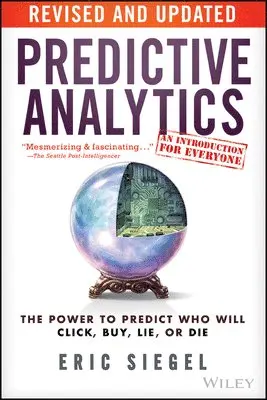
    Predictive Analytics

    The Power to Predict Who Will Click, Buy, Lie, or Die

    AvEric Siegel

    Häftad, Engelska, 2016

    208 kr

    Beställningsvara. Skickas inom 5-8 vardagar. Fri frakt över 249 kr.

    Fler format och utgåvor

    E-bok

    269 kr

    E-bok

    269 kr

    Beskrivning

    "Mesmerizing & fascinating..." —The Seattle Post-Intelligencer"The Freakonomics of big data." —Stein Kretsinger, founding executive of Advertising.comAward-winning | Used by over 30 universities | Translated into 9 languagesAn introduction for everyone. In this rich, fascinating — surprisingly accessible — introduction, leading expert Eric Siegel reveals how predictive analytics (aka machine learning) works, and how it affects everyone every day. Rather than a “how to” for hands-on techies, the book serves lay readers and experts alike by covering new case studies and the latest state-of-the-art techniques.Prediction is booming. It reinvents industries and runs the world. Companies, governments, law enforcement, hospitals, and universities are seizing upon the power. These institutions predict whether you're going to click, buy, lie, or die.Why? For good reason: predicting human behavior combats risk, boosts sales, fortifies healthcare, streamlines manufacturing, conquers spam, optimizes social networks, toughens crime fighting, and wins elections.How? Prediction is powered by the world's most potent, flourishing unnatural resource: data. Accumulated in large part as the by-product of routine tasks, data is the unsalted, flavorless residue deposited en masse as organizations churn away. Surprise! This heap of refuse is a gold mine. Big data embodies an extraordinary wealth of experience from which to learn.Predictive analytics(aka machine learning) unleashes the power of data. With this technology, the computer literally learns from data how to predict the future behavior of individuals. Perfect prediction is not possible, but putting odds on the future drives millions of decisions more effectively, determining whom to call, mail, investigate, incarcerate, set up on a date, or medicate.In this lucid, captivating introduction — now in its Revised and Updated edition — former Columbia University professor and Predictive Analytics World founder Eric Siegel reveals the power and perils of prediction: What type of mortgage risk Chase Bank predicted before the recession.Predicting which people will drop out of school, cancel a subscription, or get divorced before they even know it themselves.Why early retirement predicts a shorter life expectancy and vegetarians miss fewer flights.Five reasons why organizations predict death — including one health insurance company.How U.S. Bank and Obama for America calculated the way to most strongly persuade each individual.Why the NSA wants all your data: machine learning supercomputers to fight terrorism.How IBM's Watson computer used predictive modeling to answer questions and beat the human champs on TV's Jeopardy!How companies ascertain untold, private truths — how Target figures out you're pregnant and Hewlett-Packard deduces you're about to quit your job.How judges and parole boards rely on crime-predicting computers to decide how long convicts remain in prison.182 examples from Airbnb, the BBC, Citibank, ConEd, Facebook, Ford, Google, the IRS, LinkedIn, Match.com, MTV, Netflix, PayPal, Pfizer, Spotify, Uber, UPS, Wikipedia, and more.How does predictive analytics work? This jam-packed book satisfies by demystifying the intriguing science under the hood. For future hands-on practitioners pursuing a career in the field, it sets a strong foundation, delivers the prerequisite knowledge, and whets your appetite for more.A truly omnipresent science, predictive analytics constantly affects our daily lives. Whether you are a consumer of it — or consumed by it — get a handle on the power of Predictive Analytics.

    Produktinformation

    • Utgivningsdatum:2016-02-16
    • Mått:150 x 226 x 28 mm
    • Vikt:476 g
    • Format:Häftad
    • Språk:Engelska
    • Antal sidor:368
    • Upplaga:2
    • Förlag:John Wiley & Sons Inc
    • ISBN:9781119145677
    • Utmärkelser:Winner of Small Business Book Awards / Technology 2014 (United States)

    Utforska kategorier

    • Ledarskapsböcker inom Ekonomi och Ledarskap

    Mer om författaren

    ERIC SIEGEL, PhD, is the founder of Predictive Analytics World and executive editor of The Predictive Analytics Times. A former Columbia University professor, he is a renowned speaker, educator, and leader in the field.

    Innehållsförteckning

    • Foreword Thomas H. Davenport xviiPreface to the Revised and Updated Edition xxiWhat’s new and who’s this book for—the Predictive Analytics FAQPreface to the Original Edition xxixWhat is the occupational hazard of predictive analytics?IntroductionThe Prediction Effect 1How does predicting human behavior combat risk, fortify healthcare,toughen crime fighting, boost sales, and cut costs? Why must a computer learn in order to predict? How can lousy predictions be extremely valuable?Whatmakes data exceptionally exciting?How is data science like porn?Whyshouldn’t computers be called computers? Why do organizations predict when you will die?Chapter 1 Liftoff! Prediction Takes Action (deployment) 23How much guts does it take to deploy a predictive model into field operation, and what do you stand to gain?Whathappens when aman invests his entire life savings into his own predictive stock market trading system?Chapter 2 With Power Comes Responsibility: Hewlett-Packard,Target, the Cops, and the NSA Deduce Your Secrets (ethics) 47How do we safely harness a predictive machine that can foresee job resignation, pregnancy, and crime? Are civil liberties at risk? Why does one leading health insurance company predict policyholder death?Two extended sidebars reveal: 1) Does the government undertake fraud detection more for its citizens or for self-preservation, and 2) for what compelling purpose does the NSA need your data even if you have no connection to crime whatsoever, and can the agency use machine learning supercomputers to fight terrorism without endangering human rights?Chapter 3 The Data Effect: A Glut at the End of the Rainbow (data) 103We are upto our ears in data, but how much can this raw material really tell us? What actually makes it predictive? What are the most bizarre discoveries from data? When we find an interesting insight, why are we often better off not asking why? In what way is bigger data more dangerous? How do we avoid being fooled by random noise and ensure scientific discoveries are trustworthy?Chapter 4 The Machine That Learns: A Look inside Chase’s Prediction of Mortgage Risk (modeling) 147What form of risk has the perfect disguise? How does prediction transform risk to opportunity? What should all businesses learn from insurance companies? Why does machine learning require art in addition to science? What kind of predictive model can be understood by everyone? How can we confidently trust a machine’s predictions? Why couldn’t prediction prevent the global financial crisis?Chapter 5 The Ensemble Effect: Netflix, Crowdsourcing, and Supercharging Prediction (ensembles) 185To crowd source predictive analytics—outsource it to the public at large—a company launches its strategy, data, and research discoveries into the public spotlight. How can this possibly help the company compete? What key innovation in predictive analytics has crowd sourcing helped develop? Must supercharging predictive precision involve overwhelming complexity, or is there an elegant solution? Is there wisdom in nonhuman crowds?Chapter 6 Watson and the Jeopardy! Challenge (question answering) 207How does Watson—IBM’s Jeopardy!-playing computer—work? Why does it need predictive modeling in order to answer questions, and what secret sauce empowers its high performance? How does the iPhone’s Siri compare? Why is human language such a challenge for computers? Is artificial intelligence possible?Chapter 7 Persuasion by the Numbers: How Telenor, U.S. Bank, and the Obama Campaign Engineered Influence (uplift) 251 What is the scientific key to persuasion? Why does some marketing fiercely backfire? Why is human behavior the wrong thing to predict? What should all businesses learn about persuasion from presidential campaigns? What voter predictions helped Obama win in 2012 more than the detection of swing voters? How could doctors kill fewer patients inadvertently? How is a person like a quantum particle? Riddle: What often happens to you that cannot be perceived and that you can’t even be sure has happened afterward—but that can be predicted in advance?Afterword 291Eleven Predictions for the First Hour of 2022AppendicesA. The Five Effects of Prediction 295B. Twenty Applications of Predictive Analytics 296C. Prediction People—Cast of “Characters” 300Hands-On Guide 303Resources for Further LearningAcknowledgments 307About the Author 311Index 313Also see the Central Tables (color insert) for a cross-industry compendium of 182 examples of predictive analytics. This book’s Notes—120 pages of citations and comments pertaining to the chapters above—are available online at www.PredictiveNotes.com.