• Fri frakt över 249 kr
  • •
  • Snabba leveranser
  • •
  • Billiga böcker
Kundservice

Du är på sajten för privatpersoner.

Företag, bibliotek eller offentlig verksamhet?

Du handlar på classic.bokus.com, där alla dina funktioner finns intakta.
Till classic.bokus.com
Bokus logotyp. Gå till startsidan.
  • Erbjudanden
  • Nyheter
  • Student
  • Topplistor
  • Barn & ungdom
  • Bokus Play
  • E-böcker
  • Pocketböcker
  • Spel & pussel

10% rabatt på allt med kod: NYSTART10 →

Sidfot

Mina sidor

    Hjälp

    • Kundservice
    • Vanliga frågor och svar
    • Frakt och leverans
    • Retur vid ångerrätt
    • Reklamera vara
    • Betalning
    • Köpvillkor
    • Allmänna villkor
    • Information om webbplatsens tillgänglighet

    Om Bokus

    • Om oss
    • Pressrum
    • För studenter
    • För företag
    • För bibliotek och offentlig verksamhet
    • För leverantörer
    • Hållbarhet

    Populärt

    • Aktuella erbjudanden
    • Presentkort
    • Studentlitteratur
    • Nya böcker
    • Topplistor
    • Signerade böcker
    • Engelska böcker

    Inspiration

    • Boktips
    • BookTok
    • Populära bokserier
    • Barnbokskaraktärer
    • Populära författare
    Logotyp för Bokus
    Följ oss på Facebook (extern länk)Följ oss på Instagram (extern länk)Följ oss på YouTube (extern länk)Följ oss på TikTok (extern länk)
    bokus @ CookiesAnpassa cookiesIntegritetspolicyKöpvillkor
    Till Citymail hemsida (extern länk)Till Budbee hemsida (extern länk)Till Postnord hemsida (extern länk)Till Schenker hemsida (extern länk)Till Early Bird hemsida (extern länk)Till Walleys hemsida (extern länk)
    1. Naturvetenskap och teknik
    2. Teknik och industri
    3. Byggnadsteknik

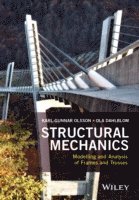
    Structural Mechanics: Modelling and Analysis of Frames and Trusses

    AvKarl-Gunnar Olsson,Ola Dahlblom

    Häftad, Engelska, 2016

    722 kr

    Beställningsvara. Skickas inom 5-8 vardagar. Fri frakt över 249 kr.

    Beskrivning

    Textbook covers the fundamental theory of structural mechanics and the modelling and analysis of frame and truss structures Deals with modelling and analysis of trusses and frames using a systematic matrix formulated displacement method with the language and flexibility of the finite element methodElement matrices are established from analytical solutions to the differential equations Provides a strong toolbox with elements and algorithms for computational modelling and numerical exploration of truss and frame structuresDiscusses the concept of stiffness as a qualitative tool to explain structural behaviourIncludes numerous exercises, for some of which the computer software CALFEM is used. In order to support the learning process CALFEM gives the user full overview of the matrices and algorithms used in a finite element analysis

    Produktinformation

    • Utgivningsdatum:2016-01-22
    • Mått:173 x 244 x 18 mm
    • Vikt:526 g
    • Format:Häftad
    • Språk:Engelska
    • Antal sidor:352
    • Förlag:John Wiley & Sons Inc
    • ISBN:9781119159339

    Utforska kategorier

    • Byggnadsteknik inom Naturvetenskap och teknik

    Mer om författaren

    Karl-Gunnar Olsson is professor in Architecture and Engineering at the Department of Architecture at Chalmers University of Technology in Gothenburg. His research is mainly aimed at development of concepts and forms for representation of engineering systems in the building design process. This includes the interaction between architects and engineers as well as the dialogue and the digital tools needed in early design phases, and range from architectural conservation to design of new buildings. Central is the formulation of theoretical concepts that support conceptual understanding of mechanical systems, such as the concept of canonical stiffness. Karl-Gunnar Olsson is also responsible for the dual degree, Master of Architecture (MArch) and MSc in Engineering, programme Architecture and Engineering at Chalmers.Ola Dahlblom is professor in Structural Mechanics at Lund University.  His main area of research is material mechanics with development of computational models for materials with complex internal structure. Examples of applications are the behaviour of concrete during hardening and the shape change of sawn timber during drying. An important part of this work is the development of computer code for simulation and visualisation of the structural behaviour. He has in recent years also been a driving force behind renewal of literature and development of computer programs for teaching structural mechanics in the Bachelor of Science and Master of Science educations.

    Innehållsförteckning

    • Preface ix1 Matrix Algebra 11.1 Definitions 11.2 Addition and Subtraction 21.3 Multiplication 21.4 Determinant 31.5 Inverse Matrix 31.6 Counting Rules 41.7 Systems of Equations 41.7.1 Systems of Equations with Only Unknown Components in the Vector 𝐚 51.7.2 Systems of Equations with Known and Unknown Components in the Vector 𝐚 61.7.3 Eigenvalue Problems 8Exercises 102 Systems of Connected Springs 132.1 Spring Relations 162.2 Spring Element 162.3 Systems of Springs 17Exercises 303 Bars and Trusses 313.1 The Differential Equation for Bar Action 333.1.1 Definitions 333.1.2 The Material Level 353.1.3 The Cross-Section Level 383.1.4 Bar Action 413.2 Bar Element 433.2.1 Definitions 433.2.2 Solving the Differential Equation 433.2.3 From Local to Global Coordinates 513.3 Trusses 55Exercises 664 Beams and Frames 714.1 The Differential Equation for Beam Action 734.1.1 Definitions 734.1.2 The Material Level 744.1.3 The Cross-Section Level 754.1.4 Beam Action 784.2 Beam Element 804.2.1 Definitions 814.2.2 Solving the Differential Equation for Beam Action 814.2.3 Beam Element with Six Degrees of Freedom 904.2.4 From Local to Global Directions 924.3 Frames 95Exercises 1095 Modelling at the System Level 1155.1 Symmetry Properties 1165.2 The Structure and the System of Equations 1205.2.1 The Deformations and Displacements of the System 1215.2.2 The Forces and Equilibria of the System 1305.2.3 The Stiffness of the System 1325.3 Structural Design and Simplified Manual Calculations 1445.3.1 Characterising Structures 1445.3.2 Axial and Bending Stiffness 1455.3.3 Reducing the Number of Degrees of Freedom 1475.3.4 Manual Calculation Using Elementary Cases 149Exercises 1516 Flexible Supports 1576.1 Flexible Supports at Nodes 1576.2 Foundation on Flexible Support 1596.2.1 The Constitutive Relations of the Connection Point 1596.2.2 The Constitutive Relation of the Base Surface 1616.2.3 Constitutive Relation for the Support Point of the Structure 1636.3 Bar with Axial Springs 1656.3.1 The Differential Equation for Bar Action with Axial Springs 1656.3.2 Bar Element 1676.4 Beam on Elastic Spring Foundation 1716.4.1 The Differential Equation for Beam Action with Transverse Springs 1716.4.2 Beam Element 173Exercises 1807 Three-Dimensional Structures 1837.1 Three-Dimensional Bar Element 1867.2 Three-Dimensional Trusses 1887.3 The Differential Equation for Torsional Action 1947.3.1 Definitions 1947.3.2 The Material Level 1957.3.3 The Cross-Section Level 1977.3.4 Torsional Action 2027.4 Three-Dimensional Beam Element 2037.4.1 Element for Torsional Action 2047.4.2 Beam Element with 12 Degrees of Freedom 2057.4.3 From Local to Global Directions 2067.5 Three-Dimensional Frames 209Exercises 2138 Flows in Networks 2178.1 Heat Transport 2198.1.1 Definitions 2198.1.2 The Material Level 2228.1.3 The Cross-Section Level 2248.1.4 The Equation for Heat Conduction 2258.1.5 Convection and Radiation 2278.2 Element for Heat Transport 2298.2.1 Definitions 2308.2.2 Solving the Heat Conduction Equation 2308.3 Networks of One-Dimensional Heat-Conducting Elements 2358.4 Analogies 2428.4.1 Diffusion – Fick’s Law 2428.4.2 Liquid Flow in Porous Media – Darcy’s Law 2438.4.3 Laminar Pipe Flow – Poiseuille’s Law 2448.4.4 Electricity – Ohm’s Law 2458.4.5 Summary 246Exercises 2479 Geometrical Non-Linearity 2519.1 Methods of Calculation 2529.2 Trusses with Geometrical Non-Linearity Considered 2559.2.1 The Differential Equation for Bar Action 2569.2.2 Bar Element 2579.2.3 Trusses 2609.3 Frames with Geometrical Non-Linearity Considered 2629.3.1 The Differential Equation for Beam Action 2629.3.2 Beam Element 2659.3.3 Frames 2749.4 Three-Dimensional Geometric Non-Linearity 277Exercises 27810 Material Non-Linearity 28110.1 Calculation Procedures 28210.2 Elastic–Perfectly Plastic Material 28410.3 Trusses with Material Non-Linearity Considered 28510.4 Frames with Material Non-Linearity Considered 289Exercises 298Appendix A Notations 301Appendix B Answers to the Exercises 303Index 323